

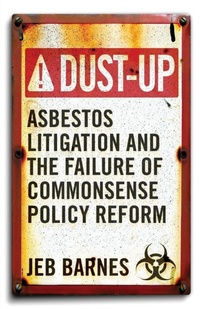
Dust-Up
Asbestos Litigation and the Failure of Commonsense Policy Reform
Will be published approx. on 8. July 2011
Book
Paperback/Softback
144 pages
978-1-58901-766-5 (ISBN)
Description
In an era of polarization, narrow party majorities, and increasing use of supermajority requirements in the Senate, policy entrepreneurs must find ways to reach across the aisle and build bipartisan coalitions in Congress. One such coalition-building strategy is the "politics of efficiency", or reform that is aimed at eliminating waste from existing policies and programs. After all, reducing inefficiency promises to reduce costs without cutting benefits, which should appeal to members of both political parties, especially given tight budgetary constraints in Washington. "Dust-Up" explores the most recent congressional efforts to reform asbestos litigation - a case in which the politics of efficiency played a central role and seemed likely to prevail. Yet, these efforts failed to produce a winning coalition, even though reform could have saved billions of dollars and provided quicker compensation to victims of asbestos-related diseases. Why? The answers, as Jeb Barnes deftly illustrates, defy conventional wisdom and force us to rethink the political effects of litigation and the dynamics of institutional change in our fragmented policymaking system.
Set squarely at the intersection of law, politics, and public policy, "Dust-Up" provides the first in-depth analysis of the political obstacles to Congress in replacing a form of litigation that nearly everyone - Supreme Court justices, members of Congress, presidents, and experts - agrees is woefully inefficient and unfair to both victims and businesses. This concise and accessible case study includes a glossary of terms and study questions, making it a perfect fit for courses in law and public policy, congressional politics, and public health.
Set squarely at the intersection of law, politics, and public policy, "Dust-Up" provides the first in-depth analysis of the political obstacles to Congress in replacing a form of litigation that nearly everyone - Supreme Court justices, members of Congress, presidents, and experts - agrees is woefully inefficient and unfair to both victims and businesses. This concise and accessible case study includes a glossary of terms and study questions, making it a perfect fit for courses in law and public policy, congressional politics, and public health.
Reviews / Votes
A concisely written and very accessible review... which ultimately help the reader identify institutional constraints embedded within policy formation. ChoiceMore details
Language
English
Place of publication
Washington, DC
United States
Target group
Professional and scholarly
US School Grade: College Graduate Student and over
Product notice
Paperback (trade)
Illustrations
Not illustrated
Dimensions
Height: 216 mm
Width: 140 mm
Thickness: 9 mm
Weight
200 gr
ISBN-13
978-1-58901-766-5 (9781589017665)
Copyright in bibliographic data and cover images is held by Nielsen Book Services Limited or by the publishers or by their respective licensors: all rights reserved.
Schweitzer Classification
Other editions
Additional editions
E-Book
07/2011
Georgetown University Press
€59.49
Available for download
Persons
Jeb Barnes is a professor and the director of graduate studies in the Department of Political Science at the University of Southern California. He is the author of Overruled? Legislative Overrides, Pluralism, and Contemporary Court-Congress Relations and coeditor of Making Policy, Making Law: An Interbranch Perspective.
Content
Preface PART I: Background1. Today's Challenging Legislative Environment and the Politics of Efficiency 2. The Asbestos Crisis in the United States PART II: Case Study3. Asbestos Litigation Reform as a "Likely" Case for the Politics of Efficiency 4. The Puzzling Politics of the FAIR Act PART III: Implications5. The Asbestos Case and the Politics of Efficency 6. The Asbestos Case, Institutional Change, and the Judicialization of American Policymaking AppendixesA. The Case Method and "Likely" Cases B. Chronology of Selected Events C. Classroom Discussion Questions Glossary of Key Legal TermsReferencesIndex