

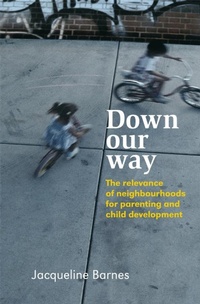
Down Our Way
The Relevance of Neighbourhoods for Parenting and Child Development
1st Edition
Will be published approx. on 30. March 2007
Book
Hardback
306 pages
978-0-470-03072-1 (ISBN)
Description
This book will describe in detail what it is like to be a parent in four different communities in England. The research data that are the basis for this description are interpreted in relation to a number of key factors, include: family social class, ethnic group, length of time on the neighbourhood and the presence of extended family locally. The book will be of interest to anyone wanting to know more about how to improve the lives of parents and children. Special focus is placed on those families who face disadvantage, either in relation to personal vulnerabilities or in relation to living in neighbourhoods lacking in resources and facilities.
Reviews / Votes
1 Introduction. 2 The Families and Neighbourhoods Study. 3 An introduction to some of the families. 4 Is this where I want to belong? 5 What can we do? Where can we go? 6 Local friends - a unique role? 7 Discipline and control. 8 Children out and about. 9 Is it "better to belong"? 10 Conclusions and implications. References. Appendix 1 The survey. Appendix 2 The qualitative study. Index.More details
Language
English
Place of publication
New York
United States
Target group
Professional and scholarly
Product notice
sewn/stitched
Paper over boards
Dimensions
Height: 160 mm
Width: 235 mm
Thickness: 22 mm
Weight
572 gr
ISBN-13
978-0-470-03072-1 (9780470030721)
Copyright in bibliographic data and cover images is held by Nielsen Book Services Limited or by the publishers or by their respective licensors: all rights reserved.
Schweitzer Classification
Other editions
Additional editions
E-Book
06/2007
1st Edition
Wiley
€156.99
Available for download
Person
Jacqueline Barnes is Professor of Psychology at Birkbeck, University of London, UK, based at the Institute for the Study of Children, Families and Social Issues. Professor Barnes is one of the directors of the national evaluation of the UK government's Sure Start local programmes initiative
.After qualifying at the University of Wisconsin to be an educational psychologist she returned to the UK and was awarded her PhD in Psychology from London University in 1983.
In the 1980s she developed the Early Years Behaviour Checklist with Naomi Richman, a widely used measure of the behavioural problems of young children in group settings. She also worked at Harvard in the USA, returning afterwards to London University. Her current research interests are: evaluation of early intervention programmes related to children's health and development and parenting; community characteristics and the environment as they relate to family functioning and children; and the use of child care in the early years, particularly factors associated with mothers of returning to work after having a new baby.
.After qualifying at the University of Wisconsin to be an educational psychologist she returned to the UK and was awarded her PhD in Psychology from London University in 1983.
In the 1980s she developed the Early Years Behaviour Checklist with Naomi Richman, a widely used measure of the behavioural problems of young children in group settings. She also worked at Harvard in the USA, returning afterwards to London University. Her current research interests are: evaluation of early intervention programmes related to children's health and development and parenting; community characteristics and the environment as they relate to family functioning and children; and the use of child care in the early years, particularly factors associated with mothers of returning to work after having a new baby.
Content
List of pictures, figures and tables ix
Acknowledgements xiii
1 Introduction 1
2 The families and neighbourhoods study 15
3 An introduction to some of the families 41
4 Is this where I want to belong? 51
5 What can we do? Where can we go? 83
6 Local friends - a unique role? 115
7 Discipline and control 143
8 Children out and about 175
9 Is it better to belong to the neighbourhood? 203
10 Conclusions and implications for the future 235
References 247
Appendix 1: The survey 257
Appendix 2: The qualitative study 269
Subject index 283
Author index 289
Acknowledgements xiii
1 Introduction 1
2 The families and neighbourhoods study 15
3 An introduction to some of the families 41
4 Is this where I want to belong? 51
5 What can we do? Where can we go? 83
6 Local friends - a unique role? 115
7 Discipline and control 143
8 Children out and about 175
9 Is it better to belong to the neighbourhood? 203
10 Conclusions and implications for the future 235
References 247
Appendix 1: The survey 257
Appendix 2: The qualitative study 269
Subject index 283
Author index 289