

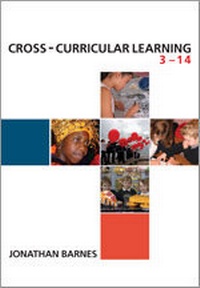
Cross-Curricular Learning 3-14
1st Edition
Published on 19. December 2006
Book
Paperback/Softback
280 pages
978-1-4129-2058-2 (ISBN)
Description
'Cross-curricular learning 3-14 provides the reader with a useful blend of examples from practice and theoretical perspectives....This book is more than a useful teaching tool and source of ideas....One of its key messages is a reminder that education needs to focus on the well-being of both children and all those working with them, including teachers' - Journal of Education for Teaching
'It is a thoughtful, well-informed and practical book that offers a strong vision of a holistic approach to learning in schools'-Early Years Educator
'A thoughtful, well-informed and accessible book, offering strong vision of a holistic approach to learning in schools, Jonathan Barnes' new book has much to offer reflective and sensitive educators, who care about the futures of the children they work with' - Anna Craft, Professor of Education, University of Exeter, Reader in Education, The Open University and Visiting Scholar, Harvard University
The new primary strategy is about creativity and flexibility - allowing much more scope for work which brings together different parts of the curriculum. This book helps teachers address the 'why' as well as the 'how', giving background information as well as the techniques to put the theories into practice.
It presents a framework for thinking through the issues as well as the practicalities of cross-curricular work (how to plan it, how to assess it, how to make sure all curriculum areas are covered). There are also plenty of practical examples of effective cross-curricular work in classroom settings.
The book introduces for the first time the scientific and educational evidence which supports the introduction of cross-curricular approaches.
This book is intended for teachers in training, their tutors, and schools, parents and teachers considering a cross-curricular approach to learning. Ideas presented are suitable for children in the 3-14 age group.
'It is a thoughtful, well-informed and practical book that offers a strong vision of a holistic approach to learning in schools'-Early Years Educator
'A thoughtful, well-informed and accessible book, offering strong vision of a holistic approach to learning in schools, Jonathan Barnes' new book has much to offer reflective and sensitive educators, who care about the futures of the children they work with' - Anna Craft, Professor of Education, University of Exeter, Reader in Education, The Open University and Visiting Scholar, Harvard University
The new primary strategy is about creativity and flexibility - allowing much more scope for work which brings together different parts of the curriculum. This book helps teachers address the 'why' as well as the 'how', giving background information as well as the techniques to put the theories into practice.
It presents a framework for thinking through the issues as well as the practicalities of cross-curricular work (how to plan it, how to assess it, how to make sure all curriculum areas are covered). There are also plenty of practical examples of effective cross-curricular work in classroom settings.
The book introduces for the first time the scientific and educational evidence which supports the introduction of cross-curricular approaches.
This book is intended for teachers in training, their tutors, and schools, parents and teachers considering a cross-curricular approach to learning. Ideas presented are suitable for children in the 3-14 age group.
Reviews / Votes
'It is a thoughtful, well-informed and practical book that offers a strong vision of a holistic approach to learning in schools'-Early Years Educator'A thoughtful, well-informed and accessible book, offering strong vision of a holistic approach to learning in schools, Jonathan Barnes' new book has much to offer reflective and sensitive educators, who care about the futures of the children they work with' - Anna Craft, Professor of Education, University of Exeter, Reader in Education, The Open University and Visiting Scholar, Harvard University
More details
Language
English
Place of publication
Thousand Oaks
United States
Target group
Professional and scholarly
Dimensions
Height: 242 mm
Width: 170 mm
Weight
489 gr
ISBN-13
978-1-4129-2058-2 (9781412920582)
Copyright in bibliographic data and cover images is held by Nielsen Book Services Limited or by the publishers or by their respective licensors: all rights reserved.
Schweitzer Classification
Other editions
New editions
Jonathan Barnes
Cross-Curricular Learning 3-14
Book
03/2011
2nd Edition
SAGE Publications Ltd
€52.23
Article exhausted; check for reprint
Jonathan Barnes
"Guardian" Guide to the House of Commons
Book
10/1992
1st Edition
Fourth Estate Ltd
€32.39
Article is exhausted; no reprint
Person
Jonathan is a Visiting Senior Research Fellow at Canterbury Christ Church University and a National Teaching Fellow. He has taught and researched for the last 50 years throughout Asia and Africa and in primary, secondary schools and prisons in England. He was a primary head teacher between 1992 and 2000. Since then he has combined work in primary Initial Teacher Education with continuing research and teaching in the arts and humanities in primary and nursery education. His books and published research on Cross-Curricular Learning, teachers' values and diversity are widely used throughout teacher education. In 2017 with peace activist Alex Ntung Jonathan founded Education4diversity, a charity dedicated to humanising, valuing and celebrating diversity through dialogue and education.
Content
What Should Schooling in the 21st Century Look Like?
What Does Good Cross-Curricular Practice Look Like?
What is the Contribution of Neuroscience to Ideas About Cross-Curricular Learning?
What are the Contributions of Modern Psychology?
The View of the Pedagog: 'We learn according to how we are taught.'
What Principles Should We Apply?
What Themes Are Suitable for Cross-Curricular Learning?
How Do We Plan For Cross-Curricular Activity?
How Can We Assess Cross-Curricular and Creative Learning?
Key Issues For Debate
What Does Good Cross-Curricular Practice Look Like?
What is the Contribution of Neuroscience to Ideas About Cross-Curricular Learning?
What are the Contributions of Modern Psychology?
The View of the Pedagog: 'We learn according to how we are taught.'
What Principles Should We Apply?
What Themes Are Suitable for Cross-Curricular Learning?
How Do We Plan For Cross-Curricular Activity?
How Can We Assess Cross-Curricular and Creative Learning?
Key Issues For Debate