

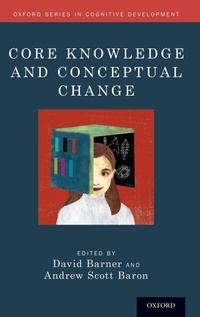
Core Knowledge and Conceptual Change
Published on 29. July 2016
Book
Hardback
408 pages
978-0-19-046763-0 (ISBN)
Description
We acquire concepts such as "atom," "force," "integer," and "democracy" long after we are born; these concepts are not part of the initial cognitive state of human beings. Other concepts like "object," "cause," or "agent" may be present early in infancy-if not innately. Processes of change occur throughout our conceptual development, which prompts two key questions: Which human concepts constitute innate, core knowledge? How do humans acquire new concepts, and how
do these concepts change in development?
Core Knowledge and Conceptual Change provides a unique theoretical and empirical introduction to the study of conceptual development, documenting key advances in case studies, including ground-breaking science on human representations of language, objects, number, events, color, space, time, beliefs, and desires. Additionally, it explores how humans engage in moral reasoning and causal explanation: Are humans born good and tainted by an imperfect world, or do we need to teach children
to be moral? Could a concept like "freedom" be woven into the human soul, or is it a historical invention, constructed over generations of humans? Written by an eminent list of contributors renowned in child development and cognitive science, this book delves widely, and deeply, into the cognitive tools
available at birth that are repurposed, combined, and transformed to complex, abstract adult conceptual representations, and should be of interest to developmental psychologists, linguists, philosophers, and students of cognitive science.
do these concepts change in development?
Core Knowledge and Conceptual Change provides a unique theoretical and empirical introduction to the study of conceptual development, documenting key advances in case studies, including ground-breaking science on human representations of language, objects, number, events, color, space, time, beliefs, and desires. Additionally, it explores how humans engage in moral reasoning and causal explanation: Are humans born good and tainted by an imperfect world, or do we need to teach children
to be moral? Could a concept like "freedom" be woven into the human soul, or is it a historical invention, constructed over generations of humans? Written by an eminent list of contributors renowned in child development and cognitive science, this book delves widely, and deeply, into the cognitive tools
available at birth that are repurposed, combined, and transformed to complex, abstract adult conceptual representations, and should be of interest to developmental psychologists, linguists, philosophers, and students of cognitive science.
Reviews / Votes
<"This is an extraordinary collection of chapters focusing on some of the most central questions in cognitive science concerning the origins of concepts, the nature of conceptual change and ultimately what concepts themselves are. Taken together, these chapters offer an invaluable and comprehensive collection of essays that will be of great interest to the cognitive science community.>"-Frank Keil, PhD, Charles C. and Dorothea S. Dilley Professor and Chair ofPsychology, Yale University <"Core Knowledge and Conceptual Change addresses the deepest questions at the heart of cognitive science: How do humans come to know the world? What is innate, and how does conceptual change take place? The answers come from a who's who of developmental psychologists, examining language, number, moral reasoning, theory of mind, and beyond. The result is a dazzling array of insights, hot-off-the-press empirical findings, and further questions that set the
research agenda for years to come. A must-read.> * Susan Gelman, PhD, Heinz Werner Distinguished University Professor of Psychology and Linguistics, University of Michigan
*
More details
Other editions
Additional editions

David Barner | Andrew Scott Baron
Core Knowledge and Conceptual Change
E-Book
06/2016
1st Edition
OUP eBook
€69.99
Available for download
David Barner | Andrew Scott Baron
Core Knowledge and Conceptual Change
E-Book
06/2016
1st Edition
OUP eBook
€69.99
Available for download
Persons
David Barner, PhD, is a Professor of Psychology and Linguistics at the University of California, San Diego. Dr. Barner studies the origin of human language and thought by studying how they develop in children in diverse cultural and linguistic contexts.
Andrew Scott Baron, PhD, is an Assistant Professor of Psychology at the University of British Columbia, Canada. Dr. Baron's research explores the nature of the human capacity to be prejudiced by examining infants' and young children's tendency to categorize others into social groups and to form positive and negative attitudes and beliefs about these groups.
Andrew Scott Baron, PhD, is an Assistant Professor of Psychology at the University of British Columbia, Canada. Dr. Baron's research explores the nature of the human capacity to be prejudiced by examining infants' and young children's tendency to categorize others into social groups and to form positive and negative attitudes and beliefs about these groups.