

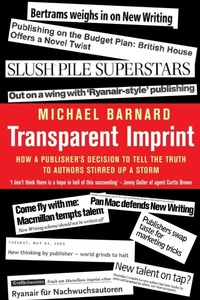
Transparent Imprint
Published on 10. October 2013
Book
Paperback/Softback
224 pages
978-1-4472-5120-0 (ISBN)
Description
When news of Macmillan's planned 'first novels' imprint leaked out in the Spring of last year, there was extensive coverage in the press, on radio and on web blogs. The Guardian called it 'Ryanair publishing'. Robert McCrum, writing in the Observer, deplored it as a marketing-led initiative and said publisher Mike Barnard had shown an 'astounding abdication of cultural responsibility'. Jonny Geller of agent Curtis Brown said, 'I don't think there is a hope in hell of this succeeding'.
There were stories that authors would have to pay for their own editing, the books would only be printed on demand, and bookshops would not touch them.
Even the Washington Post carried the story, telling its readers that Macmillan New Writing's initiative was 'the talk of Britain's book world'.
Now, a year on, the first Macmillan New Writing books are about to be launched. Bookshops will be stocking them, libraries are buying them and the imprint is making news again.
But what was the real genesis of the imprint? How was the decision made to devote a list exclusively to first-time novelists? What were the terms and conditions offered to authors? How were they treated? How were the books chosen? How were they produced cost-effectively? Who are the authors? What are the books?
Publisher Mike Barnard answers these questions and responds to the original press criticism in the new Macmillan paperback, Transparent Imprint, published to coincide with the launch of the first MNW titles in April.
The book offers an intriguing insight into the intimate workings of a great publishing company and the commercial and editorial decision-making processes. It claims successes, admits failures. It's frank, readable, and sometimes funny.
There were stories that authors would have to pay for their own editing, the books would only be printed on demand, and bookshops would not touch them.
Even the Washington Post carried the story, telling its readers that Macmillan New Writing's initiative was 'the talk of Britain's book world'.
Now, a year on, the first Macmillan New Writing books are about to be launched. Bookshops will be stocking them, libraries are buying them and the imprint is making news again.
But what was the real genesis of the imprint? How was the decision made to devote a list exclusively to first-time novelists? What were the terms and conditions offered to authors? How were they treated? How were the books chosen? How were they produced cost-effectively? Who are the authors? What are the books?
Publisher Mike Barnard answers these questions and responds to the original press criticism in the new Macmillan paperback, Transparent Imprint, published to coincide with the launch of the first MNW titles in April.
The book offers an intriguing insight into the intimate workings of a great publishing company and the commercial and editorial decision-making processes. It claims successes, admits failures. It's frank, readable, and sometimes funny.
More details
Language
English
Place of publication
London
United Kingdom
Publishing group
Pan Macmillan
Target group
Interest Age: From 18 years
Product notice
Paperback (UK-trade)
Dimensions
Height: 234 mm
Width: 156 mm
Thickness: 13 mm
Weight
389 gr
ISBN-13
978-1-4472-5120-0 (9781447251200)
Copyright in bibliographic data and cover images is held by Nielsen Book Services Limited or by the publishers or by their respective licensors: all rights reserved.
Schweitzer Classification
Person
Mike Barnard spent the first part of his working life as a freelance writer and then as a reporter, sub editor and editor on newspapers and magazines. He joined the Macmillan publishing group in 1972 and was appointed to the main board in 1985. He is the author of many articles and short stories and several technical books. He is a Liveryman of the Stationers Company, a Fellow of several professional associations and a former Chairman of Pira International, the printing and publishing industries' research association. He also lectures on publishing and production and is a Visiting Professor at the University of the Arts, London.