

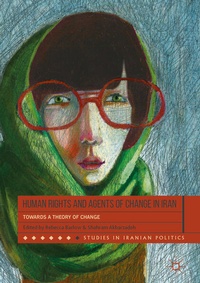
Human Rights and Agents of Change in Iran
Towards a Theory of Change
Published on 30. July 2018
Book
Hardback
X, 232 pages
978-981-10-8823-0 (ISBN)
Description
Rebecca Barlow
is a Senior Research Fellow at the Alfred Deakin Institute for Citizenship and Globalisation, Deakin University, Melbourne, Australia. Her research focuses on the Iranian women's movement and the politics of human rights in the Islamic Republic of Iran. Rebecca is the author of
Universal Women's Human Rights and the Muslim Question: Iran's One Million Signatures Campaign
(2012). Outside academia, Rebecca has worked for the Victorian Local Governance Association, where she played a key role in the production of From Compliance to Culture: A Toolkit for Local Governments to Implement the Victorian Charter of Human Rights and Responsibilities. She has also interned and acted as Consultant for the United Nations Population Fund (UNFPA) Gender, Human Rights and Culture Branch, where she worked with a team to implement the United Nations Global Forum of Faith-based Organisations in Population and Development (Istanbul, Turkey, 2008).
Shahram Akbarzadeh is Research Professor of Middle East & Central Asian Politics at the Alfred Deakin Institute for Citizenship and Globalisation, Deakin University, Australia. He has an active research interest in the politics of Central Asia, Islam, Muslims in Australia and the Middle East. Shahram is author of Uzbekistan and the United States (2005), US Foreign Policy in the Middle East (2008 with Kylie Baxter) and Muslim Active Citizenship in the West (2014 with Mario Peucker). He is the founding Editor of the Islamic Studies Series , published by Melbourne University Press, and a regular public commentator. Shahram is a member of the Editorial Board of three leading refereed journals: Global Change, Peace & Security , the Journal of Muslim Minority Affairs , the Journal of Asian Security & International Affairs.
Shahram Akbarzadeh is Research Professor of Middle East & Central Asian Politics at the Alfred Deakin Institute for Citizenship and Globalisation, Deakin University, Australia. He has an active research interest in the politics of Central Asia, Islam, Muslims in Australia and the Middle East. Shahram is author of Uzbekistan and the United States (2005), US Foreign Policy in the Middle East (2008 with Kylie Baxter) and Muslim Active Citizenship in the West (2014 with Mario Peucker). He is the founding Editor of the Islamic Studies Series , published by Melbourne University Press, and a regular public commentator. Shahram is a member of the Editorial Board of three leading refereed journals: Global Change, Peace & Security , the Journal of Muslim Minority Affairs , the Journal of Asian Security & International Affairs.
More details
Series
Edition
2018 ed.
Language
English
Place of publication
Singapore
Singapore
Target group
Professional and scholarly
Illustrations
X, 232 p.
Dimensions
Height: 216 mm
Width: 153 mm
Thickness: 18 mm
Weight
433 gr
ISBN-13
978-981-10-8823-0 (9789811088230)
DOI
10.1007/978-981-10-8824-7
Schweitzer Classification
Other editions
Additional editions

Rebecca Barlow | Shahram Akbarzadeh
Human Rights and Agents of Change in Iran
Towards a Theory of Change
Book
12/2018
Springer
€69.54
Shipment within 15-20 days
Rebecca Barlow | Shahram Akbarzadeh
Human Rights and Agents of Change in Iran
Towards a Theory of Change
E-Book
07/2018
1st Edition
Palgrave Macmillan
€69.54
Available for download
Persons
?Rebecca Barlow is a Senior Research Fellow at the Alfred Deakin Institute for Citizenship and Globalisation, Deakin University, Melbourne, Australia. Her research focuses on the Iranian women's movement and the politics of human rights in the Islamic Republic of Iran. Rebecca is the author of Universal Women's Human Rights and the Muslim Question: Iran's One Million Signatures Campaign (2012). Outside academia, Rebecca has worked for the Victorian Local Governance Association, where she played a key role in the production of From Compliance to Culture: A Toolkit for Local Governments to Implement the Victorian Charter of Human Rights and Responsibilities. She has also interned and acted as Consultant for the United Nations Population Fund (UNFPA) Gender, Human Rights and Culture Branch, where she worked with a team to implement the United Nations Global Forum of Faith-based Organisations in Population and Development (Istanbul, Turkey, 2008).
Shahram Akbarzadeh is Research Professor of Middle East & Central Asian Politics at the Alfred Deakin Institute for Citizenship and Globalisation, Deakin University, Australia. He has an active research interest in the politics of Central Asia, Islam, Muslims in Australia and the Middle East. Shahram is author of Uzbekistan and the United States (2005), US Foreign Policy in the Middle East (2008 with Kylie Baxter) and Muslim Active Citizenship in the West (2014 with Mario Peucker). He is the founding Editor of the Islamic Studies Series, published by Melbourne University Press, and a regular public commentator. Shahram is a member of the Editorial Board of three leading refereed journals: Global Change, Peace & Security, the Journal of Muslim Minority Affairs, the Journal of Asian Security & International Affairs.
Shahram Akbarzadeh is Research Professor of Middle East & Central Asian Politics at the Alfred Deakin Institute for Citizenship and Globalisation, Deakin University, Australia. He has an active research interest in the politics of Central Asia, Islam, Muslims in Australia and the Middle East. Shahram is author of Uzbekistan and the United States (2005), US Foreign Policy in the Middle East (2008 with Kylie Baxter) and Muslim Active Citizenship in the West (2014 with Mario Peucker). He is the founding Editor of the Islamic Studies Series, published by Melbourne University Press, and a regular public commentator. Shahram is a member of the Editorial Board of three leading refereed journals: Global Change, Peace & Security, the Journal of Muslim Minority Affairs, the Journal of Asian Security & International Affairs.
Content
1. Top-down or bottom-up? Towards a theory of change for human rights practice in Iran.- 2. The 'inside-track' approach to change in Iran under President Rouhani: The case of freedom on the internet.- 3. Indigenising 'modernisation' in Iran.- 4. Iranian lawyers for human rights: The Defenders of Human Rights Center.- 5. Is grassroots justice a viable alternative to impunity? The case of the Iran People's Tribunal.- 6. Secular and Islamic feminist work to increase parliamentary representation in Iran: Towards an alliance?.- 7. Struggles for revival: The Iranian student movement under the 'moderate' government (2013-2017).- 8. Environmental activism and social change in Iran.- 9. Ethnic minorities and the question of liberal multiculturalism in Iran.- 10. Intersecting issues and their implications for human right practice in Iran.