

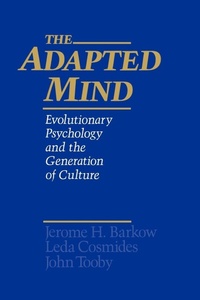
The Adapted Mind
Evolutionary Psychology and the Generation of Culture
Published on 11. January 1996
Book
Paperback/Softback
688 pages
978-0-19-510107-2 (ISBN)
Description
Anthropologists have long recognized that cultural evolution critically depends on the transmission and generation of information. However, between the selection pressures of evolution and the actual behaviour of individuals, scientists have suspected that other processes are at work. With the advent of what has come to be known as the cognitive revolution, psychologists are now exploring the evolved problem-solving and information-processing mechanisms that allow humans to absorb and generate culture. The purpose of this book is to introduce the newly crystallizing field of evolutionary psychology, which supplied the necessary connection between the underlying evolutionary biology and the complex and irreducible social phenomena studied by anthropologists, sociologists, economists, and historians.
Reviews / Votes
This book is a rare exception, a volume of fresh and original research of momentous significance that is written in such a way that ordinary mortals can immediately join the debate. * The Economist, January, 1992 * This book is a rare exception, a volume of fresh and original research of momentous significance that is written in such a way that ordinary mortals can immediately join the debate. * The Economist * ... a massive tome that throws considerable light on a number of issues ... The Adapted Mind is a very significant contribution to the field of evolutionary thinking on human psychology and culture. It brings together many well-written and scholarly chapters that do much to articulate the salient issues and give state of the art overviews. * Paul Gilbert, British Journal of Medical Psychology, 66 * one cannot afford to ignore it * Glenn D. Wilson, Person.individ. Diff. Vol. 15, No. 5, 1993 * a collection of eighteen papers by twenty-five authors which sum up and illustrate much of the best of our knowledge in the field of evolutionary psychology * Christopher Badcock, London School of Economics, ESS Newsletter No. 36, October 1994 *More details
Language
English
Place of publication
New York
United States
Target group
Professional and scholarly
Illustrations
halftones, line drawings, tables
Dimensions
Height: 234 mm
Width: 156 mm
Thickness: 37 mm
Weight
1015 gr
ISBN-13
978-0-19-510107-2 (9780195101072)
Copyright in bibliographic data and cover images is held by Nielsen Book Services Limited or by the publishers or by their respective licensors: all rights reserved.
Schweitzer Classification
Other editions
Additional editions
Jerome H. Barkow | Leda Cosmides | John Tooby
The dapted Mind
Evolutionary Psychology and the Generation of Culture
E-Book
10/1995
1st Edition
OUP USA
€74.99
Available for download
Jerome H. Barkow | Leda Cosmides | John Tooby
The dapted Mind
Evolutionary Psychology and the Generation of Culture
E-Book
10/1995
1st Edition
OUP USA
€74.99
Available for download
Content
J. Tooby & L. Cosmides: Introduction; Part I: Theoretical framework: J. Tooby & L. Cosmides: The psychological foundations of culture; D. Symons: On the use and misuse of darwinism in the study of human behavior; Part II: Cooperation: L. Cosmides & J. Tooby: Cognitive adaptations for social exchange; W.C. McGrew & A.T.C. Feistner: Two non-human primate models for the evolution of human food-sharing: chimpanzees and callitrichids; Part III: The psychology of mating and sex: D. Buss: Mate preference mechanisms: consequences for partner choice and intrasexual competition; B. Ellis: The evolution of sexual attraction: evaluative mechanisms in women; M. Wilson & M. Daly: The man who mistook his wife for a chattel; Part IV: Parental care and children: M. Profet: Pregnancy sickness as adaptation: a deterrent to maternal ingestion of teratogens; J. Mann: Nurturance or negligence: maternal psychology and behavioral preference among preterm twins; A. Fernald: Human maternal vocalizations to infants as biologically relevant signals: an evolutionary perspective; M.J. Boulton & P.K. Smith: The social nature of play fighting and play chasing: mechanisms and strategies underlying cooperation and compromise; Part V: Perception and language as adaptations: S. Pinker & P. Bloom: Natural language and natural selection; R.N. Shepherd: The perceptual organization of colors: an adaptation to regularities of the terrestrial world?; I. Silverman & M. Eals: Sex differences in spatial abilities: evolutionary theory and data; Part VI: Environmental aesthetics: G.H. Orians & J.H. Heerwagen: Evolved responses to landscapes; S. Kaplan: Environmental preference in a knowledge-seeking, knowledge-using organism; Part VII: Intrapsychic processes: R.M. Nesse & A.T. Lloyd: The evolution of psychodynamic mechanisms; Part VIII: Understanding evolutionary new cultural forms: J.H. Barkow: Beneath new culture is old psychology: gossip, class, and the environment.