

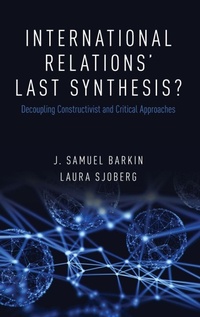
International Relations' Last Synthesis?
Decoupling Constructivist and Critical Approaches
Published on 4. April 2019
Book
Hardback
232 pages
978-0-19-046342-7 (ISBN)
Description
Many scholars, intentionally or unintentionally, have entangled constructivisms and critical theories in problematic ways, either by assigning a critical-theoretical politics to constructivisms or by assuming the appropriateness of constructivist epistemology and methods for critical theorizing. IR's Last Synthesis? makes the argument that these connections mirror IR's grand theoretical syntheses of the 1980s and 1990s and have similar constraining effects on the possibilities of IR theory. They have been made without adequate reflection, in contradiction to the base assumptions of each theoretical perspective, and to the detriment of both knowledge accumulation about global politics and theoretical rigor in disciplinary IR. It is not that constructivisms and critical theories have no common ground; rather, the fact that it has become routine for IR scholars to overstate their common ground is counterproductive to the discovery and utilization of their potential dialogues. To that end, IR's Last Synthesis? argues that scholars using the two in conjunction should be cognizant of, rather than gloss over, the tensions between the approaches and the tools they have to offer. Along these lines, the book uses the concept of affordances to look at what each has to offer the other, and to argue for a modest, reflective, specified return to (constructivist and critical) IR theorizing. By rejecting its over-simple syntheses, this book hews a road toward reviving IR theorizing.
Reviews / Votes
This book is a path-breaking work in International Relations, with implications that go beyond its immediate subject matter in critical theory and constructivism. This study convincingly demonstrates that constructivism does not entail any particular ideological position. A first-rate work of scholarship across the board, the volume will stand the test of time as a cautionary tale against tempting but ill-advised acts of synthesis, with critical theory and constructivism currently serving as the case in point."-Patrick James, Dornsife Dean's Professor, School of International Relations, University of Southern California This is not a book that anyone should have had to write. Constructivism as a family of explanatory theories focusing on creativity and contingency, and critical theory as a political sensibility that embraces emancipatory possibilities, are basically orthogonal notions, and as such could operate in a complementary manner - or could have nothing to do with one another. That they get lumped together is an artifact of the peculiar history of theoretical debates in IR. The authors make the case for dissolving that forced unity in meticulous detail. Will this be the book that at last puts the IR habit of 'theoretical synthesis' to rest?"-Patrick Thaddeus Jackson, School of International Service, American University 14/01/2019More details
Language
English
Place of publication
New York
United States
Target group
Professional and scholarly
Dimensions
Height: 240 mm
Width: 161 mm
Thickness: 17 mm
Weight
520 gr
ISBN-13
978-0-19-046342-7 (9780190463427)
Copyright in bibliographic data and cover images is held by Nielsen Book Services Limited or by the publishers or by their respective licensors: all rights reserved.
Schweitzer Classification
Other editions
Additional editions
J. Samuel Barkin | Laura Sjoberg
International Relations' Last Synthesis?
Decoupling Constructivist and Critical Approaches
E-Book
02/2019
1st Edition
OUP eBook
€34.99
Available for download
J. Samuel Barkin | Laura Sjoberg
International Relations' Last Synthesis?
Decoupling Constructivist and Critical Approaches
E-Book
02/2019
1st Edition
OUP eBook
€26.49
Available for download
Persons
J. Samuel Barkin is Professor of Global Governance in the McCormack Graduate School of Policy and Global Studies at the University of Massachusetts Boston.
Laura Sjoberg is Associate Professor of Political Science at the University of Florida.
Laura Sjoberg is Associate Professor of Political Science at the University of Florida.
Author
Professor, Department of Conflict Resolution, Human Security, and Global GovernanceProfessor, Department of Conflict Resolution, Human Security, and Global Governance, University of Massachusetts Boston
Associate Professor of Political ScienceAssociate Professor of Political Science, University of Florida
Content
Chapter 1: Introduction
Chapter 2: The Constructivist-Critical Theory Synthesis
Chapter 3: Understanding and Classifying Constructivisms
Chapter 4: Constructivism Does Not Have a Politics
Chapter 5: Understanding and Classifying Critical Approaches
Chapter 6: Critical Theory is Ontologically Promiscuous and Methodologically Agnostic
Chapter 7: A Case Against the Constructivist-Critical Theory Synthesis
Chapter 8: Thinking Beyond the Constructivist-Critical Theory Synthesis
Notes
References
Index
Chapter 2: The Constructivist-Critical Theory Synthesis
Chapter 3: Understanding and Classifying Constructivisms
Chapter 4: Constructivism Does Not Have a Politics
Chapter 5: Understanding and Classifying Critical Approaches
Chapter 6: Critical Theory is Ontologically Promiscuous and Methodologically Agnostic
Chapter 7: A Case Against the Constructivist-Critical Theory Synthesis
Chapter 8: Thinking Beyond the Constructivist-Critical Theory Synthesis
Notes
References
Index