

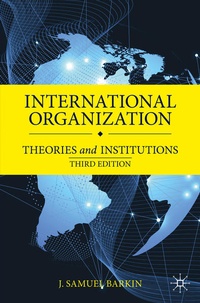
International Organization
Theories and Institutions
3rd Edition
Published on 19. March 2023
Book
Paperback/Softback
XI, 203 pages
978-3-031-22558-1 (ISBN)
Description
This comprehensively revised and updated edition offers an introduction to international organizations (IO) theory in the field of IR. It looks at the different ways in which IOs are studied and then applies these different modes to a variety of specific case studies.
The book is written as a primer for students studying global governance and IR theory. It highlights analytic tools available to understand what IOs are designed to do, how they work, what effects they have, and how to design them better. It goes beyond simple questions of whether IOs matter, and looks at the ways in which the different analytical tools developed within the rubric of IO theory are useful for answering different questions about the role of IOs in international politics.More details
Edition
Third Edition 2023
Language
English
Place of publication
Cham
Switzerland
Publishing group
Springer International Publishing
Illustrations
XI, 203 p.
Dimensions
Height: 235 mm
Width: 155 mm
Thickness: 12 mm
Weight
335 gr
ISBN-13
978-3-031-22558-1 (9783031225581)
DOI
10.1007/978-3-031-22559-8
Schweitzer Classification
Other editions
Additional editions
E-Book
03/2023
3rd Edition
Palgrave Macmillan
€80.24
Available for download
Previous edition
Book
03/2013
2nd Edition
Palgrave MacMillan
€64.19
Article exhausted; check for reprint
Person
J. Samuel Barkin
is a professor in the Department of Conflict Resolution, Human Security, and Global Governance, McCormack Graduate School, University of Massachusetts Boston, USA. He has published widely on the topics of international relations and international organization theory, including
The Sovereignty Cartel
(2021), In
ternational Relations Last Synthesis?
(2019),
Interpretive Quantification: Methodological Explorations for Critical and Constructive IR
(2017),
Realist Constructivism: Rethinking International Relations Theory
(2010). He has taught undergraduate and graduate courses on both international organization and global governance.
Content
Introduction: The State and International Organizations.- Chapter 1: Sovereignty and Globalization.-Chapter 2: Power and Interdependence.- Chapter 3: Regimes and Institutions.- Chapter 4: Efficiency and Ideas.- Chapter 5: The United Nations and Its System.- Chapter 6: From International to Human Security.- Chapter 7: The Institutions of Collective Security.- Chapter 8: Human Rights and Humanitarian Aid.- Chapter 9: Economic Institutions and Trade.- Chapter 10: International Finance.- Chapter 11: Development.- Chapter 12: The Environment.- Chapter 13: The Technical Details.- Chapter 14: The Fuzzy Borders of Intergovernmentalism.- Chapter 15: Conclusions.