

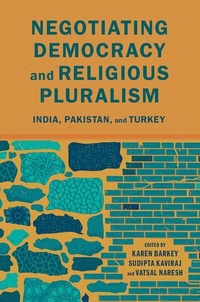
Negotiating Democracy and Religious Pluralism
India, Pakistan, and Turkey
Published on 17. August 2021
Book
Hardback
306 pages
978-0-19-753001-6 (ISBN)
Description
A collection of essays that situates and furthers contemporary debates around the prospects of democracy in diverse societies within and beyond the West.
Negotiating Democracy and Religious Pluralism examines the relationship between the functioning of democracy and the prior existence of religious plurality in three societies outside the West: India, Pakistan, and Turkey. All three societies had on one hand deep religious diversity and on the other long histories as imperial states that responded to religious diversity through their specific pre-modern imperial institutions. Each country has followed a unique historical trajectory with regard to crafting democratic institutions to deal with such extreme diversity. The volume focuses on three core themes: historical trends before the modern state's emergence that had lasting effects; the genealogies of both the state and religion in politics and law; and the problem of violence toward and domination over religious out-groups. Volume editors Karen Barkey, Sudipta Kaviarj, and Vatsal Naresh have gathered a group of leading scholars across political science, sociology, history, and law to examine this multifaceted topic. Together, they illuminate various trajectories of political thought, state policy, and the exercise of social power during and following a transition to democracy. Just as importantly, they ask us to reflexively examine the political categories and models that shape our understanding of what has unfolded in South Asia and Turkey.
Negotiating Democracy and Religious Pluralism examines the relationship between the functioning of democracy and the prior existence of religious plurality in three societies outside the West: India, Pakistan, and Turkey. All three societies had on one hand deep religious diversity and on the other long histories as imperial states that responded to religious diversity through their specific pre-modern imperial institutions. Each country has followed a unique historical trajectory with regard to crafting democratic institutions to deal with such extreme diversity. The volume focuses on three core themes: historical trends before the modern state's emergence that had lasting effects; the genealogies of both the state and religion in politics and law; and the problem of violence toward and domination over religious out-groups. Volume editors Karen Barkey, Sudipta Kaviarj, and Vatsal Naresh have gathered a group of leading scholars across political science, sociology, history, and law to examine this multifaceted topic. Together, they illuminate various trajectories of political thought, state policy, and the exercise of social power during and following a transition to democracy. Just as importantly, they ask us to reflexively examine the political categories and models that shape our understanding of what has unfolded in South Asia and Turkey.
Reviews / Votes
Negotiating Democracy and Religious Pluralism significantly contributes to comparative politics, history, sociology of religion, and religious studies. It is a candidate to become a reference book for those who study religion and politics in Turkey, Southeast Asia, and beyond. * Ramazan Kilinc, Journal of Church and State * A must read for students and experts in political science, law, sociology and history, or anyone interested in issues related to democracy and religion-this historically-grounded collection offers a crucial corrective to conventional theories and provides highly original perspectives on one of the most complicated and timely questions of our era: how to establish and maintain democratic government under conditions of religious heterogeneity. * Hanna Lerner, Tel Aviv University * This collection of fifteen essays probes the relationship of secularism, religion, and majoritarian power, highlighting the internal heterogeneities and unevenness of experiences of citizens. Grounding the work of democracy historically, this volume evocatively argues that perilous democracy is the reality of India, Pakistan, and Turkey. * Yasmin Saikia, Professor of History and Hardt-Nickachos Chair in Peace Studies, Arizona State University *More details
Series
Language
English
Place of publication
New York
United States
Target group
Professional and scholarly
Dimensions
Height: 159 mm
Width: 241 mm
Thickness: 22 mm
Weight
562 gr
ISBN-13
978-0-19-753001-6 (9780197530016)
Copyright in bibliographic data and cover images is held by Nielsen Book Services Limited or by the publishers or by their respective licensors: all rights reserved.
Schweitzer Classification
Other editions
Additional editions
Karen Barkey | Sudipta Kaviraj | Vatsal Naresh
Negotiating Democracy and Religious Pluralism
India, Pakistan, and Turkey
Book
10/2021
Oxford University Press Inc
€49.00
Shipment within 15-20 days
Sudipta Kaviraj | Vatsal Naresh
Negotiating Democracy and Religious Pluralism
India, Pakistan, and Turkey
E-Book
08/2021
OUP eBook
€22.99
Available for download
Sudipta Kaviraj | Vatsal Naresh
Negotiating Democracy and Religious Pluralism
India, Pakistan, and Turkey
E-Book
08/2021
OUP eBook
€22.99
Available for download
Persons
Karen Barkey is the Haas Distinguished Chair of Religious Diversity at the Othering & Belonging Institute and Professor of Sociology at the University of California, Berkeley. She is also currently the Director of the Center for the Study of Democracy, Toleration, and Religion (CDTR).
Sudipta Kaviraj is a Professor of Indian Politics and Intellectual History at Columbia University.
Vatsal Naresh is a PhD student in Political Science at Yale University.
Sudipta Kaviraj is a Professor of Indian Politics and Intellectual History at Columbia University.
Vatsal Naresh is a PhD student in Political Science at Yale University.
Volume editor
Haas Distinguished Chair of Religious DiversityHaas Distinguished Chair of Religious Diversity, University of California, Berkeley
Professor of Indian Politics and Intellectual HistoryProfessor of Indian Politics and Intellectual History, Columbia University
Graduate School Student in Political ScienceGraduate School Student in Political Science, Yale University
Content
Introduction
Karen Barkey, University of California - Berkeley; Sudipta Kaviraj, Columbia University; and Vatsal Naresh, Yale University
Section I: Historical perspectives
Chapter 1: Islam, Modernity, and the Question of Religious Heterodoxy: From Early Modern Empires to Modern Nation-States
Sadia Saeed, University of San Francisco
Chapter 2: Liberalism and the Path to Treason in the Ottoman Empire, 1908-1923
Christine Philliou, University of California-Berkeley
Chapter 3: Fatal Love: Intimacy and Interest in Indian Political Thought
Faisal Devji, University of Oxford
Chapter 4: Conflict, Secularism, and Toleration
Uday Singh Mehta, City University of New York
Chapter 5: Representative Democracy and Religious Thought in South Asia: Abul A'la Maududi and Vinayak Damodar Savarkar
Humeira Iqtidar, King's College London
Section II: Genealogies of state and religion
Chapter 6: Religious Pluralism and the State in India: Towards a Typology
Rochana Bajpai, SOAS, University of London
Chapter 7: Is Turkey a Postsecular Society? Secular Differentiation, Committed Pluralism, and Complementary Learning in Contemporary Turkey
Ates Altinordu, Sabanci University
Chapter 8: The Meaning of Religious Freedom: From Ireland and India to the Islamic Republic of Pakistan
Matthew J. Nelson, SOAS, University of London
Chapter 9: The Limits of Pluralism: A Perspective on Religious Freedom in Indian Constitutional Law
Mathew John, Jindal Global Law School
Chapter 10: Plurality and Pluralism: Democracy, Religious Difference and Political Imagination
Sudipta Kaviraj, Columbia University
Section III: Violence and domination
Chapter 11: Pakistan's Blasphemy Laws vs. Religious Freedom
Fatima Bokhari, Musawi
Chapter 12: Modalities of Violence: Lessons from Hindu Nationalist India
Amrita Basu, Amherst College
Chapter 13: Legal Contention and Minorities in Turkey: The Case of the Kurds and Alevis
Senem Aslan, Bates College
Chapter 14: "Stranger, Enemy": Anti-Shia Hostility and Annihilatory Politics in Pakistan
Nosheen Ali, New York University
Chapter 15: Thinking through Majoritarian Domination in Turkey and India
Karen Barkey, University of California - Berkeley; and Vatsal Naresh, Yale University
Karen Barkey, University of California - Berkeley; Sudipta Kaviraj, Columbia University; and Vatsal Naresh, Yale University
Section I: Historical perspectives
Chapter 1: Islam, Modernity, and the Question of Religious Heterodoxy: From Early Modern Empires to Modern Nation-States
Sadia Saeed, University of San Francisco
Chapter 2: Liberalism and the Path to Treason in the Ottoman Empire, 1908-1923
Christine Philliou, University of California-Berkeley
Chapter 3: Fatal Love: Intimacy and Interest in Indian Political Thought
Faisal Devji, University of Oxford
Chapter 4: Conflict, Secularism, and Toleration
Uday Singh Mehta, City University of New York
Chapter 5: Representative Democracy and Religious Thought in South Asia: Abul A'la Maududi and Vinayak Damodar Savarkar
Humeira Iqtidar, King's College London
Section II: Genealogies of state and religion
Chapter 6: Religious Pluralism and the State in India: Towards a Typology
Rochana Bajpai, SOAS, University of London
Chapter 7: Is Turkey a Postsecular Society? Secular Differentiation, Committed Pluralism, and Complementary Learning in Contemporary Turkey
Ates Altinordu, Sabanci University
Chapter 8: The Meaning of Religious Freedom: From Ireland and India to the Islamic Republic of Pakistan
Matthew J. Nelson, SOAS, University of London
Chapter 9: The Limits of Pluralism: A Perspective on Religious Freedom in Indian Constitutional Law
Mathew John, Jindal Global Law School
Chapter 10: Plurality and Pluralism: Democracy, Religious Difference and Political Imagination
Sudipta Kaviraj, Columbia University
Section III: Violence and domination
Chapter 11: Pakistan's Blasphemy Laws vs. Religious Freedom
Fatima Bokhari, Musawi
Chapter 12: Modalities of Violence: Lessons from Hindu Nationalist India
Amrita Basu, Amherst College
Chapter 13: Legal Contention and Minorities in Turkey: The Case of the Kurds and Alevis
Senem Aslan, Bates College
Chapter 14: "Stranger, Enemy": Anti-Shia Hostility and Annihilatory Politics in Pakistan
Nosheen Ali, New York University
Chapter 15: Thinking through Majoritarian Domination in Turkey and India
Karen Barkey, University of California - Berkeley; and Vatsal Naresh, Yale University