

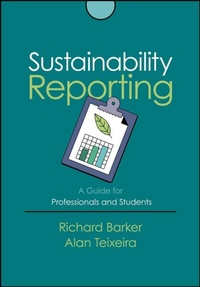
Sustainability Reporting
A Guide for Professionals and Students
1st Edition
Published on 23. April 2026
Book
Hardback
384 pages
978-1-394-35443-6 (ISBN)
Description
Discover a self-contained, authoritative guide to IFRS Sustainability Disclosure Standards
Sustainability Reporting: A Guide for Professionals and Students offers focused guidance, with practical examples, designed to explain how entities can develop disclosures to inform investors. The authors introduce the context, purpose and requirements of IFRS Sustainability Disclosure Standards. They also demonstrate how to think about applying them in practice, covering a range of sustainability-related topics. Sustainability Reporting is designed to help readers think about:
the purpose of IFRS requirements and how to apply them
the importance of governance, strategy, risk management, and metrics and targets
how to disclose information about climate-related issues
how to develop disclosure for sustainability-related matters not addressed directly by IFRS Sustainability Disclosure Standards
the role of controls and assurance
how the Standards are designed to reflect evolving levels of expertise and availability of data
how and why sustainability-related information is useful for investment decision-making
Sustainability Reporting is written to complement the official and authoritative position of the IFRS Foundation, in particular IFRS S1 General Requirements for Disclosure of Sustainability-related Financial Information and IFRS S2 Climate-related Disclosures. Perfect for accountants, sustainability professionals, investors, business leaders, directors, and others supporting or studying investor-focused financial reporting, Sustainability Reporting is an accessible guide to IFRS Sustainability Disclosure Standards.
Sustainability Reporting: A Guide for Professionals and Students offers focused guidance, with practical examples, designed to explain how entities can develop disclosures to inform investors. The authors introduce the context, purpose and requirements of IFRS Sustainability Disclosure Standards. They also demonstrate how to think about applying them in practice, covering a range of sustainability-related topics. Sustainability Reporting is designed to help readers think about:
the purpose of IFRS requirements and how to apply them
the importance of governance, strategy, risk management, and metrics and targets
how to disclose information about climate-related issues
how to develop disclosure for sustainability-related matters not addressed directly by IFRS Sustainability Disclosure Standards
the role of controls and assurance
how the Standards are designed to reflect evolving levels of expertise and availability of data
how and why sustainability-related information is useful for investment decision-making
Sustainability Reporting is written to complement the official and authoritative position of the IFRS Foundation, in particular IFRS S1 General Requirements for Disclosure of Sustainability-related Financial Information and IFRS S2 Climate-related Disclosures. Perfect for accountants, sustainability professionals, investors, business leaders, directors, and others supporting or studying investor-focused financial reporting, Sustainability Reporting is an accessible guide to IFRS Sustainability Disclosure Standards.
More details
Language
English
Place of publication
New York
United States
Target group
Professional and scholarly
Dimensions
Height: 250 mm
Width: 180 mm
Thickness: 29 mm
Weight
818 gr
ISBN-13
978-1-394-35443-6 (9781394354436)
Copyright in bibliographic data and cover images is held by Nielsen Book Services Limited or by the publishers or by their respective licensors: all rights reserved.
Schweitzer Classification
Other editions
Additional editions
E-Book
04/2026
1st Edition
Wiley
€84.99
Available for download
E-Book
04/2026
1st Edition
Wiley
€84.99
Available for download
Persons
RICHARD BARKER is a member of the International Sustainability Standards Board (ISSB). He is on leave from Said Business School, University of Oxford, where he is Professor of Accounting and served as Deputy Dean, Associate Dean for Faculty and Academic Director of the MBA. He is also Senior Associate Research Fellow at Christ Church, Oxford. Richard has previously served on the technical staff of the International Accounting Standards Board (IASB), as well as on the board of the UK's financial accounting standard setter. Richard is the recipient of several teaching prizes, including 'Most Acclaimed Lecturer' in the Social Sciences Division (awarded by Oxford University Student Union) and the Pilkington Teaching Prize (awarded by the University of Cambridge). Richard designed and directed Oxford's Leading Sustainable Corporations online programme. He qualified as a chartered management accountant while at ICI (now AstraZeneca). He holds a BA from the University of Oxford and a PhD from the University of Cambridge.
ALAN TEIXEIRA has been deeply involved in technical accounting and financial reporting for over 40 years. A New Zealander, he is an award-winning educator who has written extensively on accounting matters, including being the lead author of an introductory financial accounting textbook. He balanced an academic career at the University of Auckland while providing technical support to PwC and EY. In 2003 he joined ICANZ, leading the process for bringing IFRS Accounting Standards into New Zealand. In 2005 he joined the staff of the IASB, rising to be its Senior Technical Director. He led the development of many of the IFRS Accounting Standards used today. He also helped to develop the specifications for XBRL and the was an author of the International Integrated Reporting Framework. In 2015 he joined Deloitte as its Global Head of IFRS Research. He provides IFRS technical support to its most important audit engagements. Alan was heavily involved in the development of the first IFRS Sustainability Disclosure Standards. He holds a BCom an MCom and a PhD in Accounting and Finance from the University of Auckland and is a Fellow of CAANZ, sitting on its UK Council.
ALAN TEIXEIRA has been deeply involved in technical accounting and financial reporting for over 40 years. A New Zealander, he is an award-winning educator who has written extensively on accounting matters, including being the lead author of an introductory financial accounting textbook. He balanced an academic career at the University of Auckland while providing technical support to PwC and EY. In 2003 he joined ICANZ, leading the process for bringing IFRS Accounting Standards into New Zealand. In 2005 he joined the staff of the IASB, rising to be its Senior Technical Director. He led the development of many of the IFRS Accounting Standards used today. He also helped to develop the specifications for XBRL and the was an author of the International Integrated Reporting Framework. In 2015 he joined Deloitte as its Global Head of IFRS Research. He provides IFRS technical support to its most important audit engagements. Alan was heavily involved in the development of the first IFRS Sustainability Disclosure Standards. He holds a BCom an MCom and a PhD in Accounting and Finance from the University of Auckland and is a Fellow of CAANZ, sitting on its UK Council.
Content
About the Authors xiii
PART I OVERVIEW OF THE ISSB AND IFRS S1 1
1 Introduction 3
1.1 Aims of the Book and Target Reader 7
1.2 Structure of the Book 9
1.3 Prerequisite Reading 10
2 Global Context 11
2.1 Evolution of the Sustainability Reporting Landscape 12
2.2 Market Practice 26
2.3 The Global Baseline and Interoperability 27
2.4 Conclusion 32
3 General-Purpose Financial Reporting and IFRS Sustainability Disclosure Standards 39
3.1 The Audience-The Primary Users of General-Purpose Financial Reports 40
3.2 Decisions Relating to Providing Resources to the Entity 43
3.3 IFRS Standards 44
3.4 Assurance 49
3.5 Conclusion 54
4 IFRS S1 General Requirements for Disclosure of Sustainability-Related Financial Information 57
4.1 Objective and Scope 58
4.2 Sustainability-Related Risks and Opportunities 59
4.3 Core Content 66
4.4 Time Horizons 76
4.5 Materiality 80
4.6 Proportionality 84
4.7 Judgement and Measurement Uncertainty 86
4.8 Fair Presentation 90
4.9 A Complete Set of Sustainability-Related Financial Disclosures 91
4.10 Conclusion 93
PART II APPLYING IFRS SUSTAINABILITY DISCLOSURE STANDARDS 97
5 Identifying Sustainability-Related Risks and Opportunities 99
5.1 How to Think About Sustainability-Related Risks and Opportunities 100
5.2 Relationship with an Entity's Business Model and Value Chain 105
5.3 Impacts and Dependencies 108
5.4 Summary 115
6 Governance 121
6.1 IFRS S1 Required Disclosures 121
6.2 Corporate Governance 123
.3 Governance of Sustainability-Related Risks and Opportunities 127
6.4 Management's Role 134
6.5 Effective Disclosure 135
6.6 Conclusion 136
7 Strategy 137
7.1 Sustainability-Related Risks and Opportunities 138
7.2 Current and Anticipated Effects 142
7.3 Resilience 168
7.4 Summary 173
8 Risk Management 175
8.1 Risk Management Disclosures 177
8.2 Sustainability-Related Risks and Opportunities 182
8.3 Conclusion 188
9 Metrics and Targets 191
9.1 Metrics 191
9.2 Targets 205
9.3 Disclosure 210
9.4 Revisions to Estimates and Correcting for Errors 219
9.5 Conclusion 225
PART III CLIMATE-RELATED AND OTHER DISCLOSURE REQUIREMENTS 231
10 IFRS S2-Climate-Related Disclosures 233
10.1 Relationship Between IFRS S1 and IFRS S2 234
10.2 Scope of IFRS S2 236
10.3 Governance 237
10.4 Strategy 238
10.5 Risk Management 247
10.6 Metrics and Targets 248
10.7 Conclusion 265
11 Other Topics and Activities 289
11.1 The Process 290
11.2 Topics 292
11.3 Case Study 1: Fashion Apparel-A Clothing Retailer 300
11.4 Case Study 2: Workplace Safety 308
11.5 Financial Effects 314
11.6 Conclusion 320
PART IV USING SUSTAINABILITY-RELATED FINANCIAL DISCLOSURES 321
12 Analysis and Use of Sustainability Disclosures 323
12.1 The Scope of Investor-Oriented Information 325
12.2 Decision-Useful Information 327
12.3 Communicating with Investors 332
12.4 Conclusion 339
13 Conclusion 341
13.1 An Interdisciplinary Issue 341
13.2 Estimation and Uncertainty 342
13.3 Materiality 343
13.4 Final Words 344
Notes 345
Index 349
PART I OVERVIEW OF THE ISSB AND IFRS S1 1
1 Introduction 3
1.1 Aims of the Book and Target Reader 7
1.2 Structure of the Book 9
1.3 Prerequisite Reading 10
2 Global Context 11
2.1 Evolution of the Sustainability Reporting Landscape 12
2.2 Market Practice 26
2.3 The Global Baseline and Interoperability 27
2.4 Conclusion 32
3 General-Purpose Financial Reporting and IFRS Sustainability Disclosure Standards 39
3.1 The Audience-The Primary Users of General-Purpose Financial Reports 40
3.2 Decisions Relating to Providing Resources to the Entity 43
3.3 IFRS Standards 44
3.4 Assurance 49
3.5 Conclusion 54
4 IFRS S1 General Requirements for Disclosure of Sustainability-Related Financial Information 57
4.1 Objective and Scope 58
4.2 Sustainability-Related Risks and Opportunities 59
4.3 Core Content 66
4.4 Time Horizons 76
4.5 Materiality 80
4.6 Proportionality 84
4.7 Judgement and Measurement Uncertainty 86
4.8 Fair Presentation 90
4.9 A Complete Set of Sustainability-Related Financial Disclosures 91
4.10 Conclusion 93
PART II APPLYING IFRS SUSTAINABILITY DISCLOSURE STANDARDS 97
5 Identifying Sustainability-Related Risks and Opportunities 99
5.1 How to Think About Sustainability-Related Risks and Opportunities 100
5.2 Relationship with an Entity's Business Model and Value Chain 105
5.3 Impacts and Dependencies 108
5.4 Summary 115
6 Governance 121
6.1 IFRS S1 Required Disclosures 121
6.2 Corporate Governance 123
.3 Governance of Sustainability-Related Risks and Opportunities 127
6.4 Management's Role 134
6.5 Effective Disclosure 135
6.6 Conclusion 136
7 Strategy 137
7.1 Sustainability-Related Risks and Opportunities 138
7.2 Current and Anticipated Effects 142
7.3 Resilience 168
7.4 Summary 173
8 Risk Management 175
8.1 Risk Management Disclosures 177
8.2 Sustainability-Related Risks and Opportunities 182
8.3 Conclusion 188
9 Metrics and Targets 191
9.1 Metrics 191
9.2 Targets 205
9.3 Disclosure 210
9.4 Revisions to Estimates and Correcting for Errors 219
9.5 Conclusion 225
PART III CLIMATE-RELATED AND OTHER DISCLOSURE REQUIREMENTS 231
10 IFRS S2-Climate-Related Disclosures 233
10.1 Relationship Between IFRS S1 and IFRS S2 234
10.2 Scope of IFRS S2 236
10.3 Governance 237
10.4 Strategy 238
10.5 Risk Management 247
10.6 Metrics and Targets 248
10.7 Conclusion 265
11 Other Topics and Activities 289
11.1 The Process 290
11.2 Topics 292
11.3 Case Study 1: Fashion Apparel-A Clothing Retailer 300
11.4 Case Study 2: Workplace Safety 308
11.5 Financial Effects 314
11.6 Conclusion 320
PART IV USING SUSTAINABILITY-RELATED FINANCIAL DISCLOSURES 321
12 Analysis and Use of Sustainability Disclosures 323
12.1 The Scope of Investor-Oriented Information 325
12.2 Decision-Useful Information 327
12.3 Communicating with Investors 332
12.4 Conclusion 339
13 Conclusion 341
13.1 An Interdisciplinary Issue 341
13.2 Estimation and Uncertainty 342
13.3 Materiality 343
13.4 Final Words 344
Notes 345
Index 349