

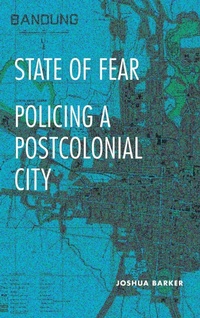
State of Fear
Policing a Postcolonial City
Published on 6. September 2024
Book
Hardback
328 pages
978-1-4780-2652-5 (ISBN)
Description
In State of Fear, Joshua Barker reckons with how fear and violence are produced and reproduced through everyday practices of rule and control. Examining the ethnographic and historical genealogies of Indonesian policing, Barker focuses on the city of Bandung, which is permeated by anxieties about security, in spite of the fact that it's a relatively safe city according to the data. Drawing from his fieldwork there during the latter years of the authoritarian New Order regime, Barker traces the complex relationship between the state and vigilante groups like neighborhood watch patrols and street gangs. Through interviews with police officers, vigilantes, and street-level toughs, he uncovers a struggle between two visions of social control that continues to animate policing in Indonesia: the modern, bureaucratic approach favored by the state, and a territorial approach that divides the city into fiefdoms overseen by charismatic individuals of authority. Synthesizing insights from in-depth ethnographic, historical, and theoretical work, Barker reveals how authoritarianism can take root not just from the top down but also from the bottom up.
Reviews / Votes
"A brilliant and arresting account of governance, vigilantism, criminality, and violence in postcolonial Indonesia, Joshua Barker's State of Fear brings a penetrating ethnographic look at Indonesia's police and neighborhood security teams together with a revealing exploration of historical materials from the late colonial period. It will leave readers spellbound with its unflinching look at the blurring of law and violence at the margins of the state." - Kenneth M. George, author of (Picturing Islam: Art and Ethics in a Muslim Lifeworld) "In this brilliant, informative, and carefully crafted book Joshua Barker shows how policing performs sovereignty and produces it across scales. Policing, he argues, creates its own target and rationale: Territoriality and surveillance both work by mobilizing a state of fear-an affective condition at the heart of a political order in which the threat of violence structures everyday life. State of Fear makes a signal contribution and contains some of the smartest ethnographic writing and analysis anyone in our discipline has ever produced." - Danilyn Rutherford, President of the Wenner-Gren FoundationMore details
Language
English
Place of publication
North Carolina
United States
Target group
College/higher education
Product notice
Cloth over boards
Illustrations
10 illustrations
Dimensions
Height: 235 mm
Width: 157 mm
Thickness: 24 mm
Weight
678 gr
ISBN-13
978-1-4780-2652-5 (9781478026525)
Copyright in bibliographic data and cover images is held by Nielsen Book Services Limited or by the publishers or by their respective licensors: all rights reserved.
Schweitzer Classification
Person
Joshua Barker is Professor of Anthropology at the University of Toronto and coeditor of Figures of Southeast Asian Modernity and State of Authority: State in Society in Indonesia.
Content
Illustrations ix
Abbreviations xi
Acknowledgments xiii
Introduction: Fear, Policing, and State Power 1
Part One: Territoriality
1. Ronda: The Neighborhood Watch 33
2. Neighborhood Fears, Vigilantism, and Street Toughs 56
Part Two: Surveillance
3. Urban Panopticon 81
4. Subjects of Surveillance 113
Part Three: Articulations
5. State of Fear 139
6. The Police Precinct 174
Conclusion: Panopticism and Prowess in a Postcolonial City 214
Glossary 237
Notes 245
References 277
Index 295
Abbreviations xi
Acknowledgments xiii
Introduction: Fear, Policing, and State Power 1
Part One: Territoriality
1. Ronda: The Neighborhood Watch 33
2. Neighborhood Fears, Vigilantism, and Street Toughs 56
Part Two: Surveillance
3. Urban Panopticon 81
4. Subjects of Surveillance 113
Part Three: Articulations
5. State of Fear 139
6. The Police Precinct 174
Conclusion: Panopticism and Prowess in a Postcolonial City 214
Glossary 237
Notes 245
References 277
Index 295