

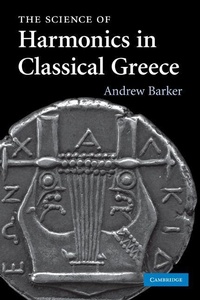
The Science of Harmonics in Classical Greece
Published on 16. June 2011
Book
Paperback/Softback
494 pages
978-0-521-28995-5 (ISBN)
Description
The ancient science of harmonics investigates the arrangements of pitched sounds which form the basis of musical melody, and the principles which govern them. It was the most important branch of Greek musical theory, studied by philosophers, mathematicians and astronomers as well as by musical specialists. This 2007 book examines its development during the period when its central ideas and rival schools of thought were established, laying the foundations for the speculations of later antiquity, the Middle Ages and the Renaissance. It concentrates particularly on the theorists' methods and purposes and the controversies that their various approaches to the subject provoked. It also seeks to locate the discipline within the broader cultural environment of the period; and it investigates, sometimes with surprising results, the ways in which the theorists' work draws on and in some cases influences that of philosophers and other intellectuals.
Reviews / Votes
Review of the hardback: 'This is a fine, important book from one of the pillars of Greek musical scholarship, and should be carefully digested to the last footnote by every serious student of the subject.' Mnemosyne Review of the hardback: 'The significance of Harmonics in Classical Greece - which displays all the features needed to become a classic for both studies in Classics and in musicology - does not only regard ancient philosophical and scientific studies. Indeed it sheds light on important aspects for medieval musicologists and for 16th and 17th -century debates, marked by a return to the ancient, even thanks to the Latin translation of Plutarch's De musica published by Carlo Valgulio in 1507.' Nuncius: Journal of the History of Science Review of the hardback: 'Barker has written an important book for anyone interested in ancient Greek music theory and its relationship with other intellectual activities of the time, such as philosophy and the empirical or mathematical sciences.' Bryn Mawr Classical ReviewMore details
Language
English
Place of publication
Cambridge
United Kingdom
Target group
Professional and scholarly
Product notice
Paperback (trade)
Illustrations
Worked examples or Exercises
Dimensions
Height: 229 mm
Width: 152 mm
Thickness: 29 mm
Weight
795 gr
ISBN-13
978-0-521-28995-5 (9780521289955)
Copyright in bibliographic data and cover images is held by Nielsen Book Services Limited or by the publishers or by their respective licensors: all rights reserved.
Schweitzer Classification
Other editions
Additional editions
Andrew Barker
The Science of Harmonics in Classical Greece
E-Book
01/2008
1st Edition
Cambridge University Press
€49.99
Available for download
Andrew Barker
The Science of Harmonics in Classical Greece
Book
09/2007
Cambridge University Press
€167.70
Shipment within 15-20 days
Person
Content
Part I. Preliminaries: Introduction; 1. Beginnings, and the problem of measurement; Part II. Empirical Harmonics: 2. Empirical harmonics before Aristoxenus; 3. The early empiricists in their cultural and intellectual contexts; 4. Interlude on Aristotle's account of a science and its methods; 5. Aristoxenus: the composition of the Elementa harmonica; 6. Aristoxenus: concepts and methods in Elementa harmonica Book 1; 7. Elementa harmonica Books 2-3: the science reconsidered; 8. Elementa harmonica Book 3 and its missing sequel; 9. Contexts and purposes of Aristoxenus' harmonics; Part III. Mathematical Harmonics: 10. Pythagorean harmonics in the fifth century: Philolaus; 11. Developments in Pythagorean harmonics: Archytas; 12. Plato; 13. Aristotle on the harmonic sciences; 14. Systematising mathematical harmonics: the Sectio canonis; 15. Quantification under attack: Theophrastus' critique; Postscript: The later centuries.