

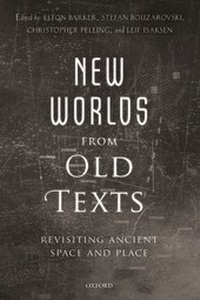
New Worlds from Old Texts
Revisiting Ancient Space and Place
Published on 3. December 2015
Book
Hardback
406 pages
978-0-19-966413-9 (ISBN)
Description
Maps dominate the modern sense of place and geography. Yet, so far as we can tell, maps were rare in the Greco-Roman world and, when mentioned in sources, are mistrusted and criticized. Today, technological advances have brought to the fore an entirely new set of methods for representing and interacting with space. In contrast to traditional 'topographic' perspectives, the territorial extent of economic and political realms is increasingly conceived though a 'topological' lens, in which the nature and frequency of links among different sites matter more than the physical distances between them.
New Worlds from Old Texts focuses on the ancient Greek experience of space, conceived of in terms of both its literature and material culture remains, and uses this to reflect on modern thinking. Comprising twelve chapters written by a highly interdisciplinary range of contributors, this edited collection explores the rich array of representational devices employed by ancient authors, whose narrative depictions of spatial relations defy the logic of images and surfaces that dominates contemporary cartographic thought. The volume focuses on Herodotus' Histories-a text that is increasingly cited by Classicists as an example of how ancient perceptions of space may have been rather different to the modern cartographic view-but also considers perceptions of space through the lens of other authors, genres, cultural contexts, and disciplines. In doing so, it reveals how a study of the ancient world can be reinvigorated by, and in turn help to shape, modern technological innovation and methods.
New Worlds from Old Texts focuses on the ancient Greek experience of space, conceived of in terms of both its literature and material culture remains, and uses this to reflect on modern thinking. Comprising twelve chapters written by a highly interdisciplinary range of contributors, this edited collection explores the rich array of representational devices employed by ancient authors, whose narrative depictions of spatial relations defy the logic of images and surfaces that dominates contemporary cartographic thought. The volume focuses on Herodotus' Histories-a text that is increasingly cited by Classicists as an example of how ancient perceptions of space may have been rather different to the modern cartographic view-but also considers perceptions of space through the lens of other authors, genres, cultural contexts, and disciplines. In doing so, it reveals how a study of the ancient world can be reinvigorated by, and in turn help to shape, modern technological innovation and methods.
Reviews / Votes
A shared vision about the need to contemplate space in new ways, Herodotus' Histories as a common arena for deliberation, and the potential of digital humanities to open new lines of research embody the three thematic axes of the book. Also, due to the frequent cross-references across chapters, the volume bears the mark of a genuinely interdisciplinary debate. All of this effec-tively entices the reader to mull over spatiality in Antiquity in a less (post-Enlightenment) cartographic manner. * C. Hernandez Garces * New Worlds from Old Texts is an excellent example of the integration of thoughtful humanistic inquiry and digital methods. It would serve as a fine example for anyone curious about digital classics. Moreover, several of the papers in Part I make a strong claim for inclusion in a classical geography syllabus and the volume is essential reading for anyone considering the spatial dimension of Herodotus * Hamish Cameron, New England Classical Journal * Readers will come to this volume for diverse reasons -- Herodotean scholarship, literary criticism, spatial theory, and/or new "mapping" technologies -- and the editors are to be commended for seeing through their initial vision for a volume that brings together various strategies for re-imagining how the ancient Greeks and Romans conceived of their world. * Rebecca K. Schindler, Classical Journal Online *More details
Language
English
Place of publication
Oxford
United Kingdom
Target group
College/higher education
Product notice
sewn/stitched
Cloth over boards
Illustrations
48 black and white illustrations
Dimensions
Height: 236 mm
Width: 157 mm
Thickness: 33 mm
Weight
771 gr
ISBN-13
978-0-19-966413-9 (9780199664139)
Schweitzer Classification
Other editions
Additional editions
Elton Barker | Stefan Bouzarovski | Christopher Pelling
New Worlds from Old Texts
Revisiting Ancient Space and Place
E-Book
12/2015
1st Edition
OUP eBook
€58.99
Available for download
Elton Barker | Stefan Bouzarovski | Christopher Pelling
New Worlds from Old Texts
Revisiting Ancient Space and Place
E-Book
12/2015
1st Edition
OUP eBook
€58.99
Available for download
Persons
Elton Barker is a Reader in Classical Studies at the Open University.
Stefan Bouzarovski is a Professor of Geography and Director of the Centre for Urban Energy and Resilience at the University of Manchester.
Christopher Pelling is Regius Professor of Greek at the University of Oxford.
Dr Leif Isaksen is a Senior Lecturer in History and Digital Humanities at Lancaster University.
Stefan Bouzarovski is a Professor of Geography and Director of the Centre for Urban Energy and Resilience at the University of Manchester.
Christopher Pelling is Regius Professor of Greek at the University of Oxford.
Dr Leif Isaksen is a Senior Lecturer in History and Digital Humanities at Lancaster University.
Content
PART 1: TEXTS, MAPS, IDEAS: ANCIENT GREEK REPRESENTATIONS OF SPACE; PART 2: THE HESTIA PROJECT: TOWARDS A NARRATIVE GEOGRAPHY OF HERODOTUS' HISTORIES; PART 3: TECHNOLOGIES, METHODOLOGIES, THEORIES: CONTEMPORARY APPROACHES TO MAPPING SPACE