

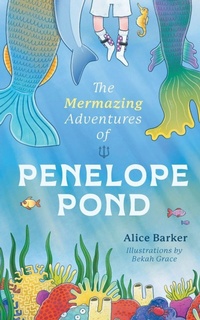
The Mermazing Adventures of Penelope Pond
Published on 29. August 2025
Book
Paperback/Softback
148 pages
978-1-0683099-3-9 (ISBN)
Description
Cockleshell Cove is a place so boring that the mapmakers didn't even bother to put it on the map. But big adventures can begin in the most unexpected of places...
Penelope Pond loves nothing more than zooming down to the beach in her wheelchair and spending time in her special cave, but everything changes the day she sees someone strange swimming in the sea - a girl, with dreadlocks in her hair and a shimmering tail!
Soon, Penelope is swept into a secret world beneath the waves, but mermaids live by ancient laws where landwalkers are not welcomed. When the rules of both Land and Ocean threaten their friendship, Penelope and Marlie must find the courage to stand up for what's right.
More details
Language
English
Place of publication
United Kingdom
Target group
Children/juvenile
Interest Age: From 7 to 12 years
Illustrations
13 black and white vignettes
Dimensions
Height: 203 mm
Width: 127 mm
Thickness: 8 mm
Weight
169 gr
ISBN-13
978-1-0683099-3-9 (9781068309939)
Copyright in bibliographic data and cover images is held by Nielsen Book Services Limited or by the publishers or by their respective licensors: all rights reserved.
Schweitzer Classification
Persons
Alice Barker is a disabled author whose work challenges how disability is portrayed in fiction. Writing across children's and new-adult genres, she creates protagonists who live full, complex lives with their disabilities rather than being defined by struggle or "overcoming" narratives. Her books include The Mermazing Adventures of Penelope Pond, an underwater adventure featuring a wheelchair-using heroine, Paraplegion, a dystopian fiction in which a disabled soldier discovers the chilling truth behind her body armour, and Sketching Scarlett, a romance told from the perspective of a man falling in love with a woman who uses a wheelchair. Through her writing, Alice aims to ensure disabled readers see themselves as the heroes of their own stories, and able-bodied readers recognise them that way too.