

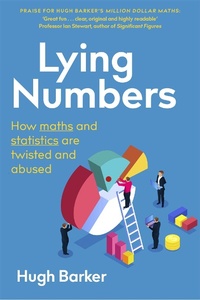
Lying Numbers
How Maths and Statistics Are Twisted and Abused
Published on 5. November 2020
Book
Paperback/Softback
256 pages
978-1-4721-4361-7 (ISBN)
Description
A readily understandable exploration of how figures are badly reported or deliberately misrepresented everywhere from political arguments and briefings to business presentations and shopping offers.
Praise for Hugh Barker's Million Dollar Maths:
'Great fun. A clear, original and highly readable account of the curious relationship between mathematics and money.' Professor Ian Stewart - author of Significant Figures
'A lively crash course in the mathematics of gambling, investing, and managing. Hugh Barker makes deep ideas fun and profitable.' William Poundstone - author of How to Predict the Unpredictable
Politicians, economists, scientists, journalists . . . all of them have been known to bend the truth and to twist the facts from time to time. But surely the numbers and statistics they rely on are cold, hard objective facts that tell the real story?
Of course the truth is much murkier than that. Figures can be misinterpreted, misunderstood, misconstrued and misused in hundreds of different ways. This book takes a look at the many ways that statistical information can be badly reported or deliberately misused in all walks of life, from political arguments, to business presentations, to more local concerns such as shopping offers and utility bills.
A polemical guide to how numbers are used to mislead, which is intended to help the reader through the minefield of dubious stats and lying numbers.
Praise for Hugh Barker's Million Dollar Maths:
'Great fun. A clear, original and highly readable account of the curious relationship between mathematics and money.' Professor Ian Stewart - author of Significant Figures
'A lively crash course in the mathematics of gambling, investing, and managing. Hugh Barker makes deep ideas fun and profitable.' William Poundstone - author of How to Predict the Unpredictable
Politicians, economists, scientists, journalists . . . all of them have been known to bend the truth and to twist the facts from time to time. But surely the numbers and statistics they rely on are cold, hard objective facts that tell the real story?
Of course the truth is much murkier than that. Figures can be misinterpreted, misunderstood, misconstrued and misused in hundreds of different ways. This book takes a look at the many ways that statistical information can be badly reported or deliberately misused in all walks of life, from political arguments, to business presentations, to more local concerns such as shopping offers and utility bills.
A polemical guide to how numbers are used to mislead, which is intended to help the reader through the minefield of dubious stats and lying numbers.
Reviews / Votes
Praise for Hugh Barker's Million Dollar Maths:Great fun. A clear, original and highly readable account of the curious relationship between mathematics and money.
Praise for Hugh Barker's Million Dollar Maths:
A lively crash course in the mathematics of gambling, investing, and managing. Hugh Barker makes deep ideas fun and profitable.
More details
Language
English
Place of publication
London
United Kingdom
Publishing group
Little, Brown Book Group
Target group
College/higher education
Professional and scholarly
Product notice
Paperback (UK-trade)
Dimensions
Height: 233 mm
Width: 151 mm
Thickness: 25 mm
Weight
316 gr
ISBN-13
978-1-4721-4361-7 (9781472143617)
Copyright in bibliographic data and cover images is held by Nielsen Book Services Limited or by the publishers or by their respective licensors: all rights reserved.
Schweitzer Classification
Other editions
Additional editions
E-Book
11/2020
Robinson
€3.99
Available for download
Person
HUGH BARKER is a non-fiction author and editor; as the latter he has edited several successful popular maths books, including A Slice of Pi. He is the author of Million Dollar Maths (Atlantic Books, October 2018) and High Tech Maths (Atlantic, 2019-20). Hugh is a keen amateur mathematician, and was accepted to study maths at Cambridge University aged 16.