

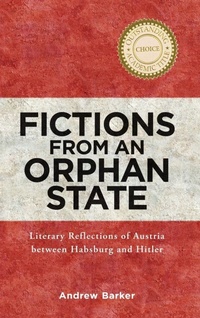
Fictions from an Orphan State
Literary Reflections of Austria between Habsburg and Hitler
Published on 1. August 2012
Book
Hardback
214 pages
978-1-57113-531-5 (ISBN)
Description
WINNER: 2013 CHOICE Outstanding Academic Title Award
A varied, vivid view of the literary culture of the often-neglected interwar Austrian republic.
The literary flair of fin-de-siecle Vienna lived on after 1918 in the First Austrian Republic even as writers grappled with the consequences of a lost war and the vanished Habsburg Empire. Reacting to historical and political issues often distinct from those in Weimar Germany, Austrian literary culture, though frequently associated with Jewish writers deeply attached to the concept of an independent Austria, reflected the republic's ever-deepening antisemitism and the growing clamor for political union with Germany.
Spanning the two momentous decades between the fall of the empire in 1918 and the Nazi Anschluss in 1938, this book explores work by canonical writers suchas Schnitzler, Kraus, Roth, and Werfel and by now-forgotten figures such as the pacifist Andreas Latzko, the arch-Nazi Bruno Brehm, and the fervently Jewish Soma Morgenstern. Also taken into account are Ernst Weiss's "Hitler" novel Der Augenzeuge and 1930s works about First Republic Austria by the German Communist writers Anna Seghers and Friedrich Wolf. Andrew Barker's book paints a varied and vivid picture of one of the most challenging and underresearched periods in twentieth-century cultural history.
Andrew Barker is Emeritus Professor of Austrian Studies at the University of Edinburgh, Scotland.
A varied, vivid view of the literary culture of the often-neglected interwar Austrian republic.
The literary flair of fin-de-siecle Vienna lived on after 1918 in the First Austrian Republic even as writers grappled with the consequences of a lost war and the vanished Habsburg Empire. Reacting to historical and political issues often distinct from those in Weimar Germany, Austrian literary culture, though frequently associated with Jewish writers deeply attached to the concept of an independent Austria, reflected the republic's ever-deepening antisemitism and the growing clamor for political union with Germany.
Spanning the two momentous decades between the fall of the empire in 1918 and the Nazi Anschluss in 1938, this book explores work by canonical writers suchas Schnitzler, Kraus, Roth, and Werfel and by now-forgotten figures such as the pacifist Andreas Latzko, the arch-Nazi Bruno Brehm, and the fervently Jewish Soma Morgenstern. Also taken into account are Ernst Weiss's "Hitler" novel Der Augenzeuge and 1930s works about First Republic Austria by the German Communist writers Anna Seghers and Friedrich Wolf. Andrew Barker's book paints a varied and vivid picture of one of the most challenging and underresearched periods in twentieth-century cultural history.
Andrew Barker is Emeritus Professor of Austrian Studies at the University of Edinburgh, Scotland.
Reviews / Votes
Ground breaking . . . . Barker is particularly adept at reading between the lines, at discovering individual and collective experience in outwardly fictional literature. He successfully employs his extensive knowledge of the era's literary production to provide captivating insights into not only select works of art, but also the often tortured biographies behind them. Most valuable may be his introduction of lesser known authors to an international audience. * FRANCIA-RECENSIO/PERSPECTIVIA.NET * [O]pens the door for a larger debate about the impact of Austria's unique political and social climate on the artistic output of [the period]. . . . [A]n important contribution to the field of Austrian Studies, as it repositions writers of the First Republic in the larger context of German-language literature and sheds new light on the events of the interwar period from an Austrian perspective. * GERMAN STUDIES REVIEW * [A] meticulously researched, groundbreaking book, one that illustrates the author's breathtaking knowledge of modern Austrian literature. Because of it, the recurrent question 'What is Austrian literature?' has become that much more exciting to consider for scholars. Barker's work is on all accounts a refreshing and welcome contribution to Austrian Studies on both sides of the Atlantic. * GERMAN QUARTERLY * [T]his is an invaluable book which draws on a lifetime's intimacy with Austrian literature to map a body of fiction, much of it barely known, against a relatively unfamiliar historical setting, with a lucid and engaging style. It must surely become a standard work. -- Ritchie Robertson * JOURNAL OF EUROPEAN STUDIES * This well-written, scholarly book has a unique emphasis. Barker . . . evaluates Austrian literature and identity separately from German. By considering both well-known and undeservedly obscure writers, he demonstrates that their insights are worthy of independent scrutiny, while he proves that a comprehensive history of Austrian literature is long overdue. . . . This excellent study fulfills a definite need in contemporary scholarship. . . . Recommended. * CHOICE *More details
Series
Language
English
Place of publication
Columbia, MD
United States
Publishing group
Boydell & Brewer Ltd
Target group
Professional and scholarly
Product notice
Cloth over boards
Dimensions
Height: 236 mm
Width: 163 mm
Thickness: 23 mm
Weight
635 gr
ISBN-13
978-1-57113-531-5 (9781571135315)
Copyright in bibliographic data and cover images is held by Nielsen Book Services Limited or by the publishers or by their respective licensors: all rights reserved.
Schweitzer Classification
Other editions
Additional editions
Andrew Barker
Fictions from an Orphan State
Literary Reflections of Austria between Habsburg and Hitler
E-Book
08/2012
1st Edition
De Gruyter
€48.99
Available for download
Person
Andrew Barker
Content
Preamble: A Cold Sun
Soldiers' Tales: Andreas Latzko, Ernst Weiss
The Habsburg Legacy: Arthur Schnitzler, Franz Werfel, Joseph Roth
"Hakenkreuz" and "Davidstern": Bruno Brehm, Soma Morgenstern
Charting February 1934: Karl Kraus, Anna Seghers, Friedrich Wolf, Alois Vogel
"Finis Austriae"?: Joseph Roth, Ernst Weiss, Heimito von Doderer
Postscript
Bibliography
Index
Soldiers' Tales: Andreas Latzko, Ernst Weiss
The Habsburg Legacy: Arthur Schnitzler, Franz Werfel, Joseph Roth
"Hakenkreuz" and "Davidstern": Bruno Brehm, Soma Morgenstern
Charting February 1934: Karl Kraus, Anna Seghers, Friedrich Wolf, Alois Vogel
"Finis Austriae"?: Joseph Roth, Ernst Weiss, Heimito von Doderer
Postscript
Bibliography
Index