

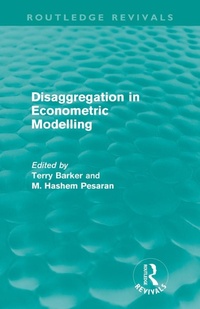
Disaggregation in Econometric Modelling (Routledge Revivals)
1st Edition
Published on 7. June 2012
Book
Paperback/Softback
366 pages
978-0-415-61663-8 (ISBN)
Description
In this book, first published in 1990, leading theorists and applied economists address themselves to the key questions of aggregation. The issues are covered both theoretically and in wide-ranging applications. Of particular intrest is the optimal aggregation of trade data, the need for micro-modelling when imoprtant non-linearities are present (for example, tax exhaustion in modelling company behaviour) and the use of a micro-model to stimulate labour supply behaviour in a macro-model of the Netherlands.
More details
Series
Language
English
Place of publication
London
United Kingdom
Publishing group
Taylor & Francis Ltd
Target group
College/higher education
Dimensions
Height: 216 mm
Width: 140 mm
Thickness: 20 mm
Weight
463 gr
ISBN-13
978-0-415-61663-8 (9780415616638)
Copyright in bibliographic data and cover images is held by Nielsen Book Services Limited or by the publishers or by their respective licensors: all rights reserved.
Schweitzer Classification
Other editions
Additional editions
E-Book
02/2014
1st Edition
Routledge
€31.49
Available for download
E-Book
02/2014
1st Edition
Routledge
€31.49
Available for download

Book
01/2011
1st Edition
Routledge
€78.10
Shipment within 15-20 days
Person
Terry Barker
Content
1. Disaggregation in econometric modelling: an introduction Part I 2. Aggregation of time-series variables: a survey 3. On the dynamic specification of aggregated models 4. Aggregation versus disaggregation in forecasting construction activity 5. Aggregation problems in a model of wage formation and employment demand 6. Aggregation bias in labour demand equations for the UK economy 7. Optimal aggregation of linear net export systems 8. The choice of aggregate production functions in Mexican industries 9. Disaggregation of hte demand for hospital care 10. Aggregation in discrete choice models: an illustration of non-linear aggregation Part II 11. Macroeconomic and micoreconomic modelling: some issues 12. MICROFKA: integrating a micro labour-supply model and a macro model of the Dutch economy 13. Macro to micro linkage: some experiments with the UK commodity flow accounts 14. What determines the bank borrowing and liquid lending of UK companies? Explanations based on aggregated and disaggregated data