

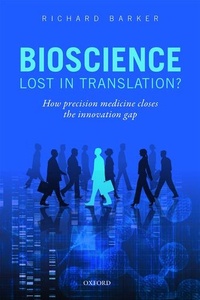
Bioscience - Lost in Translation?
How precision medicine closes the innovation gap
Published on 15. September 2016
Book
Paperback/Softback
242 pages
978-0-19-873778-0 (ISBN)
Description
Medical innovation as it stands today is fundamentally unsustainable. There is a widening gap between what biomedical research promises and the impact that it is currently achieving, in terms of patient benefit and health system improvement.
This book highlights the global problem of the ineffective translation of bioscience innovation into health system improvements and its consequences, analyses the underlying causative factors and provides powerful prescriptions for change to close the gap. It contrasts the progress in biomedicine with other areas of scientific and technological endeavour, such as information technology, in which there are faster and more reliable returns for society.
The author's career has spanned pharmaceuticals, diagnostics and health informatics and he draws lessons from a host of case examples in which bottlenecks have prevented progress, such as in dementia and antibiotic-resistant infections, and from many in which these barriers have been overcome, such as HIV therapy and targeted cancer treatment. The new era of precision medicine holds the greatest promise of closing this 'innovation gap'. Along with techniques such as open innovation and adaptive development, powerful new genomics and digital health tools are poised to transform the productivity of life sciences.
Bioscience-Lost in Translation? lays out a fresh and provocative strategy for advancing the innovation process, shaping the right policy environment and building an ecosystem to deliver the 21st century cures that are urgently needed.
This book highlights the global problem of the ineffective translation of bioscience innovation into health system improvements and its consequences, analyses the underlying causative factors and provides powerful prescriptions for change to close the gap. It contrasts the progress in biomedicine with other areas of scientific and technological endeavour, such as information technology, in which there are faster and more reliable returns for society.
The author's career has spanned pharmaceuticals, diagnostics and health informatics and he draws lessons from a host of case examples in which bottlenecks have prevented progress, such as in dementia and antibiotic-resistant infections, and from many in which these barriers have been overcome, such as HIV therapy and targeted cancer treatment. The new era of precision medicine holds the greatest promise of closing this 'innovation gap'. Along with techniques such as open innovation and adaptive development, powerful new genomics and digital health tools are poised to transform the productivity of life sciences.
Bioscience-Lost in Translation? lays out a fresh and provocative strategy for advancing the innovation process, shaping the right policy environment and building an ecosystem to deliver the 21st century cures that are urgently needed.
Reviews / Votes
Advance Praise: It is not easy to keep up with the rapid pace of biomedical innovation nor changes in society and markets. This book captures exactly where we are right now: an unprecedented wave of innovation that arrives in health systems that are not prepared. And neither is the business model of the pharmaceutical industry. * Richard Bergstroem, Director, European Federation of Pharmaceutical Industry and Associations, Belgium * Advance Praise: This is a timely and provocative analysis. It is crucially important that researchers, clinicians, industry, and regulators adapt effectively to the new era of stratified medicine. This book is a welcome contribution to the debate. * Professor Jeremy Farrar, Executive Director, The Wellcome Trust, UK * Advance Praise: Richard Barker presents a provocative and thoughtful review of the health care ecosystem, demonstrating time and again that communication and collaboration across the stakeholder community are essential to realizing patient benefits from biomedical innovation. * Dr Barbara Lopez Kunz, Global Chief Executive, Drug Information Association, Switzerland * Advance Praise: Richard Barker, drawing on a quarter of a century of deep practical involvement in the topic, has written an invaluable synthesis of the factors that account for the disappointing rate of translation of science into affordable treatments to address unmet clinical need. Crucial will be forging of transparent productive relationships between academia, industry and an enlightened regulatory system. Essential reading for all those interested in making the medical innovation process faster, more productive and sustainable. * Professor Sir John Tooke, co-Chair of the Centre for the Advancement of Sustainable Medical Innovation, UK, former Vice-Provost of University College London * Advance Praise: Concisely frames the rich, dynamic environment for biologic/medical science with all the opportunities and challenges and offers orderly, thoughtful, practical approaches and solutions to facilitate and optimize medical innovation science. This book is suitable for both the knowledgeable scientific and the interested lay communities. * Dr Michael Friedman, Emeritus Chief Executive, City of Hope Cancer Center, Duarte, CA, USA and board member of life science companies * Advance Praise: This book provides an overview and in-depth analysis of medical science, drug development, etc., along with recommendations that are impressive. Amazing to say the least. * Mike Casey, board member and former Chief Executive of US biotech companies and former senior executive at Johnson & Johnson * Advance Praise: This is an important and timely book. Richard Barker comprehensively reviews current progress, but perhaps more importantly points out encouraging paths of translation as we move forward. In doing so, he provides a comprehensive scientific and socio-cultural rationale and basis for closing the collaboration gap, for bridging scientific advances, new product development and evaluation, and clinical care. * Stephen P. Spielberg, MD, PhD, former Dean, Dartmouth Medical School, Hannover, NH, USA, former Deputy Commissioner, US FDA, USA, and Editor-in-Chief, Therapeutic Innovation and Regulatory Science *More details
Language
English
Place of publication
Oxford
United Kingdom
Target group
College/higher education
Professional and scholarly
Product notice
Paperback (trade)
Unsewn / adhesive bound
Dimensions
Height: 231 mm
Width: 155 mm
Thickness: 15 mm
Weight
386 gr
ISBN-13
978-0-19-873778-0 (9780198737780)
Copyright in bibliographic data and cover images is held by Nielsen Book Services Limited or by the publishers or by their respective licensors: all rights reserved.
Schweitzer Classification
Other editions
Additional editions
E-Book
09/2016
1st Edition
OUP eBook
€33.99
Available for download

E-Book
08/2016
1st Edition
OUP eBook
€33.99
Available for download
Person
Professor Richard Barker has been Director of CASMI since its creation and was instrumental in its inception and launch. He is a strategic advisor, speaker and author on healthcare and life sciences. Richard has spent most of his career in healthcare, as a leader of organisations, as a board member and as a consultant. His leadership roles have spanned therapeutics, diagnostics and informatics both in the United States and in Europe. He was recently voted as one of the top 50 most influential people in UK healthcare and he sits on several healthcare and life sciences advisory boards on both sides of the Atlantic. His passions include securing a sustainable future for healthcare and redesigning how new medical technology is brought into practice. He now lives in London but is a frequent visitor to the US, where he spent 11 years working in Boston, New Haven, New York and San Francisco.
Content
INDEX