

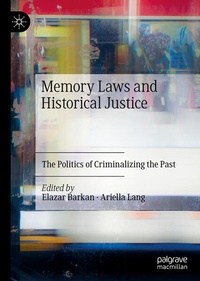
Memory Laws and Historical Justice
Description
Reviews / Votes
"This collection examines from a non-legal perspective how memory laws have functioned as political instruments. Edited, brought together, and extensively introduced by two pioneers in the field of Historical Dialogue, this volume casts a wide geographic and political net - from Spain, to Russia and Eastern Europe, to Israel, to Rwanda and beyond. This work not only contributes to the discussion on the politics of memory, the politics of identity, and analyzing the impediments to transitional justice, but also to understanding the dynamics of repressive regimes, even long after their demise."
Nanci Adler, NIOD Institute for War, Holocaust and Genocide Studies/University of Amsterdam, the NetherlandsMore details
Other editions
Additional editions
Persons
Elazar Barkan is Professor of International and Public Affairs and the Director of the Human Rights Concentration at Columbia University's School of International and Public Affairs, USA. His research interests focus on human rights, the role of history in contemporary society and politics, and the response to gross historical crimes and injustices.
Ariella Lang is Associate Dean of Academic Affairs, Director of Undergraduate Research and Fellowships at Columbia College and a Lecturer at Columbia University's Institute for the Study of Human Rights. Her research interests include minority rights and cultures, genocide studies, and the relationship between religion and nationalism.