

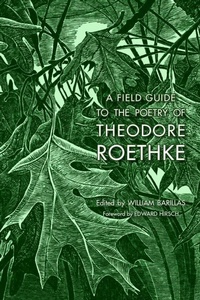
A Field Guide to the Poetry of Theodore Roethke
Description
This volume is the first to reconsider Roethke's work in terms of the expanded critical approaches to literature that have emerged since his death in 1963. Editor William Barillas and over forty contributors, including highly respected literary scholars, critics, and writers such as Peter Balakian, Camille Paglia, Jay Parini, and David Wojahn, collectively make a case for Roethke's poetry as a complete, unified, and evolving body of work. The accessible essays employ a number of approaches, including formalism, ecocriticism, reader-response, and feminist critique to explicate the poetics, themes, and the biographical, historical, cultural, and literary contexts of Roethke's work.
Reviews / Votes
"[T]his new anthology's many critical voices suit Roethke's multi-faceted work.... A Field Guide should bring new readers closer to the liveliness of Roethke's poems, which will become their own." (Poetry Northwest) "[T]he Field Guide brings together all the elements needed for a sophisticated understanding of Roethke, his contexts, and his art. It presents leading historical and contemporary critical approaches to his poetry, and it suggests areas deserving further study." (MidAmerica) "This book draws readers closer to Roethke's poetry than any other single study has. Recommended." (Choice) "Barillas's thoroughly diverse and democratic reassessment of Roethke's radically diverse oeuvre resituates Roethke's high and proper place in American poetry.... A Field Guide to the Poetry of Theodore Roethke has altered and deepened my thinking, not just about Roethke but Poetry itself." (Poetry International Online) "This ingeniously structured 'field guide' to Roethke's poetry reintroduces us to a body of work that changed the sound and sense of twentieth-century poetry. Timely, engaging, and stylistically diverse essays consider Roethke's poems from new angles, and situate him as an early practitioner of ecopoetry. These reappraisals remind us of the power of Roethke's 'weird word-music,' his mastery of the greenhouse's 'alien textures,' and the reach of his 'defamiliarizing' poetic language, which influenced Sylvia Plath, Robert Bly, James Wright, Seamus Heaney, and so many others. This is an indispensable collection for a new generation of Roethke's readers." "What a lovely model this book sets: a gathering of short essays by skilled readers on a great poet whose work is ripe for rediscovery. William Barillas has devised an elegant format that allows many voices to sound in a variety of registers, while keeping the poems themselves constantly in the foreground. This book offers scholars, poets, teachers, and students a wide array of paths through the inexhaustibly rich terrain of Roethke's poems, traversing their vibrant renderings of both inner and outer landscapes, their sustained dialogue with poetic tradition, and their prescient engagement with environmental concerns." "These essays, written from multiple perspectives, make a welcome and accessible companion to Roethke's Collected Poems, while making the case for exploring the full range of the poet's work." "A long overdue re-examination and celebration of the incandescent work of poet Theodore Roethke, bringing his work to a whole new generation of readers. Highly recommended." "Roethke's large, multitudinous body of work, while never out of print, has somehow gotten lost in the past decades. This book, expertly edited by William Barillas, should help rectify that odd neglect. It puts his work in perspective." "One of the great strengths of this book is its reconsideration of Roethke's work in the light of critical developments such as ecocriticism, feminist criticism, and reader response theory. This is an extremely timely and important collection."More details
Other editions
Additional editions
Person
Content
Foreword (EDWARD HIRSCH)
Preface
Acknowledgments
House, Field, Stones, and Stars: An Introduction (WILLIAM BARILLAS)
Open House (1941)
1. “Open House”: Prying and Potential in an Early Poem (BRANDON RUSHTON)
2. “To My Sister” (WILLIAM HEYEN)
3. “Beneath an Undivided Sky”: Environmental Disorder and Human Passivity in “Interlude” (KRISTIN M. DISTEL)
4. “Sharper on the Ear”: “The Light Comes Brighter” and the Subtle Phenomena of Place (ROD PHILLIPS)
5. Smart Like Auden? “Lull” and “September 1, 1939” (PATRICK GILL)
6. Ironic Quest in “Highway: Michigan” (RONALD PRIMEAU)
7. Movement through Space, Sound, and Time in “Night Journey” (MARCEL INHOFF)
The Lost Son and Other Poems (1948)
8. “Cuttings” and “Cuttings (later)”: Roethke’s Minute Carnivals (MICHAEL HINDS)
9. All the Small, Unlovely Things: “Root Cellar” (JOHN ROHRKEMPER)
10. Locating the Poet in “Weed Puller” (LYN COFFIN)
11. “Orchids”: Undomesticating the Greenhouse (BROOKE HORVATH)
12. “Moss-Gathering” and Roethke’s Romantic Child of Nature (MARC MALANDRA)
13. The Storm of the Mind vs. Family and Machine in “Big Wind” (RUSSELL BRICKEY)
14. “Long Days under the Sloped Glass”: Greenhouse Memories in “Transplanting” (CARRIE DUKE)
15. “Frau Bauman, Frau Schmidt, and Frau Schwartze” and the Sleeping Beauty Tale (MARCIA NOE and LAURA DUNCAN)
16. Meter in “My Papa’s Waltz” (WILLIAM BARILLAS)
17. Syntax and Diction in “Dolor” (LUKE BREKKE)
18. Imagery and Abstraction in “Night Crow” (SARAH KATHRYN MOORE)
19. “The Lost Son”: An Emotional Journey through the Landscapes of Loss (BORJA AGUILÓ OBRADOR)
20. Respite for the Lost Son: “A Field of Light” (JEFFREY CLAPP)
Praise to the End! (1951)
21. Homegrown Cosmologies: Animism and Elegy in “Where Knock Is Open Wide” (DAVID WOJAHN)
22. “Give Way, Ye Gates” and Roethke’s Praise to the End! Sequence (PETER BALAKIAN)
The Waking (1953)
23 “The Visitant” (CAMILLE PAGLIA)
24. “Elegy for Jane”: The Nature of Grief (DAVID RADAVICH)
25. Dancing “The Dance”: Roethke’s Poetics of Appropriation (ADAM PUTZ)
26. Subduing Fear in “The Waking” (FRANK J. KEARFUL)
Words for the Wind (1958)
27. Love, Selfhood, and Sublimation in “Words for the Wind” (ANDREW DAVID KING)
28. Moving Circles in “I Knew a Woman” (JAY PARINI)
29. “First Meditation” and Roethke’s Career (DON BOGEN)
I Am! Says th e Lamb (1961)
30. A Few Thousand Words on Theodore Roethke, Children’s Poetry, and Three Poems Concerning Two Turtles (One of Whom Is Named Myrtle) (JOSEPH T. THOMAS JR.)
The Far Field (1964)
31. “The Longing”: Alienation, Place, and the Desire for Home (KATHARINE BUBEL)
32. Spirit, Self, and Shorebirds: The Pacific Pastoral of “Meditation at Oyster River” (NICHOLAS BRADLEY)
33. “Journey to the Interior,” “The Longing,” and the Search for a Definitive Text (NEAL BOWERS)
Contents
34. Mnetha in “The Long Waters” (JOHN J. MCKENNA)
35. The Ecological Vision of “The Far Field” (BERNARD QUETCHENBACH)
36. Nature Mysticism in “The Rose” (EDWARD MORIN)
37. “The Abyss”: Finding the Next Life in This One (TRENTON HICKMAN)
38. “Otto”: An Insight into Roethke’s Poetic Vision (JEFF VANDE ZANDE)
39. “The Meadow Mouse”: A Poem of Compassion (NORMAN CHANEY)
40. The Zoopoetics of “The Pike” (AARON M. MOE)
41. Roethke’s Dark Society: Revisiting “In a Dark Time” (WALTER KALAIDJIAN)
42. “I Am Not Yet Undone”: Navigating the Journey from Life to Death in “Infirmity” (LAURA GILL)
43. Symbolism and the Mystic’s Way in “The Tree, the Bird” (CHRISTOPHER GIROUX)
44. “Once More, the Round”: Roethke’s Last Word (WILLIAM BARILLAS)
Works Cited
Notes on Contributors
Index