

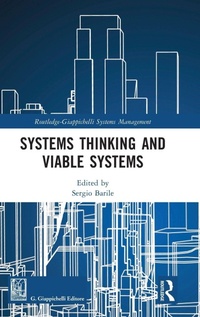
Systems Thinking and Viable Systems
1st Edition
Published on 26. February 2024
Book
Hardback
224 pages
978-1-032-75684-4 (ISBN)
Description
In the last few decades, managerial and business studies have shown an increasing inability to explain and forecast emergent dynamics in society, economics, and the environment.
Consolidated managerial approaches and business theories seem to be incapable of communicating and depicting the ongoing evolution, and new perspectives are required to support both researchers and practitioners in tracing new paths for development. Building upon the constructivist approach, this book illustrates the multiple advantages that systems thinking can offer in supporting a holistic understanding of social and economic phenomena.
The book proposes a representation of the firm as a viable system and represents its functioning and decision-making processes trough a recursive depiction that can be applied for each of the multiple levels through which socio-economic environments are defined. As a result of the focus on the differences between decision making and problem-solving processes, the book enriches current knowledge about systems thinking and provides useful instruments through which both researchers and practitioners can effectively understand the multiple variables able to influence decisions and actions within a firm's configuration.
The book is aimed at both postgraduate students and researchers interested in the multiple dimensions of systems thinking.
Consolidated managerial approaches and business theories seem to be incapable of communicating and depicting the ongoing evolution, and new perspectives are required to support both researchers and practitioners in tracing new paths for development. Building upon the constructivist approach, this book illustrates the multiple advantages that systems thinking can offer in supporting a holistic understanding of social and economic phenomena.
The book proposes a representation of the firm as a viable system and represents its functioning and decision-making processes trough a recursive depiction that can be applied for each of the multiple levels through which socio-economic environments are defined. As a result of the focus on the differences between decision making and problem-solving processes, the book enriches current knowledge about systems thinking and provides useful instruments through which both researchers and practitioners can effectively understand the multiple variables able to influence decisions and actions within a firm's configuration.
The book is aimed at both postgraduate students and researchers interested in the multiple dimensions of systems thinking.
More details
Series
Language
English
Place of publication
London
United Kingdom
Publishing group
Taylor & Francis Ltd
Target group
College/higher education
Postgraduate
Illustrations
6 s/w Tabellen, 42 s/w Zeichnungen, 43 s/w Abbildungen, 1 s/w Photographie bzw. Rasterbild
6 Tables, black and white; 42 Line drawings, black and white; 1 Halftones, black and white; 43 Illustrations, black and white
Dimensions
Height: 240 mm
Width: 161 mm
Thickness: 19 mm
Weight
578 gr
ISBN-13
978-1-032-75684-4 (9781032756844)
Copyright in bibliographic data and cover images is held by Nielsen Book Services Limited or by the publishers or by their respective licensors: all rights reserved.
Schweitzer Classification
Other editions
Additional editions
Sergio Barile
Systems Thinking and Viable Systems
Book
07/2025
1st Edition
Routledge
€60.00
Shipment within 10-20 days
Sergio Barile
Systems Thinking and Viable Systems
E-Book
02/2024
1st Edition
Routledge
€60.49
Available for download
Sergio Barile
Systems Thinking and Viable Systems
E-Book
02/2024
1st Edition
Routledge
€60.49
Available for download
Person
Sergio Barile is Full Professor of Economics and Business Management (SECSP/08) at the Faculty of Economics, University of Rome "La Sapienza". He holds the chair of "Economics and Business Management", and of "Algorithms and Platforms for Business Decisions". He boasts an academic and professional career of excellence characterised by long experience in running university, Master's and PhD courses, heading the Department of Management and coordinating the PhD programme in Management, Banking and Commodity Sciences. He has served on administrative and supervisory bodies in public and private organisations. His areas of research range from business economics to systems theory. He is one of the main expert of reference for the studies on Viable Systems Approach in its various forms, in particular with reference to: governance and business management, decision theory, complexity theory. He is the author of more than one hundred and fifty national and international publications. His journal publications and books are cited by thousands of researchers worldwide and are the subject of growing interest.
Content
1. Epistemological premises 2. Systems thinking 3. The firm as a viable system 4. The conceptual difference between decision making and problem solving 5. Possible decision-making areas 6. The viable system as a universal model for decision-making processes