

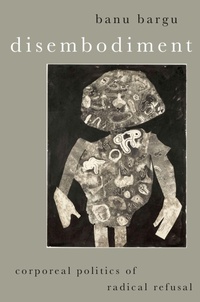
Disembodiment
Corporeal Politics of Radical Refusal
Published on 19. December 2024
Book
Hardback
504 pages
978-0-19-760853-1 (ISBN)
Description
Disembodiment examines self-destruction, self-injury, and self-endangerment as actions that express the injustices and indignities of the life conditions of impoverished, dispossessed, and dominated peoples. Author Banu Bargu troubles the dominant approach that treats these acts as individual pathologies, cries for help, and signs of despair. Instead, she suggests that they should be read as unconventional performances of resistance and refusal that are erased, marginalized, and distorted by metanarratives of history as progress and of agency as freedom and intentionality. Situating these practices in a dialectic of desubjectivation and counter-subjectivation, Bargu argues that they dispel a western metaphysics of subjecthood and invoke alternative ways of being human and of relating to one's body and the world. Pursuing philosophical questions about the meaning of agency, the direction of history, and the limits of the political generated by the forfeiture of the body, Bargu offers a stark and unforgiving critique of our present.
As a work in global critical theory whose normative compass is the suffering body, Disembodiment brings together corporeal enactments of defiance and refusal from the global south with major thinkers of western modernity and prominent critical-theoretical traditions of the twentieth century. Bargu moves from such historical precedents as the suicides of enslaved Africans during the transatlantic crossing, the hunger strikes of woman suffragists in England's prisons, and Gandhian fasting practices in the Indian anticolonial struggle to contemporary examples that include the hunger and thirst strikes in the Maze and Guantanamo, the self-incineration of Mohammed Bouazizi, and the lip-sewing practices of migrants and asylum seekers in detention centers and border zones of the global north today. She takes the reader on an unsettling journey that delineates the emergence of a corporeal repertoire of contention. Performed by the powerless who find themselves in crisis, this repertoire is built on the expressive agency of the body and its ability to irrupt, undoing its training in composure and radicalizing the meaning of dignity.
Disembodiment presents a bold materialist theory of corporeal agency, which upholds the body's powers as fundamentally rebellious and ultimately undomesticatable
As a work in global critical theory whose normative compass is the suffering body, Disembodiment brings together corporeal enactments of defiance and refusal from the global south with major thinkers of western modernity and prominent critical-theoretical traditions of the twentieth century. Bargu moves from such historical precedents as the suicides of enslaved Africans during the transatlantic crossing, the hunger strikes of woman suffragists in England's prisons, and Gandhian fasting practices in the Indian anticolonial struggle to contemporary examples that include the hunger and thirst strikes in the Maze and Guantanamo, the self-incineration of Mohammed Bouazizi, and the lip-sewing practices of migrants and asylum seekers in detention centers and border zones of the global north today. She takes the reader on an unsettling journey that delineates the emergence of a corporeal repertoire of contention. Performed by the powerless who find themselves in crisis, this repertoire is built on the expressive agency of the body and its ability to irrupt, undoing its training in composure and radicalizing the meaning of dignity.
Disembodiment presents a bold materialist theory of corporeal agency, which upholds the body's powers as fundamentally rebellious and ultimately undomesticatable
More details
Series
Language
English
Place of publication
New York
United States
Target group
College/higher education
Dimensions
Height: 240 mm
Width: 160 mm
Thickness: 42 mm
Weight
798 gr
ISBN-13
978-0-19-760853-1 (9780197608531)
Copyright in bibliographic data and cover images is held by Nielsen Book Services Limited or by the publishers or by their respective licensors: all rights reserved.
Schweitzer Classification
Other editions
Additional editions
E-Book
09/2024
OUP eBook
€25.99
Available for download
E-Book
09/2024
OUP eBook
€25.99
Available for download
Person
Banu Bargu is Professor in History of Consciousness at University of California, Santa Cruz. Her research and publications are situated at the intersection of political and critical theory, anthropology, history of social movements and resistance practices, and Middle East politics. She is the author of Starve and Immolate: The Politics of Human Weapons, which received the First Book Award given by the Foundations of Political Theory section of the American Political Science Association and was named an Outstanding Academic Title by Choice. She is the incoming co-editor of Political Theory, the flagship journal of the field.
Content
Preface Chapter I Why Did Bouazizi Kill Himself? Chapter II The Other Bouazizis of Our Times: Disembodiment and Dignity Chapter III Suicide and the Modern Subject Chapter IV On "Futures Pitilessly Blocked and Passions Violently Choked": A Political History of Disembodiment Chapter V From the Maze to Guantanamo: The Violent Unmaking of the Modern Subject Chapter VI Corporeal Critique: The Undomesticatable and Expressive Agency Chapter VII Throwaway Bodies: Gestures of Refusal from the Global South Chapter VIII The Body Anterior: Toward a Materialism of Corporeal Agency Chapter IX Parrhesia of the Powerless Conclusion The Corporeal Repertoire of the Oppressed Acknowledgements Bibliography