

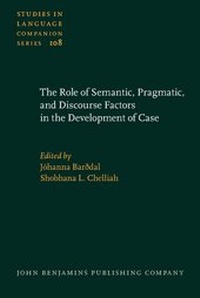
The Role of Semantic, Pragmatic, and Discourse Factors in the Development of Case
Published on 11. March 2009
Book
Hardback
432 pages
978-90-272-0575-9 (ISBN)
Description
The aim of this volume is to bring non-syntactic factors in the development of case into the eye of the research field, by illustrating the integral role of pragmatics, semantics, and discourse structure in the historical development of morphologically marked case systems. The articles represent fifteen typologically diverse languages from four different language families: (i) Indo-European: Vedic Sanskrit, Russian, Greek, Latin, Latvian, Gothic, French, German, Icelandic, and Faroese; (ii) Tibeto-Burman, especially the Bodic languages and Meithei; (iii) Japanese; and (iv) the Pama-Nyungan mixed language Gurindji Kriol. The data also show considerable diversity and include elicited, archival, corpus-based, and naturally occurring data. Discussions of mechanisms where change is obtained include semantically and aspectually motivated synchronic case variation, discourse motivated subject marking, reduction or expansion of case marker distribution, case syncretism motivated by semantics, syntax, or language contact, and case splits motivated by pragmatics, metonymy, and subjectification.
More details
Series
Language
English
Place of publication
Amsterdam
Netherlands
Target group
Professional and scholarly
Illustrations
+ index
Dimensions
Height: 245 mm
Width: 164 mm
Weight
955 gr
ISBN-13
978-90-272-0575-9 (9789027205759)
Copyright in bibliographic data and cover images is held by Nielsen Book Services Limited or by the publishers or by their respective licensors: all rights reserved.
Schweitzer Classification
Other editions
Additional editions
Jóhanna Barðdal | Shobhana L. Chelliah
The Role of Semantic, Pragmatic, and Discourse Factors in the Development of Case
Selected Papers from the 37th Linguistic Symposium on Romance Languages (LSRL), Pittsburgh, 15-18 March 2007
E-Book
03/2009
1st Edition
John Benjamins Publishing Company
€130.99
Available for download
Persons
Content
1. List of contributors; 2. Introduction: The role of semantic, pragmatic and discourse factors in the development of case (by Barddal, Johanna); 3. Part I. Semantically and aspectually motivated synchronic case variation; 4. Case variation in Gothic absolute constructions (by Dewey, Tonya Kim); 5. Some semantic and pragmatic aspects of object alternation in Early Vedic (by Dahl, Eystein); 6. Part II. Discourse motivated subject marking; 7. The case of the shifty ergative marker: A pragmatic shift in the ergative marker of one Australian mixed language (by Meakins, Felicity); 8. How useful is case morphology? The loss of the Old French two-case system within a theory of Preferred Argument structure (by Detges, Ulrich); 9. Part III. Reduction or expansion of case marker distribution; 10. The development of case in Germanic (by Barddal, Johanna); 11. A usage-based approach to change: Old Russian possessive constructions (by Eckhoff, Hanne Martine); 12. Lacking in Latvian: Case variation from a cognitive and constructional perspective (by Berg-Olsen, Sturla); 13. Verb classes and dative objects in Insular Scandinavian (by Jonsson, Johannes Gisli); 14. Transitive adjectives in Japanese (by Caluianu, Daniela); 15. Part IV. Case syncretism motivated by syntax, semantics or language contact; 16. Patterns of development, patterns of syncretism of relational morphology in the Bodic languages (by Noonan, Michael); 17. The evolution of local cases and their grammatical equivalent in Greek and Latin (by Luraghi, Silvia); 18. Argument structure and alignment variations and changes in Late Latin (by Cennamo, Michela); 19. Case loss in Texas German: The influence of semantic and pragmatic factors (by Boas, Hans C.); 20. Part V. Case splits motivated by pragmatics, metonymy and subjectification; 21. Semantic role to new information in Meithei (by Chelliah, Shobhana L.); 22. From less personal to more personal: Subjectification of ni-marked NPs in Japanese discourse (by Sadler, Misumi); 23. Author index; 24. Subject index