

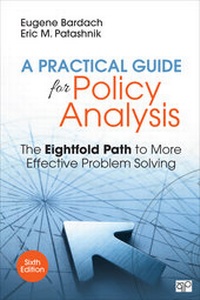
A Practical Guide for Policy Analysis
The Eightfold Path to More Effective Problem Solving
6th Edition
Published on 14. October 2019
Book
Paperback/Softback
216 pages
978-1-5063-6888-7 (ISBN)
Description
Drawing on more than 40 years of experience with policy analysis, best-selling authors Eugene Bardach and Eric M. Patashnik use real-world examples to teach you how to be effective, accurate, and persuasive policy analysts. The Sixth Edition of A Practical Guide for Policy Analysis presents dozens of concrete tips, new case studies, and step-by-step strategies for the budding analyst as well as the seasoned professional.
Reviews / Votes
"Bardach and Patashnik provide a strong analytical framework to guide the novice student in exploring policy options. The text is substantive yet approachable, providing a bridge between theory and practice that is meaningful for both undergraduate and graduate students of public policy." -- Kimberly Ratcliff "Professors Bardach and Patashnik's "Eightfold Path" provides a wise and engaging how-to guide that meets the central challenge of policy analysis: combining scientific evidence and social goals to craft practical, real-world solutions." -- Thomas S. Dee "Bardach and Patashnik's A Practical Guide for Policy Analysis has become a genuine classic of policy analysis because it offers a versatile framework for confronting policy issues of all types-from persistent, long-standing problems to new, emergent challenges. Like every classic work, it contains different layers of insight for different readers. Junior analysts can use the eight basic elements as a primer. Intermediate analysts can add the design principles. Experienced analysts can deepen their practice by applying the eightfold path to increasingly complex problems. I wouldn't think of teaching policy analysis at any level without this elegant guide to our craft." -- Karen Baehler "A Practical Guide for Policy Analysis still remains the most accessible and practical guide for those learning the craft of public policy analysis. It offers a clear road map to conduct effective policy analysis, and provides a terrific list of useful resources and helpful hints to do so. The newer substantive chapters in the book on design problems, gathering political support, and asking the right questions make clear that the authors believe, justifiably, that policy analysis is not a linear craft and that policy adoption is not strictly technical. The additional chapter on understanding the role of big data in policy analysis is terrific and exposes readers to an important question in policy analysis of what is evidence. The Guide should be required reading for all students in public affairs type undergraduate- and graduate-level programs." -- Michael Stoll "This book remains the gold standard for introducing students to key issues in policy analysis. I have used it many times in teaching Policy Analysis courses for both students and practicing policy analysts. The new edition adds a lot of helpful new material (e.g., discussions of Big Data) that will be helpful to students struggling to think systematically about how to assess policy alternatives. Other books cover economic and technical analytical skills that are essential to policy analysis, but no other source covers the process of policy analysis with the depth, insight and wisdom of Bardach and Patashnik." -- R. Kent Weaver, Distinguished Professor of Public Policy ?"From my undergraduate "Introduction to Public Policy" course through MPP client-based policy analysis courses, A Practical Guide for Policy Analysis has been essential reading. The book sets students on an eight-fold path from succinctly defining policy problems through advocating on behalf of a well-reasoned proposal. It provides structured thinking for students new to public policy and hands-on advice for those about to become policy professionals - all in tight, well-written, accessible, and interesting prose. It is a pleasure to see the growth in students that this text helps ensure and to hear from our alumni who refer back to it so regularly." -- Craig Volden, Professor of Public Policy and Politics and Associate Dean for Academic Affairs "I was introduced to Bardach's book when I was a graduate student and have begun using it in my courses for the past twenty years. The content and style is very accessible and informative for students who want to learn about practical skills that will help them in the workplace." -- Kimberly Speers "A Practical Guide for Policy Analysis is the essential text to introduce health policy students to the practice of policy analysis. The authors offer a persuasive argument for why defining the problem is the fundamental yet challenging first step of policy analysis; this lesson is critical for health policy, where issue rhetoric abounds. The book offers a step-by-step methodology that appeals to students' need for structure, while reminding readers that the process of policy analysis-and politics-is inherently complex and non-linear. Students who master the book's core lessons will learn to embrace an iterative mode of thinking and a storytelling mode of writing, skills that will serve policy professionals and policy researchers well throughout their careers." -- Sarah GollustMore details
Edition
6th Revised edition
Language
English
Place of publication
Washington
United States
Publishing group
SAGE Publications Inc
Target group
College/higher education
Edition type
Revised edition
Dimensions
Height: 229 mm
Width: 152 mm
ISBN-13
978-1-5063-6888-7 (9781506368887)
Copyright in bibliographic data and cover images is held by Nielsen Book Services Limited or by the publishers or by their respective licensors: all rights reserved.
Schweitzer Classification
Other editions
Previous edition
Eugene S. Bardach | Eric M. Patashnik
A Practical Guide for Policy Analysis
The Eightfold Path to More Effective Problem Solving
Book
11/2015
5th Edition
SAGE Publications Inc
€59.60
Article exhausted; check for reprint
Persons
Eugene Bardach has been teaching graduate-level policy analysis workshop classes since 1973 at the Goldman School of Public Policy, University of California, Berkeley, in which time he has coached some 500 projects. He is a broadly based political scientist with wide-ranging teaching and research interests. His focus is primarily on policy implementation and public management, and most recently on problems of facilitating better interorganizational collaboration in service delivery (e.g., in human services, environmental enforcement, fire prevention, and habitat preservation). He also maintains an interest in problems of homeland defense, regulatory program design and execution, particularly in areas of health, safety, consumer protection, and equal opportunity. Bardach has developed novel teaching methods and materials at Berkeley, has directed and taught in residentially based training programs for higher-level public managers, and has worked for the Office of Policy Analysis at the US Department of Interior. He is the recipient of the 1998 Donald T. Campbell Award of the Policy Studies Organization for creative contribution to the methodology of policy analysis, and is a Fellow of the American Academy of Arts and Sciences. This book is based on his experience teaching students the principles of policy analysis and then helping them to execute their project work.
Eric M. Patashnik is Julis-Rabinowitz Professor of Public Policy and Political Science, and Director of Brown's Master of Public Affairs program in the Watson Institute for International and Public Affairs. He is also Nonresident Senior Fellow at the Brookings Institution and a Fellow of the National Academy of Public Administration. Before coming to Brown, Patashnik held faculty positions at University of Virginia (UVA), UCLA, and Yale University. During his time at UVA, he served as associate dean and acting dean at the Frank Batten School of Leadership and Public Policy. Patashnik's research focuses on the politics of American national policymaking, especially health policy, the welfare state, and the reform process. He is the author or editor of seven books. Patashnik has twice won the Louis Brownlow Book Award of the National Academy of Public Administration and has also won the Don K. Price Book Award of the American Political Science Association. Patashnik received his MPP and Ph.D from the University of California, Berkeley. Earlier in his career, Patashnik was a legislative analyst for the US House Subcommittee on Elections.
Eric M. Patashnik is Julis-Rabinowitz Professor of Public Policy and Political Science, and Director of Brown's Master of Public Affairs program in the Watson Institute for International and Public Affairs. He is also Nonresident Senior Fellow at the Brookings Institution and a Fellow of the National Academy of Public Administration. Before coming to Brown, Patashnik held faculty positions at University of Virginia (UVA), UCLA, and Yale University. During his time at UVA, he served as associate dean and acting dean at the Frank Batten School of Leadership and Public Policy. Patashnik's research focuses on the politics of American national policymaking, especially health policy, the welfare state, and the reform process. He is the author or editor of seven books. Patashnik has twice won the Louis Brownlow Book Award of the National Academy of Public Administration and has also won the Don K. Price Book Award of the American Political Science Association. Patashnik received his MPP and Ph.D from the University of California, Berkeley. Earlier in his career, Patashnik was a legislative analyst for the US House Subcommittee on Elections.
Content
PREFACE
ACKNOWLEDGMENTS
ABOUT THE AUTHORS
INTRODUCTION
PART I THE EIGHTFOLD PATH
STEP ONE: DEFINE THE PROBLEM
STEP TWO: ASSEMBLE SOME EVIDENCE
STEP THREE: CONSTRUCT THE ALTERNATIVES
STEP FOUR: SELECT THE CRITERIA
STEP FIVE: PROJECT THE OUTCOMES
STEP SIX: CONFRONT THE TRADE-OFFS
STEP SEVEN: STOP, FOCUS, NARROW, DEEPEN, DECIDE!
STEP EIGHT: TELL YOUR STORY
PART II ASSEMBLING EVIDENCE
GETTING STARTED
LOCATING RELEVANT SOURCES
GAINING ACCESS AND ENGAGING ASSISTANCE
CONDUCTING A POLICY RESEARCH INTERVIEW
USING LANGUAGE TO CHARACTERIZE AND CALIBRATE
PROTECTING CREDIBILITY
STRATEGIC DILEMMAS OF POLICY RESEARCH
PART III HANDLING A DESIGN PROBLEM
IT'S A PRODUCTION SYSTEM
CROSSWALKS FROM THE EIGHTFOLD PATH TO "SYSTEMS OF ACTION"
DEFINE THE PROBLEM ? FOCUS ON A PRIMARY OUTCOME
CONSTRUCT THE ALTERNATIVES ? CONFIGURE THE SYSTEM'S ORGANIZATIONAL STRUCTURE AND ITS OPERATING PROCESSES
SELECT THE CRITERIA ? DEFINE THE OBJECTIVES TO BE ACHIEVED
PROJECT THE OUTCOMES ? TEST WHETHER IT WILL WORK
CONFRONT THE TRADE-OFFS ? EXAMINE THE SYSTEM FROM MULTIPLE PERSPECTIVES
DESIGN A TRANSITION STRATEGY
PART IV "SMART (BEST) PRACTICES" RESEARCH: UNDERSTANDING AND MAKING USE OF WHAT LOOK LIKE GOOD IDEAS FROM SOMEWHERE ELSE
DEVELOP REALISTIC EXPECTATIONS
ANALYZE SMART PRACTICES
OBSERVE THE PRACTICE
DESCRIBE GENERIC VULNERABILITIES
BUT WILL IT WORK HERE?
BACK TO THE EIGHTFOLD PATH
APPENDIX A THINGS GOVERNMENTS DO
I. TAXES
II. REGULATION
III. SUBSIDIES AND GRANTS
IV. SERVICE PROVISION
V. AGENCY BUDGETS
VI. INFORMATION
VII. THE STRUCTURE OF PRIVATE RIGHTS
VIII. THE FRAMEWORK OF ECONOMIC ACTIVITY
IX. EDUCATION AND CONSULTATION
X. FINANCING AND CONTRACTING
XI. BUREAUCRATIC AND POLITICAL REFORMS
APPENDIX B UNDERSTANDING PUBLIC AND NONPROFIT INSTITUTIONS: ASKING THE RIGHT QUESTIONS
MISSION
ENVIRONMENT
PERFORMANCE MEASUREMENT
TECHNOLOGY
PRODUCTION/DELIVERY PROCESSES
FRONTLINE WORKERS AND CO-PRODUCERS
PARTNERS AND OTHER OUTSIDERS
CENTRALIZATION/DECENTRALIZATION
CULTURE AND COMMUNICATIONS
POLITICS
LEADERSHIP
CHANGE
APPENDIX C STRATEGIC ADVICE ON THE DYNAMICS OF GATHERING POLITICAL SUPPORT
SEQUENCING
TIMING
APPENDIX D TIPS FOR WORKING WITH CLIENTS
APPENDIX E SUGGESTIONS FOR INCORPORATING "BIG DATA" AND RIGOROUS SCIENTIFIC EVIDENCE INTO POLICY ANALYSIS
WHERE TO BEGIN
KNOW YOUR DATA
USE ADMINISTRATIVE DATA AND EXPERIMENTS TO INFORM PROBLEM DEFINITION
EXPAND YOUR OPTION SET AND SEE CONSTRAINTS AS LEARNING OPPORTUNITIES
USE DATA VISUALIZATION TO TELL YOUR STORY
REFERENCES
INDEX
ACKNOWLEDGMENTS
ABOUT THE AUTHORS
INTRODUCTION
PART I THE EIGHTFOLD PATH
STEP ONE: DEFINE THE PROBLEM
STEP TWO: ASSEMBLE SOME EVIDENCE
STEP THREE: CONSTRUCT THE ALTERNATIVES
STEP FOUR: SELECT THE CRITERIA
STEP FIVE: PROJECT THE OUTCOMES
STEP SIX: CONFRONT THE TRADE-OFFS
STEP SEVEN: STOP, FOCUS, NARROW, DEEPEN, DECIDE!
STEP EIGHT: TELL YOUR STORY
PART II ASSEMBLING EVIDENCE
GETTING STARTED
LOCATING RELEVANT SOURCES
GAINING ACCESS AND ENGAGING ASSISTANCE
CONDUCTING A POLICY RESEARCH INTERVIEW
USING LANGUAGE TO CHARACTERIZE AND CALIBRATE
PROTECTING CREDIBILITY
STRATEGIC DILEMMAS OF POLICY RESEARCH
PART III HANDLING A DESIGN PROBLEM
IT'S A PRODUCTION SYSTEM
CROSSWALKS FROM THE EIGHTFOLD PATH TO "SYSTEMS OF ACTION"
DEFINE THE PROBLEM ? FOCUS ON A PRIMARY OUTCOME
CONSTRUCT THE ALTERNATIVES ? CONFIGURE THE SYSTEM'S ORGANIZATIONAL STRUCTURE AND ITS OPERATING PROCESSES
SELECT THE CRITERIA ? DEFINE THE OBJECTIVES TO BE ACHIEVED
PROJECT THE OUTCOMES ? TEST WHETHER IT WILL WORK
CONFRONT THE TRADE-OFFS ? EXAMINE THE SYSTEM FROM MULTIPLE PERSPECTIVES
DESIGN A TRANSITION STRATEGY
PART IV "SMART (BEST) PRACTICES" RESEARCH: UNDERSTANDING AND MAKING USE OF WHAT LOOK LIKE GOOD IDEAS FROM SOMEWHERE ELSE
DEVELOP REALISTIC EXPECTATIONS
ANALYZE SMART PRACTICES
OBSERVE THE PRACTICE
DESCRIBE GENERIC VULNERABILITIES
BUT WILL IT WORK HERE?
BACK TO THE EIGHTFOLD PATH
APPENDIX A THINGS GOVERNMENTS DO
I. TAXES
II. REGULATION
III. SUBSIDIES AND GRANTS
IV. SERVICE PROVISION
V. AGENCY BUDGETS
VI. INFORMATION
VII. THE STRUCTURE OF PRIVATE RIGHTS
VIII. THE FRAMEWORK OF ECONOMIC ACTIVITY
IX. EDUCATION AND CONSULTATION
X. FINANCING AND CONTRACTING
XI. BUREAUCRATIC AND POLITICAL REFORMS
APPENDIX B UNDERSTANDING PUBLIC AND NONPROFIT INSTITUTIONS: ASKING THE RIGHT QUESTIONS
MISSION
ENVIRONMENT
PERFORMANCE MEASUREMENT
TECHNOLOGY
PRODUCTION/DELIVERY PROCESSES
FRONTLINE WORKERS AND CO-PRODUCERS
PARTNERS AND OTHER OUTSIDERS
CENTRALIZATION/DECENTRALIZATION
CULTURE AND COMMUNICATIONS
POLITICS
LEADERSHIP
CHANGE
APPENDIX C STRATEGIC ADVICE ON THE DYNAMICS OF GATHERING POLITICAL SUPPORT
SEQUENCING
TIMING
APPENDIX D TIPS FOR WORKING WITH CLIENTS
APPENDIX E SUGGESTIONS FOR INCORPORATING "BIG DATA" AND RIGOROUS SCIENTIFIC EVIDENCE INTO POLICY ANALYSIS
WHERE TO BEGIN
KNOW YOUR DATA
USE ADMINISTRATIVE DATA AND EXPERIMENTS TO INFORM PROBLEM DEFINITION
EXPAND YOUR OPTION SET AND SEE CONSTRAINTS AS LEARNING OPPORTUNITIES
USE DATA VISUALIZATION TO TELL YOUR STORY
REFERENCES
INDEX