

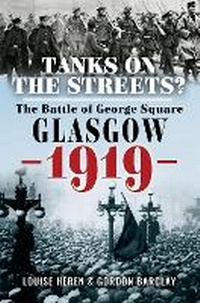
Tanks on the Streets?
The Battle of George Square, Glasgow, 1919
Published on 4. August 2023
Book
Hardback
232 pages
978-1-5267-8265-6 (ISBN)
Description
At 12.08pm on Friday 31 January 1919, Margaret Buchanan drives her tram into George Square in Glasgow's city centre. She slows down to avoid the youths and men holding their arms up to stop her; some even jump onto the front of her tram. Swirling around her tram is a sea of heavy-coated men who have been on strike since Monday, demanding a reduction to a forty-hour working week. Crucially, the tram workers have not joined the strike; they are being abused as 'scabs'. Constables and officers of Glasgow's police force use their hands to try to part the crowd to allow the tram to proceed, but their efforts fail and batons are drawn.
Within minutes, the violence will have spread across and beyond the Square; men will have been injured; the Sheriff will have read the Riot Act; strike leaders will lie stunned and bleeding inside the City Chambers; policemen and protestors will lie beaten in the streets.
The violence and destruction in the Square, the streets to the north and south, in Glasgow Green and even south of the River Clyde, involves thousands of men. The city authorities believe the situation is beyond the control of the outnumbered police; the Sheriff sends a message to the local army commander requesting assistance.
For the first time in history, tanks will be despatched as 'military aid to the civil power'. They will be accompanied by 10,000 soldiers. At approximately 12.30pm on Friday 31 January 1919, a century of myth-making commences. Using thousands of pages of court papers, memoirs and news reports, this book is the first attempt to tell the story of what happened in day-by-day detail.
Within minutes, the violence will have spread across and beyond the Square; men will have been injured; the Sheriff will have read the Riot Act; strike leaders will lie stunned and bleeding inside the City Chambers; policemen and protestors will lie beaten in the streets.
The violence and destruction in the Square, the streets to the north and south, in Glasgow Green and even south of the River Clyde, involves thousands of men. The city authorities believe the situation is beyond the control of the outnumbered police; the Sheriff sends a message to the local army commander requesting assistance.
For the first time in history, tanks will be despatched as 'military aid to the civil power'. They will be accompanied by 10,000 soldiers. At approximately 12.30pm on Friday 31 January 1919, a century of myth-making commences. Using thousands of pages of court papers, memoirs and news reports, this book is the first attempt to tell the story of what happened in day-by-day detail.
More details
Language
English
Place of publication
Barnsley
United Kingdom
Publishing group
Pen & Sword Books Ltd
Illustrations
30 black and white illustrations
Dimensions
Height: 165 mm
Width: 242 mm
Thickness: 28 mm
Weight
542 gr
ISBN-13
978-1-5267-8265-6 (9781526782656)
Copyright in bibliographic data and cover images is held by Nielsen Book Services Limited or by the publishers or by their respective licensors: all rights reserved.
Schweitzer Classification
Other editions
Additional editions
E-Book
04/2025
Pen & Sword History
€18.18
Available for download
Persons
LOUISE HEREN is a television documentary producer and writer, and history academic specializing in early twentieth-century Scottish social and crime history. She lives 'down south', which is too far for comfort from the archives and libraries that are her life-blood.
GORDON BARCLAY is an archaeologist and historian, working on the physical and archival remains of the defence of Scotland in the 19th and 20th centuries. He is particularly interested in the misuse of the past in support of Scottish and English nationalist politics.
GORDON BARCLAY is an archaeologist and historian, working on the physical and archival remains of the defence of Scotland in the 19th and 20th centuries. He is particularly interested in the misuse of the past in support of Scottish and English nationalist politics.