

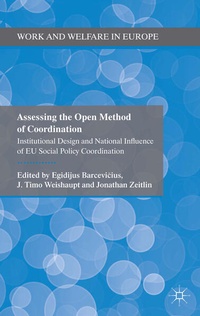
Assessing the Open Method of Coordination
Institutional Design and National Influence of EU Social Policy Coordination
Published on 26. March 2014
Book
Hardback
XVII, 286 pages
978-1-137-02261-5 (ISBN)
Description
Based on the findings of a large-scale, comparative research project, this volume systematically assesses the institutional design and national influence of the Open Method of Coordination in Social Inclusion and Social Protection (pensions and health/long-term care), at the European Union level and in ten EU Member States.
More details
Series
Edition
2014 edition
Language
English
Place of publication
London
United Kingdom
Target group
Professional and scholarly
Product notice
sewn/stitched
Cloth over boards
With dust jacket
Illustrations
XVII, 286 p.
Dimensions
Height: 218 mm
Width: 142 mm
Thickness: 23 mm
Weight
522 gr
ISBN-13
978-1-137-02261-5 (9781137022615)
DOI
10.1057/9781137022622
Schweitzer Classification
Other editions
Additional editions
E. Barcevicius | T. Weishaupt | J. Zeitlin
Assessing the Open Method of Coordination
Institutional Design and National Influence of EU Social Policy Coordination
E-Book
03/2014
1st Edition
Palgrave Macmillan
€53.49
Available for download
E. Barcevicius | T. Weishaupt | J. Zeitlin
Assessing the Open Method of Coordination
Institutional Design and National Influence of EU Social Policy Coordination
Book
01/2014
Palgrave Macmillan
€53.49
Shipment within 15-20 days
Persons
Vicki Donlevy, Policy and Research Division of Ecorys, UK
Caroline de la Porte, University of Southern Denmark
Helene Schönheinz, University of Salzburg, Austria
Bart Vanhercke, European Social Observatory, Belgium
Content
1. Institutional Design and National Influence of EU Social Policy Coordination: Advancing a Contradictory Debate 2. Tracing the Social OMC from its Origins To Europe 2020 3. Is the Social OMC Fit for Purpose? Adequacy and Institutional Design, 2006-2010 4. An OMC for all Policies: is Belgium (still) the Best Pupil in the Class? 5. The Social OMC in France: the Realm of the Happy Few? 6. The Social OMC in Germany: Slow but Steady? 7. The Social OMC in Denmark: European Ideas Meet Domestic Politics 8. The Social OMC in the UK: Beyond Cheap Talk? 9. The Social OMCs at Work: Identifying and Explaining Variations in National Use and Influence