

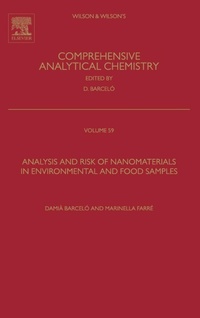
Analysis and Risk of Nanomaterials in Environmental and Food Samples: Volume 59
Published on 31. August 2012
Book
Hardback
415 pages
978-0-444-56328-6 (ISBN)
Description
The application of nanotechnology in different consumer products has delivered new products with highly desirable properties, but at same time has opened a new window for a wide group of emerging contaminants and a new type of human exposure which needs to be assessed.
Most of the current human toxicological information on nanomaterials comes from nano-sized particles in air, and their effects via inhalation. Other routes of human exposure, such as water and food, and the effects on human health and the environment have been less studied. It is the recent research in these areas that is highlighted here in one of the first books covering the analysis and ecotoxicological evaluation of nanomaterials in food and the environment, with both matrices being of considerable interest. In addition to providing a global summary of recent research, this book shows how widely used chromatographic and spectroscopic methods can be added to the analytical arsenal of microscopic techniques that have commonly been used to characterize nanomaterials.
Most of the current human toxicological information on nanomaterials comes from nano-sized particles in air, and their effects via inhalation. Other routes of human exposure, such as water and food, and the effects on human health and the environment have been less studied. It is the recent research in these areas that is highlighted here in one of the first books covering the analysis and ecotoxicological evaluation of nanomaterials in food and the environment, with both matrices being of considerable interest. In addition to providing a global summary of recent research, this book shows how widely used chromatographic and spectroscopic methods can be added to the analytical arsenal of microscopic techniques that have commonly been used to characterize nanomaterials.
Reviews / Votes
"Elsevier Science and Technology's new book presents the latest studies and ecotoxicological assessment of nanomaterials in food and the environment in detail. Besides summarizing the latest research , this book explains how commonly utilized spectroscopic and chromatographic techniques can complement microscopic methods commonly utilized for characterization of nanomaterials." --AZoNano.com, September 26, 2013"I highly recommend this book to everyone interested in the environmental and analytical aspects of NM and NP. It is a comprehensive and stimulating book rich in references to literature." --Analytical and Bioanalytical Chemistry, July 26, 2013
More details
Series
Language
English
Place of publication
Oxford
United Kingdom
Publishing group
Elsevier Science & Technology
Target group
Professional and scholarly
Analytical chemists, food scientists, environmental scientists, toxicologists
Product notice
Laminated cover
Dimensions
Height: 229 mm
Width: 152 mm
Thickness: 22 mm
Weight
677 gr
ISBN-13
978-0-444-56328-6 (9780444563286)
Copyright in bibliographic data and cover images is held by Nielsen Book Services Limited or by the publishers or by their respective licensors: all rights reserved.
Schweitzer Classification
Other editions
Additional editions
Damià Barceló | Marinella Farre
Analysis and Risk of Nanomaterials in Environmental and Food Samples
E-Book
08/2012
Elsevier
€197.00
Available for download
Persons
Prof. dr. Barcelo Damia, Director of the Catalan Institute for Water Research (ICRA) and Professor at the Institute of Environmental Assessment and Water Research (IDAEA), Barcelona, Spain. His expertise is in water quality assessment and management, fate, risk and removal of emerging contaminants in wastewater treatment plants and analysis, fate and risk of emerging contaminants and nanomaterials in the aquatic environment. He published over 900 papers, 200 book chapters and has h index 91. He was a coordinator of several national and EU projects and at the moment he coordinates two EU projects: GLOBAQUA , on multiple stressors in the aquatic environment and SEA-on-a-CHIP, on the development of sensor technolgies for emerging contamaints in marine aquaculture. He is CoEditor in Chief of the journal Science of Total Environment and the book series Comprehensive Analytical Chemistry, both form Elsevier.. Marinella Farre, CSIC - Instituto de Diagnostico Ambiental y Estudios del Agua (IDAEA), Barcelona, Spain. Dr Marinella Farre has a PhD in Chemistry from University of Barcelona (Dec.2003), and Research scientist, permanent staff at IDAEA-CSIC from (Jul. 2008). She has more than 150 scientific papers in journals of SCI (H-index of 49), 22 book chapters and she has co-Editor of a book. She has supervised 3 PhD Thesis and currently is the supervisor of 4 on-going more. She is involved in the study of the occurrence and impact of organic micropollutants in the environment by chromatography coupled to advanced mass spectrometry approaches as well as the development and applications of new biological tools such as biosensors. She was involved in 30 Research projects with national and EU funds. She was the coordinator of the EU Sea-on-a-Chip EU project and the national projects Integra-Coast and Nano-Transfer. Currently, she is involved in the projects NaToxAq (IP), Globaqua (participant), Nano-Transfer (IP) and Plas-Med (Coordinator).
Content
1. Introduction to the analysis and risk of nanomaterials in environmental and food samples, Marinella Farre and Damia Barcelo
2. Analysis of nanoparticles based on electrophoretic separations, A. I. Lopez-Lorente, B. M. Simonet, and Miguel Valcarcel
3. Biopolymer-based nanomaterials: Potential applications in bioremediation of contaminated
wastewaters and soils, Gurpreet Singh Dhillon, Surinder Kaur, Mausam Verma, and Satinder Kaur Brar
4. Analysis and fate of organic nanomaterials in environmental samples, Josep Sanchis, Marinella Farre, and Damia Barcelo
5. Characterization of engineered nanoparticles in natural waters, Anne Galyean, Howard S. Weinberg, R. David Holbrook and Michael Leopold
6. Chemical and ecotoxicological assessment of dendrimers in the aquatic environment, Maria M. Ulaszewska, M. Dolores Hernando, Ana Ucles, Roberto Rosal, Antonio Rodriguez, Eloy Garcia-Calvo and Amadeo R. Fernandez-Alba
7. Engineered nanoparticles in textiles and textile wastewaters, Iva Rezic
8. Inorganic nanoparticles and the environment: Balancing benefits and risks, Eudald Casals and Victor Puntes
9. Fullerenes in environmental samples: C60 in atmospheric particulate matter, Troy Benn, Pierre Herckes and Paul Westerhoff
10. Nanomaterials in food, which way forward? Yolanda Pico and Cristina Blasco
2. Analysis of nanoparticles based on electrophoretic separations, A. I. Lopez-Lorente, B. M. Simonet, and Miguel Valcarcel
3. Biopolymer-based nanomaterials: Potential applications in bioremediation of contaminated
wastewaters and soils, Gurpreet Singh Dhillon, Surinder Kaur, Mausam Verma, and Satinder Kaur Brar
4. Analysis and fate of organic nanomaterials in environmental samples, Josep Sanchis, Marinella Farre, and Damia Barcelo
5. Characterization of engineered nanoparticles in natural waters, Anne Galyean, Howard S. Weinberg, R. David Holbrook and Michael Leopold
6. Chemical and ecotoxicological assessment of dendrimers in the aquatic environment, Maria M. Ulaszewska, M. Dolores Hernando, Ana Ucles, Roberto Rosal, Antonio Rodriguez, Eloy Garcia-Calvo and Amadeo R. Fernandez-Alba
7. Engineered nanoparticles in textiles and textile wastewaters, Iva Rezic
8. Inorganic nanoparticles and the environment: Balancing benefits and risks, Eudald Casals and Victor Puntes
9. Fullerenes in environmental samples: C60 in atmospheric particulate matter, Troy Benn, Pierre Herckes and Paul Westerhoff
10. Nanomaterials in food, which way forward? Yolanda Pico and Cristina Blasco