

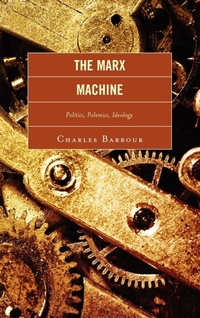
The Marx Machine
Politics, Polemics, Ideology
Published on 21. June 2012
Book
Hardback
158 pages
978-0-7391-1046-1 (ISBN)
Description
Karl Marx has rarely, if ever, been treated as a writer. Charles Barbour argues not only that we can examine the literary and rhetorical aspects of Marx's texts, but also that, as soon as we begin to do so, those texts begin to take on new and entirely unexpected political implications. In the past, Marx scholars have characterized his literary remains as either a relatively coherent body of work, or a structure cut in half by a single, all-important "epistemological break." Neither metaphor really captures the incredible proliferation of documents that we retroactively label Karl Marx. Barbour proposes that we characterize them, instead, as a machine, or an assemblage of fragments and components that can be put together and taken apart in any number of different ways for any number of different purposes.
Focusing primarily on Marx's early polemical writings, and especially the debates with Bruno Bauer and Max Stirner that make up most of the voluminous manuscript now called "The German Ideology," The Marx Machine endeavors to show how some of Marx's most consistently denigrated and ignored works can in fact be approached as responses to Marx's contemporary critics.
Focusing primarily on Marx's early polemical writings, and especially the debates with Bruno Bauer and Max Stirner that make up most of the voluminous manuscript now called "The German Ideology," The Marx Machine endeavors to show how some of Marx's most consistently denigrated and ignored works can in fact be approached as responses to Marx's contemporary critics.
Reviews / Votes
The triumph of neoliberalism and the end of the Cold War have virtually obliterated Marx's legacy - outside doctrinaire circles. Going beyond both structuralist and deconstructive readings, Barbour's book presents 'another Marx' whose texts reveal multiple plateaus of meaning (held together by a commitment to equality). What becomes evident in the study is that exorcising legacies exacts a steep price on critical thought. -- Fred Dallmayr, University of Notre Dame In this extraordinary study Babour shows that he is Marx's star reader, finding subtleties in neglected minor works as well as in major ones supposedly well known. Deploying an impressive philosophical apparatus-Althusser to Ranciere-Babour's work creates a stimulating and lively intertextuality that liberates Marx from his best friends and worst enemies. -- Terrell Carver, University of Bristol Barbour (Univ. of Western Sydney, Australia) adopts what he calls a deliberately averted gaze when analyzing Marx and the tension between theory and practice. Given the volume of work produced on Marx, and the volume of his works still left underanalyzed, the book's conceit is that the construct of "Marx" represents "components or parts [that] can be attached to or assembled with other texts, or other components and parts both inside and outside of the Marxist tradition or traditions." The book intends to reconstruct a version of Marxism that is conscious of its mechanistic conception of Marx through a system of meanings launched from "a thousand plateaus," which must be deciphered by recognizing that the "literary form of Marx's work is as significant as is its supposedly scientific content." Toward this end, the first two chapters cohere much more clearly than the latter two. Although each of the latter have their independent merits, the whole project, perhaps intentionally, lacks a precisely consistent overall arc. Since the author seeks to show the import and revealing character of the discontinuities in Marx's work in order to undermine the simple, mechanistic readings, this might be intentional. Summing Up: Recommended. Upper-division undergraduate, graduate, and research collections. * Choice Reviews *More details
Language
English
Place of publication
United States
Publishing group
Bloomsbury Publishing Plc
Target group
Professional and scholarly
Dimensions
Height: 235 mm
Width: 157 mm
Thickness: 13 mm
Weight
392 gr
ISBN-13
978-0-7391-1046-1 (9780739110461)
Copyright in bibliographic data and cover images is held by Nielsen Book Services Limited or by the publishers or by their respective licensors: all rights reserved.
Schweitzer Classification
Other editions
Additional editions
E-Book
06/2012
1st Edition
Lexington Books
€94.99
Available for download
E-Book
06/2012
1st Edition
Lexington Books
€94.99
Available for download
Person
Charles Barbour is lecturer in the School of Humanities and Communications at the University of Western Sydney.
Content
Introduction: Another Marx
Chapter 1: Of Multiple Breaks: Marx in Res Publica
Chapter 2: Copying Machines: Reading "The Leipzig Council"
Chapter 3: The Fractured Essence: On Historical Materialism
Chapter 4: Allegories of Writing: Marx and Literature
Conclusion: Marx and Us
Chapter 1: Of Multiple Breaks: Marx in Res Publica
Chapter 2: Copying Machines: Reading "The Leipzig Council"
Chapter 3: The Fractured Essence: On Historical Materialism
Chapter 4: Allegories of Writing: Marx and Literature
Conclusion: Marx and Us