

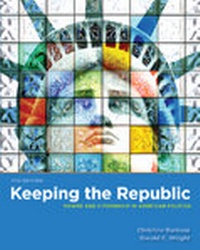
Keeping the Republic, 4th edition + CQ Press's Guide to the 2010 Midterm Elections Supplement package
1st Edition
Published on 15. July 2010
Book
978-1-60871-651-7 (ISBN)
Description
Keeping the Republic now with a free supplement analyzing the midterm elections!
Midterm Elections Supplement
Coming in July, this valuable supplement will provide an insider's guide to the 2010 midterm elections. When placing your order, be sure to use the ISBN on this page to ensure that your students receive the supplement packaged FREE with their textbook.
Keeping the Republic, 4th Edition
The 2008 election will go down in the history books for a number of reasons, including the first African American at the top of a national party ticket, the longest nomination fight in recent memory, and a viable female candidate for president for the first time ever, but one of its most striking hallmarks is the early and enthusiastic involvement of young voters. While the passion they bring is encouraging, the key to their lasting impact will be the extent to which they really understand the functioning of the American political system, leading to a deeper and more abiding engagement.
By using the themes of power and citizenship, Barbour and Wright encourage students to analyze "who gets what and how" and evaluate how well the political system is working. In order to "keep the republic," students need to shoulder responsibilities as well as exercise their rights. In order to see where politics intersects their own roles as citizens, they need to absorb the ideas and theories that animate the study of political science and think critically about them. And in order to keep students reading, the prose needs to be clear, friendly, and relevant.
The key to this new fourth edition is thorough updating- including the 2008 elections-and the integration of subtle enhancements every class-tested, well-reviewed, and well developed book should offer. In addition to examining recent events and scholarship, more than half the photos are new, the figures and tables reflect current data, and new vignettes open a majority of chapters.
The themes of power and citizenship are touched on in every chapter, with each pedagogical feature extending the analytic and evaluative work of the text:
* Who, What, How, and WHEN. These stunning visual and rich textual timelines track change and show the impact of key issues in American political history, such as immigration, third parties, whistleblowers, and developments in the media and in federal-state relations.
* What's at Stake? Chapter-opening vignettes vividly show what people are struggling to get from politics and how the rules affect who gets it. Acting as a bookend to the chapter, What's at Stake Revisited reexamines the story to further evaluate who wins and who loses.
* Profiles in Citizenship. Based on personal interviews, profiles of such luminaries as Bill Richardson, Condoleezza Rice, Sandra Day O'Connor, and Bill Maher provide powerful examples of how students might also affect change in the political process.
* Consider the Source. With the aim of modeling critical thinking skills, these boxes do more than tell students to analyze political information; rather, the authors show them how to do it-a crucial step in getting students to think like political scientists.
* Who Are We? A wealth of figures and charts showcase important demographic data and reinforce the idea that politics is a complex endeavor among diverse groups with often divergent ideas of government's role in individual lives.
* Who, What, How. Concise section summaries help orient students and reinforce analytic themes.
* The Citizens and... A designated chapter section that helps students evaluate the quality of democratic governance in America.
* Thinking outside the Box. Pointed questions get students to challenge their assumptions about American politics.
CUSTOMIZED VERSIONS AVAILABLE!
CQ Press is now offering customized versions of Keeping the Republic. E-mail collegesales@cqpress.com to learn more about this exciting new option.
Midterm Elections Supplement
Coming in July, this valuable supplement will provide an insider's guide to the 2010 midterm elections. When placing your order, be sure to use the ISBN on this page to ensure that your students receive the supplement packaged FREE with their textbook.
Keeping the Republic, 4th Edition
The 2008 election will go down in the history books for a number of reasons, including the first African American at the top of a national party ticket, the longest nomination fight in recent memory, and a viable female candidate for president for the first time ever, but one of its most striking hallmarks is the early and enthusiastic involvement of young voters. While the passion they bring is encouraging, the key to their lasting impact will be the extent to which they really understand the functioning of the American political system, leading to a deeper and more abiding engagement.
By using the themes of power and citizenship, Barbour and Wright encourage students to analyze "who gets what and how" and evaluate how well the political system is working. In order to "keep the republic," students need to shoulder responsibilities as well as exercise their rights. In order to see where politics intersects their own roles as citizens, they need to absorb the ideas and theories that animate the study of political science and think critically about them. And in order to keep students reading, the prose needs to be clear, friendly, and relevant.
The key to this new fourth edition is thorough updating- including the 2008 elections-and the integration of subtle enhancements every class-tested, well-reviewed, and well developed book should offer. In addition to examining recent events and scholarship, more than half the photos are new, the figures and tables reflect current data, and new vignettes open a majority of chapters.
The themes of power and citizenship are touched on in every chapter, with each pedagogical feature extending the analytic and evaluative work of the text:
* Who, What, How, and WHEN. These stunning visual and rich textual timelines track change and show the impact of key issues in American political history, such as immigration, third parties, whistleblowers, and developments in the media and in federal-state relations.
* What's at Stake? Chapter-opening vignettes vividly show what people are struggling to get from politics and how the rules affect who gets it. Acting as a bookend to the chapter, What's at Stake Revisited reexamines the story to further evaluate who wins and who loses.
* Profiles in Citizenship. Based on personal interviews, profiles of such luminaries as Bill Richardson, Condoleezza Rice, Sandra Day O'Connor, and Bill Maher provide powerful examples of how students might also affect change in the political process.
* Consider the Source. With the aim of modeling critical thinking skills, these boxes do more than tell students to analyze political information; rather, the authors show them how to do it-a crucial step in getting students to think like political scientists.
* Who Are We? A wealth of figures and charts showcase important demographic data and reinforce the idea that politics is a complex endeavor among diverse groups with often divergent ideas of government's role in individual lives.
* Who, What, How. Concise section summaries help orient students and reinforce analytic themes.
* The Citizens and... A designated chapter section that helps students evaluate the quality of democratic governance in America.
* Thinking outside the Box. Pointed questions get students to challenge their assumptions about American politics.
CUSTOMIZED VERSIONS AVAILABLE!
CQ Press is now offering customized versions of Keeping the Republic. E-mail collegesales@cqpress.com to learn more about this exciting new option.
More details
Language
English
Place of publication
Washington
United States
Publishing group
SAGE Publications Inc
Weight
1356 gr
ISBN-13
978-1-60871-651-7 (9781608716517)
Copyright in bibliographic data and cover images is held by Nielsen Book Services Limited or by the publishers or by their respective licensors: all rights reserved.
Schweitzer Classification
Persons
Christine Barbour teaches in the Political Science Department at Indiana University, and directs the department's IU POLS DC internship program. She is a faculty liaison for the University's dual-credit program, which delivers an online version of her Intro to American Politics class to high school students across the state. At Indiana, Professor Barbour has been a Lilly Fellow, working on a project to increase student retention in large introductory courses, and a member of the Freshman Learning Project, a university-wide effort to improve the first-year undergraduate experience. She has served on the New York Times College Advisory Board, working with other educators to develop ways to integrate newspaper reading into the undergraduate curriculum. She has won multiple teaching honors, but the two awarded by her students mean the most to her: the Indiana University Student Alumni Association Award for Outstanding Faculty and the Indiana University Chapter of the Society of Professional Journalists Brown Derby Award. When not teaching or writing textbooks, Professor Barbour enjoys traveling with her coauthor, blogging about food and travel, and playing with her dogs and cat. She contributes to Bloom Magazine of Bloomington and is a coauthor several cookbooks. She also makes jewelry from precious metals and rough gemstones. If she ever retires, she will open a jewelry shop in a renovated Airstream on the beach in Apalachicola, Florida, where she plans to write another cookbook and a book about the local politics, development, and fishing industry.
Gerald C. Wright taught political science at Indiana University from 1981 until his recent retirement. An accomplished scholar of American politics, and the 2010 winner of the State Politics and Policy Association's Career Achievement Award, his work includes Statehouse Democracy: Public Opinion and Policy in the American States (1993), coauthored with Robert S. Erikson and John P. McIver, and more than fifty articles on elections, public opinion, and state politics. Professor Wright's research interests focus on representation - the fundamental relationship among citizens, their preferences, and public policy. He writes primarily about state politics, representation, political parties, and inequality.
He is currently working on a book about parties and representation in U.S. legislatures. He has been a consultant for Project Vote Smart for a number of years and was a founding member of Indiana University's Freshman Learning Project. In retirement, Professor Wright grows vegetables, golfs, fishes, travels, and plays with his dogs and cat. He is an awesome cook.
Greg Giroux was previously a senior writer with CQ-Roll Call Group, specializing in politics and elections. He has been a major contributor to the past six editions of CQ's Politics in America, the almanac that profiles all members of Congress and their constituencies. Giroux joined CQ in 1996 and served as editorial assistant and researcher at the CQ Weekly magazine prior to joining the political reporting staff in 1998. Giroux is a graduate of The College of William and Mary in Williamsburg, Va.
Gerald C. Wright taught political science at Indiana University from 1981 until his recent retirement. An accomplished scholar of American politics, and the 2010 winner of the State Politics and Policy Association's Career Achievement Award, his work includes Statehouse Democracy: Public Opinion and Policy in the American States (1993), coauthored with Robert S. Erikson and John P. McIver, and more than fifty articles on elections, public opinion, and state politics. Professor Wright's research interests focus on representation - the fundamental relationship among citizens, their preferences, and public policy. He writes primarily about state politics, representation, political parties, and inequality.
He is currently working on a book about parties and representation in U.S. legislatures. He has been a consultant for Project Vote Smart for a number of years and was a founding member of Indiana University's Freshman Learning Project. In retirement, Professor Wright grows vegetables, golfs, fishes, travels, and plays with his dogs and cat. He is an awesome cook.
Greg Giroux was previously a senior writer with CQ-Roll Call Group, specializing in politics and elections. He has been a major contributor to the past six editions of CQ's Politics in America, the almanac that profiles all members of Congress and their constituencies. Giroux joined CQ in 1996 and served as editorial assistant and researcher at the CQ Weekly magazine prior to joining the political reporting staff in 1998. Giroux is a graduate of The College of William and Mary in Williamsburg, Va.