

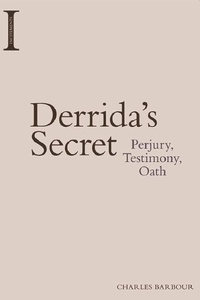
Derrida's Secret
Perjury, Testimony, Oath
Published on 17. May 2017
Book
Paperback/Softback
304 pages
978-1-4744-2500-1 (ISBN)
Description
A new philosophical reflection on the secret and its importance to our contemporary political experience
The Snowden Affair, Wikileaks, the 'lone wolf' terrorist, Clinton's private email account - the secret is arguably the central element of our contemporary political experience. Now, Charles Barbour looks at the basic ontological question 'what is a secret?'
Organised as a reflection on Jacques Derrida's later writings on secrecy, four chapters each look at a separate problematic: society and the oath, literature and testimony, philosophy and deception, and time and death.
Barbour shows that secrecy is not a negation of our relations with others, but a necessary condition of those relations. We can only reveal ourselves to one another (and, indeed, to anything other) insofar as we conceal as well.
Key Features
Provides a new philosophical reflection on the question of the secret, and its importance to contemporary political experience
Develops a unique reading of the later work of the philosopher Jacques Derrida, and of his largely overlooked discussions of the secret in his later writings and seminars
Initiates a new method of approaching Derrida's work - one that rejects obscurity and reveals the lucidity of his thought
Compares Derrida's work with that of the German sociologist Georg Simmel, and thus argues for the significance of Derrida's work for sociology
Connects Derrida's work to a series of philosophical debates in the Analytic tradition, such as the problems of consciousness, self-deception, and other minds
Compares Derrida's work on the secret with a series of other important political thinkers, including Deleuze, Schmitt, Arendt, Bataille and Agamben.
Keywords: Secrecy, Law, Oath, Testimony, Jacques Derrida, Georg Simmel
Subject: philosophy
The Snowden Affair, Wikileaks, the 'lone wolf' terrorist, Clinton's private email account - the secret is arguably the central element of our contemporary political experience. Now, Charles Barbour looks at the basic ontological question 'what is a secret?'
Organised as a reflection on Jacques Derrida's later writings on secrecy, four chapters each look at a separate problematic: society and the oath, literature and testimony, philosophy and deception, and time and death.
Barbour shows that secrecy is not a negation of our relations with others, but a necessary condition of those relations. We can only reveal ourselves to one another (and, indeed, to anything other) insofar as we conceal as well.
Key Features
Provides a new philosophical reflection on the question of the secret, and its importance to contemporary political experience
Develops a unique reading of the later work of the philosopher Jacques Derrida, and of his largely overlooked discussions of the secret in his later writings and seminars
Initiates a new method of approaching Derrida's work - one that rejects obscurity and reveals the lucidity of his thought
Compares Derrida's work with that of the German sociologist Georg Simmel, and thus argues for the significance of Derrida's work for sociology
Connects Derrida's work to a series of philosophical debates in the Analytic tradition, such as the problems of consciousness, self-deception, and other minds
Compares Derrida's work on the secret with a series of other important political thinkers, including Deleuze, Schmitt, Arendt, Bataille and Agamben.
Keywords: Secrecy, Law, Oath, Testimony, Jacques Derrida, Georg Simmel
Subject: philosophy
Reviews / Votes
Derrida's Secret is a tour de force, extraordinarily clear, interesting and lucid. -- David Wills, Brown University Derrida's Secret is a major and critical innovation. It shows how Derrida's concerns are both explicitly political as well as how they are central and vital for thinking about agency, subjectivity and the relationship to truth. What emerges in this reading is a Derrida who is concerned with the everyday, with the ordinary and with the very human dilemmas about truth and life and death. -- James Martel, San Francisco State UniversityMore details
Series
Language
English
Place of publication
Edinburgh
United Kingdom
Target group
College/higher education
Product notice
Paperback (trade)
Unsewn / adhesive bound
Illustrations
1 black and white illustration
Dimensions
Height: 190 mm
Width: 134 mm
Thickness: 25 mm
Weight
338 gr
ISBN-13
978-1-4744-2500-1 (9781474425001)
Copyright in bibliographic data and cover images is held by Nielsen Book Services Limited or by the publishers or by their respective licensors: all rights reserved.
Schweitzer Classification
Person
Charles Barbour is Senior Lecturer in Philosophy at Western Sydney University. He is the author of The Marx Machine: Politics, Polemics, Ideology (Lexington Books, 2012). He is co-editor of Action and Appearance: Ethics and the Politics of Writing in Hannah Arendt (Continuum, 2011) and After Sovereignty (Routledge, 2009). He has written numerous book chapters and journal articles on social and political theory, with a special emphasis on Karl Marx.
Content
AcknowledgmentsList of AbbreviationsIntroduction: Cauernosis Anfractibus
Under Oath: Secrecy, Perjury, and the Social Bond
Open Secrets: Literature, Politics, and Testimonial Truth
Between Two Solitudes: Self-Deception, Consciousness, and the Other Mind
Being Alone: Death, Solitude, and the End of the World
Conclusion: SecretionsBibliographyIndex
Under Oath: Secrecy, Perjury, and the Social Bond
Open Secrets: Literature, Politics, and Testimonial Truth
Between Two Solitudes: Self-Deception, Consciousness, and the Other Mind
Being Alone: Death, Solitude, and the End of the World
Conclusion: SecretionsBibliographyIndex