

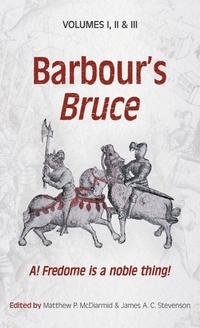
Barbour's Bruce
A! Fredome is a noble thing!
Published on 28. March 2023
Book
Hardback
762 pages
978-1-897976-49-4 (ISBN)
Description
Barbour's Bruce (c. 1375) is the oldest substantial piece of literature in Older Scots. It narrates in four-stress couplets the feats of Robert Bruce and his supporters, most notably James Douglas and Thomas Randolph. Their heroic activities, including battles against odds and clever out-manoeuvrings as well as open warfare, provide opportunities for discussion of good leadership, the celebration of freedom, and a construction of Scottishness alongside a narrative with enough verifiable historical detail to make it compelling and convincing. Barbour's narrative implicitly locates Bruce and Douglas against European traditions of the Nine Worthies, particularly Alexander, and shows a sophisticated sense of structure in the central placing of Bannockburn and Bruce's speech on freedom.
This edition by McDiarmid and Stevenson, out of print for several years, is now reissued by the Scottish Text Society. In addition to the text, it provides a full introduction, notes and a glossary.
This edition by McDiarmid and Stevenson, out of print for several years, is now reissued by the Scottish Text Society. In addition to the text, it provides a full introduction, notes and a glossary.
More details
Language
English
Place of publication
Edinburgh
United Kingdom
Target group
Professional and scholarly
Product notice
Cloth over boards
Dimensions
Height: 222 mm
Width: 145 mm
Thickness: 44 mm
Weight
1073 gr
ISBN-13
978-1-897976-49-4 (9781897976494)
Copyright in bibliographic data and cover images is held by Nielsen Book Services Limited or by the publishers or by their respective licensors: all rights reserved.
Schweitzer Classification
Other editions
Additional editions
John Barbour | Matthew P. McDiarmid | James A. C. Stevenson
Barbour's Bruce
A! Fredome is a noble thing!
E-Book
03/2023
1st Edition
De Gruyter
€96.99
Available for download
Persons
John Barbour (c. 1330-1395) concluded his career as archdeacon of Aberdeen. He was associated with the royal Stewart affinity, and his works seek to establish both Bruce and Stewart rights to the throne. The Bruce is the earliest surviving text in Scots: it narrates the feats of Robert Bruce and James Douglas during the First War of Independence. Matthew McDiarmid (25 June 1914-12 February 1996) was a Scottish literary scholar, essayist, campaigning academic and poet.
McDiarmid was one of the leading members of a pioneering generation of Scottish academics who laboured and campaigned for a proper place for Scotland's literature in Scottish universities. At the opening of his career, no Scottish university had a dedicated professor of Scottish literature; by the time of his death, there were six. J.A.C. Stevenson was a leading scholar and philologist of his generation, and his edition of the Bruce is still standard.
McDiarmid was one of the leading members of a pioneering generation of Scottish academics who laboured and campaigned for a proper place for Scotland's literature in Scottish universities. At the opening of his career, no Scottish university had a dedicated professor of Scottish literature; by the time of his death, there were six. J.A.C. Stevenson was a leading scholar and philologist of his generation, and his edition of the Bruce is still standard.
Content
Volume I
General Introduction
Synopsis of the Narrative
Textual Notes
Commentary
Appendix I: Lines from Wyntoun's Cronykil
Appendix II: The 'Edinburgh' Rubrics
Appendix III: Conversion Factors
Glossary
Persons and Places in the text
Volume II
Textual and Editorial Introduction
Book I
Book II
Book III
Book IV
Book V
Book VI
Book VII
Book VIII
Book IX
Book X
Volume III
Book XI
Book XII
Book XIII
Book XIV
Book XV
Book XVI
Book XVII
Book XVIII
Book XIX
Book XX
General Introduction
Synopsis of the Narrative
Textual Notes
Commentary
Appendix I: Lines from Wyntoun's Cronykil
Appendix II: The 'Edinburgh' Rubrics
Appendix III: Conversion Factors
Glossary
Persons and Places in the text
Volume II
Textual and Editorial Introduction
Book I
Book II
Book III
Book IV
Book V
Book VI
Book VII
Book VIII
Book IX
Book X
Volume III
Book XI
Book XII
Book XIII
Book XIV
Book XV
Book XVI
Book XVII
Book XVIII
Book XIX
Book XX