

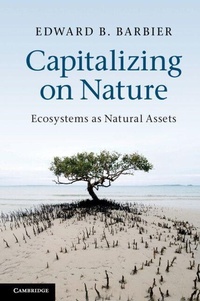
Capitalizing on Nature
Ecosystems as Natural Assets
1st Edition
Published on 8. September 2011
Book
Paperback/Softback
336 pages
978-0-521-18927-9 (ISBN)
Description
The basic unit of nature - the ecosystem - is a special form of wealth, which we can think of as a stock of natural capital. However, perhaps because this capital is free, we have tended to view it as limitless, abundant and always available for our use, exploitation and conversion. Capitalizing on Nature shows how modeling ecosystems as natural capital can help us to analyze the economic behavior that has led to the overuse of so much ecological wealth. It explains how this concept of ecosystem as natural capital sheds light on a number of important issues, including landscape conversion, ecological restoration, ecosystem resilience and collapse, spatial benefits and payments for ecosystem services. The book concludes by focusing on major policy challenges that need to be overcome in order to avert the worsening problem of ecological scarcity and how we can fund novel financing mechanisms for global conservation.
Reviews / Votes
'Spiced with a rich melange of historical perspective and insightful empirical illustration, Barbier sets out the key issues necessary to address the challenge of the unfolding 'Age of Ecological Scarcity'. This volume will draw readers from multiple fields including economics, ecology and environmental sciences.' Ian Bateman, Professor of Environmental Sciences, CSERGE, University of East Anglia 'This important book, by a leader in natural resource economics, is essential reading for anyone interested in knowing what 'sustainable development' really means.' Professor Sir Peter Crane, Carl W. Knobloch, Jr Dean, Yale University 'A landmark contribution to the development of the theory of natural capital, this book combines broad scholarship and novel research to address the central challenge in environmental economics.' Simon Levin, George M. Moffett Professor of Biology, Princeton University 'Barbier's latest book is the clearest exposition yet of ecological scarcity as an economic problem and of ecosystems as valuable natural assets. 'Natural Capital' as a concept has come of age, and as one of its key proponents, Barbier does justice both to its pedagogical complexity and to its significance for our common future.' Pavan Sukhdev, McCluskey Fellow 2011, Yale University, and Study Leader TEEBMore details
Language
English
Place of publication
Cambridge
United Kingdom
Target group
Professional and scholarly
Product notice
Paperback (trade)
Illustrations
49 s/w Abbildungen, 13 Tabellen
13 Tables, black and white; 49 Line drawings, unspecified
Dimensions
Height: 229 mm
Width: 152 mm
Thickness: 19 mm
Weight
488 gr
ISBN-13
978-0-521-18927-9 (9780521189279)
Copyright in bibliographic data and cover images is held by Nielsen Book Services Limited or by the publishers or by their respective licensors: all rights reserved.
Schweitzer Classification
Other editions
Additional editions
E-Book
11/2011
1st Edition
Cambridge University Press
€20.49
Available for download
Book
09/2011
Cambridge University Press
€93.80
Shipment within 15-20 days
Person
Edward B. Barbier is the John S. Bugas Professor of Economics in the Department of Economics and Finance, University of Wyoming. He has over twenty-five years' experience as an environmental and resource economist, working mainly on the economics of environment and development issues. He is the author of many books on environmental policy, including Natural Resources and Economic Development (2005), A Global Green New Deal (2010) and Scarcity and Frontiers: How Economies Have Developed Through Natural Resource Exploitation (2010), all published by Cambridge University Press.
Content
List of figures; List of tables; List of boxes; Preface; Acknowledgements; 1. Ecological scarcity as an economic problem; 2. Ecosystem services and ecological landscapes; 3. The basic natural asset model; 4. Spatial variation in ecosystems; 5. The open economy; 6. Ecological collapse; 7. The way ahead; 8. Policies in the age of ecological scarcity; Index.