

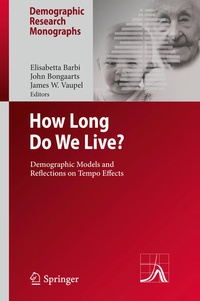
How Long Do We Live?
Demographic Models and Reflections on Tempo Effects
Published on 30. November 2010
Book
Paperback/Softback
XIV, 284 pages
978-3-642-09727-0 (ISBN)
Description
How should life expectancy be calculated? More generally, how should life - bles be estimated? Since John Graunt's pioneering contribution, read before theRoyalSocietyofLondonat6p. m. onthe27thofFebruary1661,demog- phers have developed better and better methods. Some concerns were raised, including concerns about how to deal with heterogeneous populations p- lished in an article inDemography in 1979 that I wrote with Kenneth Manton and Eric Stallard. Yet, a few years ago nearly all demographers believed that as long as the underlying population and death counts were accurate, then lifetables could be reliably estimated. John Bongaarts and Gri? Feeney launched a revolutionary assault on this dogma. Two key contributions by them are reprinted in Part I of this mo- graph. Some very good demographers agreed, as least in part, with B- gaarts' and Feeney's radical argument that when death rates are changing, then tempo e?ects distort conventional calculations of life expectancy. Other very good demographers disagreed.
So John Bongaarts and I brought some leading demographers together in a research meeting, co-sponsored by the Max Planck Institute for Demographic Research and the Population Co- cil and held in New York City on November 18 and 19, 2004. Many of the papers discussed at the workshop, generally after considerable revision, were published in Demographic Research in 2005 and 2006. Nine of these articles, in some cases somewhat revised, are published in this monograph: they are the ?rst seven chapters in Part II and the two chapters in Part III.
So John Bongaarts and I brought some leading demographers together in a research meeting, co-sponsored by the Max Planck Institute for Demographic Research and the Population Co- cil and held in New York City on November 18 and 19, 2004. Many of the papers discussed at the workshop, generally after considerable revision, were published in Demographic Research in 2005 and 2006. Nine of these articles, in some cases somewhat revised, are published in this monograph: they are the ?rst seven chapters in Part II and the two chapters in Part III.
More details
Series
Edition
Softcover reprint of hardcover 1st ed. 2008
Language
English
Place of publication
Berlin
Germany
Publishing group
Springer Berlin
Target group
Professional and scholarly
Research
Illustrations
58 s/w Abbildungen
XIV, 284 p. 58 illus.
Dimensions
Height: 235 mm
Width: 155 mm
Thickness: 17 mm
Weight
458 gr
ISBN-13
978-3-642-09727-0 (9783642097270)
DOI
10.1007/978-3-540-78520-0
Schweitzer Classification
Other editions
Additional editions

Elisabetta Barbi | John Bongaarts | James W. Vaupel
How Long Do We Live?
Demographic Models and Reflections on Tempo Effects
Book
04/2008
Springer
€106.99
Shipment within 10-15 days
Content
How long do we live? Demographic models and reflections on tempo effects: An introduction.- How long do we live? Demographic models and reflections on tempo effects: An introduction.- Theoretical basis for the mortality tempo effect.- Estimating mean lifetime.- The quantum and tempo of life-cycle events.- Critiques, extensions and applications of the mortality tempo effect.- Demographic translation and tempo effects: An accelerated failure time perspective.- Lifesaving, lifetimes and lifetables.- Tempo and its tribulations.- Tempo effects in mortality: An appraisal.- Increments to life and mortality tempo.- Mortality tempo versus removal of causes of mortality: Opposite views leading to different estimations of life expectancy.- Tempo effect on age-specific death rates.- Mortality tempo-adjustment: Theoretical considerations and an empirical application.- Comparison of period and cohort measures of longevity.- Five period measures of longevity.- Found in translation? A cohort perspective on tempo-adjusted life expectancy.- Conclusions.- Afterthoughts on the mortality tempo effect.- Turbulence in lifetables: Demonstration by four simple examples.