

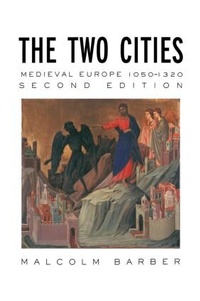
The Two Cities
Medieval Europe 1050-1320
2nd Edition
Published on 8. April 2004
Book
Hardback
560 pages
978-0-415-17414-5 (ISBN)
Description
First published to wide critical acclaim in 1992, The Two Cities has become an essential text for students of medieval history. For the second edition, the author has thoroughly revised each chapter, bringing the material up to date and taking the historiography of the past decade into account.
The Two Cities covers a colourful period from the schism between the eastern and western churches to the death of Dante. It encompasses key topics such as:
the Crusades
the expansionist force of the Normans
major developments in the way kings, emperors and Popes exercised their powers
a great flourishing of art and architecture
the foundation of the very first universities.
Running through it all is the defining characteristic of the high Middle Ages: the delicate relationship between the spiritual and secular worlds, the two 'cities' of the title.
This survey provides all the facts and background information that students need, and is defined into straightforward thematic chapters. It makes extensive use of primary sources, and makes new trends in research accessible to students. Its fresh approach gives students the most rounded, lively and integrated view of the high Middle Ages available.
The Two Cities covers a colourful period from the schism between the eastern and western churches to the death of Dante. It encompasses key topics such as:
the Crusades
the expansionist force of the Normans
major developments in the way kings, emperors and Popes exercised their powers
a great flourishing of art and architecture
the foundation of the very first universities.
Running through it all is the defining characteristic of the high Middle Ages: the delicate relationship between the spiritual and secular worlds, the two 'cities' of the title.
This survey provides all the facts and background information that students need, and is defined into straightforward thematic chapters. It makes extensive use of primary sources, and makes new trends in research accessible to students. Its fresh approach gives students the most rounded, lively and integrated view of the high Middle Ages available.
Reviews / Votes
'Meets every conceivable need and effectively renders redundant all earlier textbooks on the high Middle Ages ... in short, the book is excellent in every respect.' - History TodayMore details
Edition
2nd edition
Language
English
Place of publication
London
United Kingdom
Publishing group
Taylor & Francis Ltd
Target group
College/higher education
General
Illustrations
27 s/w Photographien bzw. Rasterbilder, 15 s/w Zeichnungen, 19 s/w Tabellen
19 Tables, black and white; 15 Line drawings, black and white; 27 Halftones, black and white
Dimensions
Height: 246 mm
Width: 174 mm
Weight
1200 gr
ISBN-13
978-0-415-17414-5 (9780415174145)
Copyright in bibliographic data and cover images is held by Nielsen Book Services Limited or by the publishers or by their respective licensors: all rights reserved.
Schweitzer Classification
Other editions
New editions
Book
approx. 03/2026
3rd Edition
Routledge
€260.30
Not yet published
Additional editions
Book
04/2004
2nd Edition
Routledge
€75.60
Shipment within 15-20 days
Previous edition

Book
11/1991
Routledge
€106.66
Article exhausted; check for reprint
Person
Malcolm Barber is Professor of Medieval History at the University of Reading. His many books include The Templars, The Cathars and The New Knighthood, A History of the Order of the Temple.
Content
Part 1: The Social and Economic Structure 1. The Physical Environment 2. Social Structure 3. Economic Development Part 2: The Papacy 4. The Papacy 5. The Crusades 6. Monasticism and the Friars 7. Popular Religion and Heresy Part 3: Political Change 8. The Empire 9. The Kingdom of Sicily 10. The Italian City-States 11. The Capetian Monarchy 12. The Kingdom of England 13. The Iberian Kingdoms 14. The States of Eastern and Northern Europe 15. The Crusader States Part 4: Perceptions of the World 16. The Medieval World View 17. Intellectual Life 18. Art and Society 19. Western Christendom and the Wider World