

Eccentric Renaissance
El Greco, Michael Damaskenos, Georgios Klontzas
Will be published approx. on 19. December 2024
Book
Hardback
336 pages
978-0-19-020900-1 (ISBN)
Description
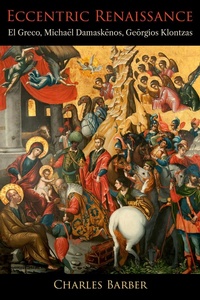
The Byzantine icon has long remained marginal to the study of art's history, only emerging from Giorgio Vasari's condemnation of the gilded, unnatural style of Byzantine painting (maniera greca) when his theories were challenged in the early twentieth century. Eccentric Renaissance focuses on an earlier reaction to Vasari's narrative and discusses three artists who shaped distinct responses to the hegemonic sway of sixteenth-century Italian art. Domenikos Theotokopoulos (more familiarly known as El Greco), Michael Damaskenos, and Georgios Klontzas were contemporary icon painters on the Venetian colony of Crete. Trained in the rich tradition of Cretan painting, these artists differed from their forebears in asserting a self-conscious creativity in their work. They renewed the art of icon painting in the context of Venetian colonialism by reconsidering how their art might address the contemporary world.
Deemed eccentric, El Greco's work presented a Greek path contrary to the one promoted in Vasari's history of art. His was an art that was sensual, complex, and difficult. Michael Damaskenos's profound engagement with Venetian painting was mixed with traditional iconic styles, reflecting life in a colony in which Orthodox and Catholic, Greek and Venetian were fluid rather than static descriptors of the self. Georgios Klontzas used his art to confront the horrors of his day. The impending threat of the Ottoman conquest of Crete and the outbreak of plague in 1592 shaped his extraordinary manuscript, Apocalypse and History, that sought to understand these calamities in light of both divine providence and human experience. Each of these artists chose an eccentric point of departure for their work. Greek, colonized, and fearful, they invite us to look again and to look differently at the later sixteenth century.
Deemed eccentric, El Greco's work presented a Greek path contrary to the one promoted in Vasari's history of art. His was an art that was sensual, complex, and difficult. Michael Damaskenos's profound engagement with Venetian painting was mixed with traditional iconic styles, reflecting life in a colony in which Orthodox and Catholic, Greek and Venetian were fluid rather than static descriptors of the self. Georgios Klontzas used his art to confront the horrors of his day. The impending threat of the Ottoman conquest of Crete and the outbreak of plague in 1592 shaped his extraordinary manuscript, Apocalypse and History, that sought to understand these calamities in light of both divine providence and human experience. Each of these artists chose an eccentric point of departure for their work. Greek, colonized, and fearful, they invite us to look again and to look differently at the later sixteenth century.
Reviews / Votes
Barber (Princeton Univ.) moves beyond his studies of the history and theory of the icon, iconoclasm, Byzantine aesthetics, and intellectual history by taking his readers on an intriguing study of what happened to the Byzantine icon as Western art advanced into 16th-century style and techniques.... Recommended. * Choice *More details
Language
English
Place of publication
New York
United States
Product notice
sewn/stitched
Cloth over boards
Illustrations
160 colour photos
Dimensions
Height: 239 mm
Width: 162 mm
Thickness: 31 mm
Weight
572 gr
ISBN-13
978-0-19-020900-1 (9780190209001)
Copyright in bibliographic data and cover images is held by Nielsen Book Services Limited or by the publishers or by their respective licensors: all rights reserved.
Schweitzer Classification
Other editions
Additional editions
E-Book
10/2024
OUP eBook
€53.99
Available for download
E-Book
10/2024
OUP eBook
€53.99
Available for download
Person
Charles Barber is Donald Drew Egbert Professor of Art and Archaeology at Princeton University. Among his previous publications are Figure and Likeness: On the Limits of Representation in Byzantine Iconoclasm, Contesting the Logic of Painting: Art and Understanding in Eleventh-Century Byzantium, and, as coeditor with Stratis Papaioannou, Michael Psellos on Literature and Art: A Byzantine Perspective on Aesthetics.
Content
Acknowledgments
List of Illustrations
Introduction
1. Andrea Cornaro's World
2. Domenikos Theotokopoulos' Arte Moderna alla Greca
3. Michael Damaskenos and the Poetics of Difference
4. Foreseen: Georgios Klontzas in a Plague Year
Conclusion
Bibliography
Index
List of Illustrations
Introduction
1. Andrea Cornaro's World
2. Domenikos Theotokopoulos' Arte Moderna alla Greca
3. Michael Damaskenos and the Poetics of Difference
4. Foreseen: Georgios Klontzas in a Plague Year
Conclusion
Bibliography
Index