

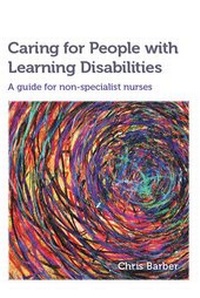
Caring for People with Learning Disabilities
A guide for non-specialist nurses
Published on 11. February 2015
Book
Paperback/Softback
192 pages
978-1-908625-28-1 (ISBN)
Description
From the Foreword by Cecilia Anim, OBE (RCN President, 2015-2018):
"...an enjoyable, touching and inspirational read for all those involved in the lives of people with learning disabilities"
Caring for People with Learning Disabilities is a concise introduction to the subject which covers all aspects of the care and support of the learning disabilities patient, for the non-specialist.
All people with learning disabilities are entitled to the same high standard of care as people who do not have a learning disability and to have their health and care needs met in full. The vast majority of student nurses, practising nurses and healthcare professionals are not learning disability specialists, but they still need to provide care for patients with learning disabilities, often for health needs that are not related to the person's disability.
The book covers a wide range of issues and aims to:
Improve knowledge and understanding of what learning disability is and what it means to live with a learning disability.
Provide practical advice and suggestions to improve the quality of care provided to people with learning disabilities.
Written in a jargon-free style, the book has numerous practical examples and case studies to help the reader frame the special requirements of the learning disabilities patient in the healthcare setting.
This book will help nurses and carers improve their understanding of learning disability and provide the high quality care to which people with learning disabilities are entitled.
"...an enjoyable, touching and inspirational read for all those involved in the lives of people with learning disabilities"
Caring for People with Learning Disabilities is a concise introduction to the subject which covers all aspects of the care and support of the learning disabilities patient, for the non-specialist.
All people with learning disabilities are entitled to the same high standard of care as people who do not have a learning disability and to have their health and care needs met in full. The vast majority of student nurses, practising nurses and healthcare professionals are not learning disability specialists, but they still need to provide care for patients with learning disabilities, often for health needs that are not related to the person's disability.
The book covers a wide range of issues and aims to:
Improve knowledge and understanding of what learning disability is and what it means to live with a learning disability.
Provide practical advice and suggestions to improve the quality of care provided to people with learning disabilities.
Written in a jargon-free style, the book has numerous practical examples and case studies to help the reader frame the special requirements of the learning disabilities patient in the healthcare setting.
This book will help nurses and carers improve their understanding of learning disability and provide the high quality care to which people with learning disabilities are entitled.
Reviews / Votes
'Overall, I am really enjoying the read, and there is a nice flow across the book...alongside allowing the discussion and application of the theory. I am impressed how the author has managed to discuss such a wide range of issues in an engaging and easy-to-read format. This should make a lot of sense to students.'Lecturer, University of Central Lancashire
More details
Language
English
Place of publication
Cheltenham
United Kingdom
Target group
Professional and scholarly
Dimensions
Height: 244 mm
Width: 172 mm
Weight
371 gr
ISBN-13
978-1-908625-28-1 (9781908625281)
Copyright in bibliographic data and cover images is held by Nielsen Book Services Limited or by the publishers or by their respective licensors: all rights reserved.
Schweitzer Classification
Other editions
New editions
Book
04/2022
Lantern Publishing Ltd
€21.50
Shipment within 3-4 weeks
Additional editions
E-Book
03/2015
Lantern Publishing
€20.99
Available for download
Person
Chris Barber is a registered nurse (learning disabilities), qualifying as such in December 1989, and he holds an MEd from the University of Birmingham in special educational needs (autism). He has worked as a nurse, as a visiting lecturer in learning disability nursing at Birmingham City University, and for the eleven years up to 2021 as a full-time care-giver for his late wife. Chris is a parent of a young man who is on the autism spectrum, and he himself was diagnosed at the end of 2008 as being 'high-functioning autistic'. Chris sits on the editorial boards of the British Journal of Nursing, the British Journal of Mental Health Nursing, and the British Journal of Health Care Assistants and has written a number of articles and papers on a wide variety of subjects including learning disabilities, care givers, spirituality and autism. He is the author of Autism and Asperger's Conditions, published by Quay Books in 2011.
Content
1. Introduction
2. What is learning disability?
3. People with profound and multiple learning disabilities
4. Legislation, strategies and reports for those with a learning disability
5. Medical care and support for those with a learning disability
6. Learning disability and consent to treatment
7. Learning disability and mental health
8. Learning disability and forensic care
9. Sexuality and people with a learning disability
10. Ageing and those with a learning disability
11. Dying, death and bereavement and people with a learning disability
12. Care and support for those who are informal care givers
13. Disability and carer discrimination
14. Learning disability and spirituality
15. The future and learning disability
2. What is learning disability?
3. People with profound and multiple learning disabilities
4. Legislation, strategies and reports for those with a learning disability
5. Medical care and support for those with a learning disability
6. Learning disability and consent to treatment
7. Learning disability and mental health
8. Learning disability and forensic care
9. Sexuality and people with a learning disability
10. Ageing and those with a learning disability
11. Dying, death and bereavement and people with a learning disability
12. Care and support for those who are informal care givers
13. Disability and carer discrimination
14. Learning disability and spirituality
15. The future and learning disability