

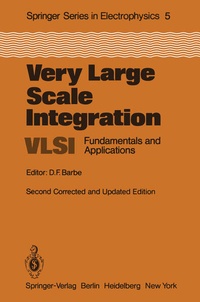
Very Large Scale Integration (VLSI)
Fundamentals and Applications
2nd Edition
Published on 22. April 2012
Book
Paperback/Softback
XII, 304 pages
978-3-642-88642-3 (ISBN)
Description
Even elementary school students of today know that electronics can do fan tastic things. Electronic calculators make arithmetic easy. An electronic box connected to your TV set provides a wonderful array of games. Electronic boxes can translate languages! Electronics has even changed watches from a pair of hands to a set of digits. Integrated circuit (IC) chips, which use transistors to store information in binary form and perform binary arithmetic, make all of this possible. In just a short twenty years, the field of inte grated circuits has progressed from chips containing several transistors performing simple functions such as OR and AND functions to chips presently available which contain thousands of transistors performing a wide range of memory, control and arithmetic functions. In the late 1970's Very Large Scale Integration (VLSI) caught the imagin ation of the industrialized world. The United States, Japan and other coun tries now have substantial efforts to push the frontier of microelectronics across the one-micrometer barrier and into sub-micrometer features. The achievement of this goal will have tremendous impl ications, both technolo gical and economic for the countries involved.
More details
Series
Edition
Second Edition 1982
Language
English
Place of publication
Berlin
Germany
Publishing group
Springer Berlin
Target group
Professional and scholarly
Research
Illustrations
XII, 304 p.
Dimensions
Height: 235 mm
Width: 155 mm
Thickness: 18 mm
Weight
487 gr
ISBN-13
978-3-642-88642-3 (9783642886423)
DOI
10.1007/978-3-642-88640-9
Schweitzer Classification
Other editions
Additional editions
Book
02/1982
2nd Edition
Springer
€128.39
Article exhausted; check different version
Content
1. Introduction.- 1.1 Outlook.- 1.2 Scope of this Volume.- 1.3 Summary.- References.- 2. VLSI Device Fundamentals.- 2.1 Fundamentals of VLSI Device Improvements.- 2.2 Problem Areas for VLSIC's.- 2.3 Small-Geometry MOS Anomalies.- 2.4 VLSIC Projections.- 2.5 Conclusions.- References.- 3. Advanced Lithography.- 3.1 Optical Lithography.- 3.2 Electron Lithography.- 3.3 X-Ray Lithography.- 3.4 Ion Lithography.- 3.5 Conclusion.- References.- 4. Computer Aided Design for VLSI.- 4.1 What is Computer Aided Design?.- 4.2 History.- 4.3 State-of-the-Art.- 4.4 Perspective.- 4.5 Management of Complexity.- 4.6 Structured Design.- 4.7 Functional Design Tools.- 4.8 Physical Design Tools.- 4.9 Design Management.- 4.10 Conclusion.- References.- 5. GaAs Digital Integrated Circuits for Ultra High Speed LSI/VLSI.- 5.1 Performance Advantages Expected for GaAs ICs.- 5.2 Circuit Approaches for GaAs Digital Logic ICs.- 5.3 GaAs Integrated Circuits: Fabrication Technology.- 5.4 Performance Results for GaAs Digital ICs.- 5.5 Summary, Conclusions and Projections.- Appendix: Nonlinear Switching Analysis for PD?d.- Dependence on ?d and FET K-Value.- References.- 6. VLSI Architecture.- 6.1 VLSI Technology Basis.- 6.2 VLSI Device Architecture.- 6.3 VLSI System Architecture.- 6.4 VLSI Architecture Case Study.- 6.5 Conclusion.- References.- 7. VLSI Applications and Testing.- 7.1 VLSI Applications.- 7.2 VLSI Testing.- 7.3 Conclusion.- References.- 8. VHSIC Technology and Systems.- 8.1 IC Progress.- 8.2 Throughput Capacity.- 8.3 Defense Systems.- 8.4 The VHSIC Program.- 8.5 Example Brassboard Systems.- 8.6 Scaling to Smaller Dimensions: Benefits and Barriers.- 8.7 Computer-Aided Design.- 8.8 Testing.- 8.9 Substrates.- 8.10 Summary.- References.- 9. VLSI in Other Countries.- 9.1 Past Major Semiconductor Programs.- 9.2 Present National Semiconductor Programs.- 9.3 Future Prospects.- References.- Additional References.- Additional References.