

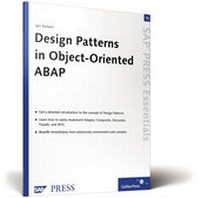
Design Patterns in Object-Oriented ABAP
SAP PRESS Essentials 15
1st Edition
Published on 1. January 1970
Book
Hardback
88 pages
978-1-59229-087-1 (ISBN)
Description
This new SAP PRESS Essentials technical guide introduces experienced ABAP programmers to the detailed concepts of Design Patterns in object-oriented ABAP. Using real-life scenarios from a fully functional business application, the author shares key insights, while showing you proven best practices for how to implement the most common Design Patterns in ABAP Objects. Adapter, Composite, Decorator, Façade, and-probably the most well known -Model View Controller (MVC) are all covered extensively.
After reading this exclusive guide, you can quickly unleash the full potential of Design Patterns to improve performance and quality, as well as the robustness of your most critical applications.
More details
Other editions
New editions
Igor Barbaric
Design Patterns in Object-Oriented ABAP
Book
12/2009
2nd Edition
SAP PRESS
€69.95
Article is exhausted, reprint undefined
Person
Author
Igor Barbaric is a software-development specialist with seven years of experience in development for SAP solutions (ABAP) and Microsoft products (Access, Excel), in system integration (SAP-MS products and SAP-Java), and in SAP system administration.
He worked as a team member on several international projects. He was a speaker at the SDN Meets Labs (Walldorf/Rot, 2005) and SAP TechEd (Vienna, 2005), with a session titled Design Patterns in Object-Oriented ABAP.
Content
1. Introduction ... 5
... 1.1 What are Design Patterns? ... 5
... 1.2 Communication in Patterns ... 6
... 1.3 Design Patterns in Software Design ... 6
... 1.4 Success story: The Project and its By-product ... 7
... 1.5 Conventions in this Book ... 7
... 1.6 Prerequisites ... 8
... 1.7 Structure of the Book ... 9
2. The Demo Application ... 11
3. The Singleton Pattern ... 15
... 3.1 Definition ... 15
... 3.2 Case-Study Problem: Instantiating Application Only Once ... 15
... 3.3 Summary ... 17
4. The Adapter Pattern ... 19
... 4.1 Definition ... 19
... 4.2 Case-Study Problem: Application with a Command Tree ... 19
... 4.3 The Adapter in the Demo Application ... 20
... 4.4 Interface lif_interface ... 20
... 4.5 Class lcl_application ... 21
... 4.6 Summary ... 26
5. The Façade Pattern ... 27
... 5.1 Definition ... 27
... 5.2 Case-Study Problem: Vendor-Specific User-Defined Text on Purchase Order ... 27
... 5.3 Class lcl_mod_facade ... 30
... 5.4 Class lcl_st_text_facade ... 31
... 5.5 Summary ... 36
6. The Composite Pattern ... 37
... 6.1 Definition ... 37
... 6.2 Case-Study Problem: Organizing Flights by Date ... 38
... 6.3 Class lcl_mod_composite ... 39
... 6.4 Summary ... 46
7. The Decorator Pattern ... 47
... 7.1 Definition ... 47
... 7.2 Case-Study Problem: Lookup Data for Internal Tables ... 48
... 7.3 Class lcl_itab_dec ... 50
... 7.4 Class lcl_itab_dec_vendor ... 53
... 7.5 Class lcl_itab_dec_st_text ... 59
... 7.6 Other Decorators in the Application ... 61
... 7.7 Implementation of the Decorator Pattern in the Application ... 61
... 7.8 Summary ... 62
8. The Model-View-Controller (MVC) Pattern ... 63
... 8.1 Definition ... 63
... 8.2 Case-Study Problem: Displaying Table Data in Different Ways ... 64
... 8.3 Class lcl_con ... 66
... 8.4 Class lcl_mod ... 67
... 8.5 Class lcl_con_alv ... 72
... 8.6 Class lcl_con_alv_facade ... 75
... 8.7 Class lcl_con_dd ... 76
... 8.8 Summary ... 80
9. Summary ... 83
Index ... 85
... 1.1 What are Design Patterns? ... 5
... 1.2 Communication in Patterns ... 6
... 1.3 Design Patterns in Software Design ... 6
... 1.4 Success story: The Project and its By-product ... 7
... 1.5 Conventions in this Book ... 7
... 1.6 Prerequisites ... 8
... 1.7 Structure of the Book ... 9
2. The Demo Application ... 11
3. The Singleton Pattern ... 15
... 3.1 Definition ... 15
... 3.2 Case-Study Problem: Instantiating Application Only Once ... 15
... 3.3 Summary ... 17
4. The Adapter Pattern ... 19
... 4.1 Definition ... 19
... 4.2 Case-Study Problem: Application with a Command Tree ... 19
... 4.3 The Adapter in the Demo Application ... 20
... 4.4 Interface lif_interface ... 20
... 4.5 Class lcl_application ... 21
... 4.6 Summary ... 26
5. The Façade Pattern ... 27
... 5.1 Definition ... 27
... 5.2 Case-Study Problem: Vendor-Specific User-Defined Text on Purchase Order ... 27
... 5.3 Class lcl_mod_facade ... 30
... 5.4 Class lcl_st_text_facade ... 31
... 5.5 Summary ... 36
6. The Composite Pattern ... 37
... 6.1 Definition ... 37
... 6.2 Case-Study Problem: Organizing Flights by Date ... 38
... 6.3 Class lcl_mod_composite ... 39
... 6.4 Summary ... 46
7. The Decorator Pattern ... 47
... 7.1 Definition ... 47
... 7.2 Case-Study Problem: Lookup Data for Internal Tables ... 48
... 7.3 Class lcl_itab_dec ... 50
... 7.4 Class lcl_itab_dec_vendor ... 53
... 7.5 Class lcl_itab_dec_st_text ... 59
... 7.6 Other Decorators in the Application ... 61
... 7.7 Implementation of the Decorator Pattern in the Application ... 61
... 7.8 Summary ... 62
8. The Model-View-Controller (MVC) Pattern ... 63
... 8.1 Definition ... 63
... 8.2 Case-Study Problem: Displaying Table Data in Different Ways ... 64
... 8.3 Class lcl_con ... 66
... 8.4 Class lcl_mod ... 67
... 8.5 Class lcl_con_alv ... 72
... 8.6 Class lcl_con_alv_facade ... 75
... 8.7 Class lcl_con_dd ... 76
... 8.8 Summary ... 80
9. Summary ... 83
Index ... 85