

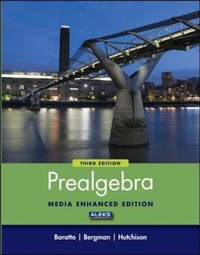
Prealgebra, Media Enhanced Edition
3rd Edition
Published on 16. February 2009
Book
Board book
866 pages
978-0-07-729962-0 (ISBN)
Description
Prealgebra: Media Enhanced Edition, 3e by Baratto/Bergman is the latest offering from authors Stefan Baratto and Barry Bergman. This media enhanced edition of Prealgebra focuses on mastering math through practice with the integration of the ALEKS (R) software. ALEKS helps to remediate students who may have a lack of prerequisite knowledge for the prealgebra course by way of an artificial intelligence engine. ALEKS provides students with a map (pictorial graph) of their progress to identify mathematical skills they have mastered and skills where remediation is required. Icons accompany exercises in the text where a similar problem is available in ALEKS.
More details
Edition
3rd edition
Language
English
Place of publication
United States
Publishing group
McGraw-Hill Education - Europe
Illustrations
Illustrations, color
Dimensions
Height: 277 mm
Width: 218 mm
Thickness: 33 mm
Weight
1767 gr
ISBN-13
978-0-07-729962-0 (9780077299620)
Copyright in bibliographic data and cover images is held by Nielsen Book Services Limited or by the publishers or by their respective licensors: all rights reserved.
Schweitzer Classification
Other editions
New editions
Stefan Baratto | Barry Bergman | Donald Hutchison
Prealgebra
Book
08/2013
4th Edition
McGraw Hill Higher Education
€243.50
Shipment within 15-20 days
Persons
Stefan began teaching math and science in New York City middle schools. He also taught math at the University of Oregon, Southeast Missouri State University, and York County Technical College. Currently, Stefan is a member of the mathematics faculty at Clackamas Community College where he has found a niche, delighting in the CCC faculty, staff, and students. Stefans own education includes the University of Michigan (BGS, 1988), Brooklyn College (CUNY), and the University of Oregon (MS, 1996).
Stefan is currently serving on the AMATYC Executive Board as the organizations Northwest Vice President. He has also been involved with ORMATYC, NEMATYC, NCTM, and the State of Oregon Math Chairs group, as well as other local organizations. He has applied his knowledge of math to various fi elds, using statistics, technology, and web design. More personally, Stefan and his wife, Peggy, try to spend time enjoying the wonders of Oregon and the Pacifi c Northwest. Their activities include scuba diving, self-defense training, and hiking.
Barry has enjoyed teaching mathematics to a wide variety of students over the years. He began in the fi eld of adult basic education and moved into the teaching of high school mathematics in 1977. He taught high school math for 11 years, at which point he served as a K-12 mathematics specialist for his county. This work allowed him the opportunity to help promote the emerging NCTM standards in his region.
In 1990, Barry began the next portion of his career, having been hired to teach at Clackamas Community College. He maintains a strong interest in the appropriate use of technology and visual models in the learning of mathematics.
Throughout the past 32 years, Barry has played an active role in professional organizations. As a member of OCTM, he contributed several articles and activities to the groups journal. He has presented at AMATYC, OCTM, NCTM, ORMATYC, and ICTCM conferences. Barry also served 4 years as an offi cer of ORMATYC and participated on an AMATYC committee to provide feedback to revisions of NCTMs standards.
Don began teaching in a preschool while he was an undergraduate. He subsequently taught children with disabilities, adults with disabilities, high school mathematics, and college mathematics. Although each position offered different challenges, it was always breaking a challenging lesson into teachable components that he most enjoyed.
It was at Clackamas Community College that he found his professional niche. The community college allowed him to focus on teaching within a department that constantly challenged faculty and students to expect more. Under the guidance of Jim Streeter, Don learned to present his approach to teaching in the form of a textbook. Don has also been an active member of many professional organizations. He has been president of ORMATYC, AMATYC committee chair, and ACM curriculum committee member. He has presented at AMATYC, ORMATYC, AACC, MAA, ICTCM, and a variety of other conferences.
Above all, he encourages you to be involved, whether as a teacher or as a learner. Whether discussing curricula at a professional meeting or homework in a cafeteria, it is the process of communicating an idea that helps one to clarify it.
Stefan is currently serving on the AMATYC Executive Board as the organizations Northwest Vice President. He has also been involved with ORMATYC, NEMATYC, NCTM, and the State of Oregon Math Chairs group, as well as other local organizations. He has applied his knowledge of math to various fi elds, using statistics, technology, and web design. More personally, Stefan and his wife, Peggy, try to spend time enjoying the wonders of Oregon and the Pacifi c Northwest. Their activities include scuba diving, self-defense training, and hiking.
Barry has enjoyed teaching mathematics to a wide variety of students over the years. He began in the fi eld of adult basic education and moved into the teaching of high school mathematics in 1977. He taught high school math for 11 years, at which point he served as a K-12 mathematics specialist for his county. This work allowed him the opportunity to help promote the emerging NCTM standards in his region.
In 1990, Barry began the next portion of his career, having been hired to teach at Clackamas Community College. He maintains a strong interest in the appropriate use of technology and visual models in the learning of mathematics.
Throughout the past 32 years, Barry has played an active role in professional organizations. As a member of OCTM, he contributed several articles and activities to the groups journal. He has presented at AMATYC, OCTM, NCTM, ORMATYC, and ICTCM conferences. Barry also served 4 years as an offi cer of ORMATYC and participated on an AMATYC committee to provide feedback to revisions of NCTMs standards.
Don began teaching in a preschool while he was an undergraduate. He subsequently taught children with disabilities, adults with disabilities, high school mathematics, and college mathematics. Although each position offered different challenges, it was always breaking a challenging lesson into teachable components that he most enjoyed.
It was at Clackamas Community College that he found his professional niche. The community college allowed him to focus on teaching within a department that constantly challenged faculty and students to expect more. Under the guidance of Jim Streeter, Don learned to present his approach to teaching in the form of a textbook. Don has also been an active member of many professional organizations. He has been president of ORMATYC, AMATYC committee chair, and ACM curriculum committee member. He has presented at AMATYC, ORMATYC, AACC, MAA, ICTCM, and a variety of other conferences.
Above all, he encourages you to be involved, whether as a teacher or as a learner. Whether discussing curricula at a professional meeting or homework in a cafeteria, it is the process of communicating an idea that helps one to clarify it.
Content
PREALGEBRA: An Integrated Equation ApproachCHAPTER 1 Whole NumbersPretest Chapter 11.1 Introduction to Whole Numbers and Place Value1.2 Addition of Whole Numbers1.3 Subtraction of Whole Numbers1.4 Rounding, Estimation, and Ordering of Whole Numbers1.5 Multiplication of Whole Numbers1.6 Division of Whole Numbers1.7 Exponents and Whole Numbers1.8 Grouping Symbols and the Order of Operations1.9 An Introduction to EquationsSummarySummary ExercisesSelf-Test for Chapter 1CHAPTER 2 Integers and Introduction to AlgebraPretest Chapter 22.1 Introduction to Integers2.2 Addition of Integers2.3 Subtraction of Integers2.4 Multiplication of Integers2.5 Division of Integers2.6 Introduction to Algebra: Variables and Expressions2.7 Evaluating Algebraic Expressions2.8 Simplifying Algebraic Expressions2.9 Introduction to Linear Equations2.10 The Addition Property of EqualitySummarySummary ExercisesSelf-Test for Chapter 2Cumulative Review for Chapters 1 to 2 CHAPTER 3 Fractions and EquationsPretest Chapter 33.1 Introduction to Fractions3.2 Prime Numbers and Factorization3.3 Equivalent Fractions3.4 Multiplication and Division of Fractions3.5 The Multiplication Property of Equality3.6 Linear Equations in One VariableSummarySummary ExercisesSelf-Test for Chapter 3Cumulative Review for Chapters 1 to 3CHAPTER 4 Applications of Fractions and EquationsPretest Chapter 44.1 Addition and Subtraction of Fractions4.2 Operations on Mixed Numbers4.3 Applications Involving Fractions 4.4 Equations Containing Fractions4.5 Applications of Linear Equations in One Variable4.6 Complex Fractions (optional)SummarySummary ExercisesSelf-Test for Chapter 4Cumulative Review for Chapters 1 to 4CHAPTER 5 DecimalsPretest Chapter 55.1 Introduction to Decimals, Place Value, and Rounding5.2 Addition and Subtraction of Decimals 5.3 Multiplication of Decimals5.4 Division of Decimals5.5 Fractions and Decimals5.6 Equations Containing Decimals5.7 Square Roots and the Pythagorean Theorem5.8 ApplicationsSummarySummary ExercisesSelf-Test for Chapter 5Cumulative Review for Chapters 1 to 5CHAPTER 6 Ratio, Rate, and ProportionPretest Chapter 66.1 Ratios6.2 Rates6.3 Proportions6.4 Similar Triangles and Proportions6.5 Linear Measurement and ConversionSummarySummary ExercisesSelf-Test for Chapter 6Cumulative Review for Chapters 1 to 6CHAPTER 7 PercentPretest Chapter 77.1 Percents, Decimals, and Fractions7.2 Solving Percent Problems Using Proportions7.3 Solving Percent Applications Using Equations7.4 Applications: Simple and Compound Interest7.5 More Applications of PercentSummarySummary ExercisesSelf-Test for Chapter 7Cumulative Review for Chapters 1 to 7CHAPTER 8 GeometryPretest Chapter 88.1 Lines and Angles8.2 Perimeter and Circumference8.3 Area and VolumeSummarySummary ExercisesSelf-Test for Chapter 8Cumulative Review for Chapters 1 to 8 CHAPTER 9 Graphing and Introduction to StatisticsPretest Chapter 99.1 Tables and Graphs of Data9.2 The Rectangular Coordinate System9.3 Linear Equations in Two Variables9.4 Mean, Median, and ModeSummarySummary ExercisesSelf-Test for Chapter 9Cumulative Review for Chapters 1 to 9CHAPTER 10 PolynomialsPretest Chapter 1010.1 Properties of Exponents10.2 Introduction to Polynomials10.3 Addition and Subtraction of Polynomials10.4 Multiplying Polynomials10.5 Introduction to Factoring PolynomialsSummarySummary ExercisesSelf-Test for Chapter 10Practice Final Exam