

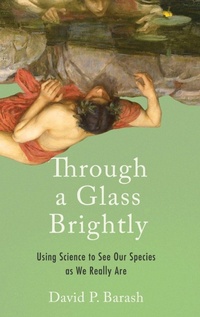
Through a Glass Brightly
Using Science to See Our Species as We Really Are
Published on 11. October 2018
Book
Hardback
216 pages
978-0-19-067371-0 (ISBN)
Description
Human beings have long seen themselves as the center of the universe, the apple of God's eye, specially-created creatures who are somehow above and beyond the natural world. This viewpoint - a persistent paradigm of our own unique self-importance - is as dangerous as it is false. In Through a Glass Brightly, noted scientist David P. Barash explores the process by which science has, throughout time, cut humanity "down to size," and how humanity has responded. A good paradigm is a tough thing to lose, especially when its replacement leaves us feeling more vulnerable and less special. And yet, as science has progressed, we find ourselves - like it or not - bereft of many of our most cherished beliefs, confronting an array of paradigms lost.
Barash models his argument around a set of "old" and "new" paradigms that define humanity's place in the universe. This new set of paradigms range from provocative revelations as to whether human beings are well designed, whether the universe has somehow been established with our species in mind (the so-called anthropic principle), whether life itself is inherently fragile, and whether Homo sapiens might someday be genetically combined with other species (and what that would mean for our self-image). Rather than seeing ourselves through a glass darkly, science enables us to perceive our strengths and weaknesses brightly and accurately at last, so that paradigms lost becomes wisdom gained. The result is a bracing, remarkably hopeful view of who we really are.
Barash models his argument around a set of "old" and "new" paradigms that define humanity's place in the universe. This new set of paradigms range from provocative revelations as to whether human beings are well designed, whether the universe has somehow been established with our species in mind (the so-called anthropic principle), whether life itself is inherently fragile, and whether Homo sapiens might someday be genetically combined with other species (and what that would mean for our self-image). Rather than seeing ourselves through a glass darkly, science enables us to perceive our strengths and weaknesses brightly and accurately at last, so that paradigms lost becomes wisdom gained. The result is a bracing, remarkably hopeful view of who we really are.
Reviews / Votes
... briskly erudite study. * Barbara Kiser, Nature *More details
Language
English
Place of publication
New York
United States
Dimensions
Height: 240 mm
Width: 161 mm
Thickness: 16 mm
Weight
487 gr
ISBN-13
978-0-19-067371-0 (9780190673710)
Copyright in bibliographic data and cover images is held by Nielsen Book Services Limited or by the publishers or by their respective licensors: all rights reserved.
Schweitzer Classification
Other editions
Additional editions
E-Book
07/2018
1st Edition
OUP eBook
€15.49
Available for download
E-Book
07/2018
1st Edition
OUP eBook
€15.49
Available for download
Person
David P. Barash is an evolutionary biologist and Professor Emeritus of Psychology at the University of Washington. He has written more than 280 peer-reviewed articles and nearly 40 books. Barash has penned numerous op-eds in the Los Angeles Times, The New York Times, and the Chicago Tribune, as well as numerous pieces in The Chronicle of Higher Education, Nautilus, and aeon.
Content
Part 1: The allure of human centrality, or, how we persistently try to deny our place in the natural world1. The Journey to Brobdignag2. From Centrality to Periphery3. The Meaning of Life4. Well Designed?5. The Anthropic Principle6. Tardigrades, Trisolarans and the Toughness of Life7. Of Humanzees and Chimphumans8. Separateness of SelfPart 2: New Ways of Understanding Human Nature9. Uniquely Thoughtful10. Conflict between Parents and Offspring11. True or False?12. The Myth of Monogamy13. War and Peace14. About Those Better Angels ...15. Who's in Charge?16. The Paradox of PowerConclusion: Optare aude