

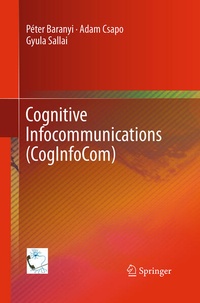
Cognitive Infocommunications (CogInfoCom)
Published on 23. August 2016
Book
Paperback/Softback
XIX, 219 pages
978-3-319-35947-2 (ISBN)
Description
This book describes the theoretical foundations of cognitive infocommunications (CogInfoCom), and provides a survey on state-of-the-art solutions and applications within the field. The book covers aspects of cognitive infocommunications in research fields such as affective computing, BCI, future internet, HCI, HRI, sensory substitution, and virtual/augmented interactions, and also introduces newly proposed paradigms and initiatives under the field, including CogInfoCom channels, speechability and socio-cognitive ICT. The book focuses on describing the merging between humans and information and communications technology (ICT) at the level of cognitive capabilities with an approach towards developing future cognitive ICT.
More details
Edition
Softcover reprint of the original 1st ed. 2015
Language
English
Place of publication
Cham
Switzerland
Publishing group
Springer International Publishing
Target group
Professional and scholarly
Illustrations
XIX, 219 p.
Dimensions
Height: 235 mm
Width: 155 mm
Thickness: 14 mm
Weight
371 gr
ISBN-13
978-3-319-35947-2 (9783319359472)
DOI
10.1007/978-3-319-19608-4
Schweitzer Classification
Other editions
Additional editions
Péter Baranyi | Adam Csapo | Gyula Sallai
Cognitive Infocommunications (CogInfoCom)
Book
11/2015
Springer
€106.99
Shipment within 10-15 days
Persons
Peter Baranyi is a professor at the Széchenyi István Unversity of Gyor, and Head of the 3D Internet based Control and Communications Laboratory at the Institute for Computer Science and Control of the Hungarian Academy of Sciences.
Adam Csapo is a postdoctoral researcher at the Institute for Computer Science and Control of the Hungarian Academy of Sciences, and an associate professor at the Széchenyi István University of Gyor.
Gyula Sallai is a professor at Budapest University of Technology and Economics, and Scientific Director of the Future Internet Research Coordination Centre.
Content
Introduction.- Cognitive info communications (Cog Info Com).- Synergies between Cog Info Com and other Fields.- Emerging Research Areas Under Cog Info Co.- Cog Info Com Channels.- Cognitive Capabilities of Augmented/Virtual Avatars.- Cognitive Capabilities of Social Networks.- Networked Speech ability.- Cog Info Com Biases.