

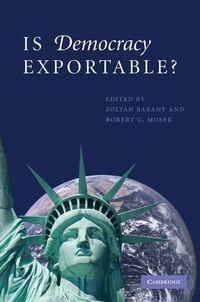
Is Democracy Exportable?
Published on 6. July 2009
Book
Paperback/Softback
316 pages
978-0-521-74832-2 (ISBN)
Description
Can democratic states transplant the seeds of democracy into developing countries? What have political thinkers going back to the Greek city-states thought about their capacity to promote democracy? How can democracy be established in divided societies? This books answers these and other fundamental questions behind the concept known as 'democracy promotion.' Following an illuminating concise discussion of what political philosophers from Plato to Montesquieu thought about the issue, the authors explore the structural preconditions (culture, divided societies, civil society) as well as the institutions and processes of democracy building (constitutions, elections, security sector reform, conflict, and trade). Along the way they share insights about what policies have worked, which ones need to be improved or discarded, and, more generally, what advanced democracies can do to further the cause of democratization in a globalizing world. In other words, they seek answers to the question, Is democracy exportable?
Reviews / Votes
"This collection of searching essays by a group of distinguished policy-oriented scholars artfully combines contributions that reach deeply into history, philosophy, and culture with others that hew to tough-minded empiricism and practicality. Sobriety and optimism are present in equal measure, leading to telling insights about a basic question of our time: can well-intentioned outside actors affect the democratic destiny of countries around the world?"- Thomas Carothers, Carnegie Endowment for International Peace "This book provides a long-overdue corrective to the neglect of the empirical underpinnings of an increasingly important dimension of foreign policy and international relations - efforts to export or promote democracy around the world. It is a creative and solid piece of scholarship that examines this issue from virtually all relevant perspectives."
- Richard Gunther, The Ohio State University
More details
Language
English
Place of publication
Cambridge
United Kingdom
Target group
College/higher education
Professional and scholarly
Product notice
Paperback (trade)
Illustrations
1 Tables, unspecified; 3 Line drawings, unspecified
Dimensions
Height: 229 mm
Width: 152 mm
Thickness: 17 mm
Weight
460 gr
ISBN-13
978-0-521-74832-2 (9780521748322)
Copyright in bibliographic data and cover images is held by Nielsen Book Services Limited or by the publishers or by their respective licensors: all rights reserved.
Schweitzer Classification
Other editions
Additional editions
Zoltan Barany | Robert G. Moser
Is Democracy Exportable?
E-Book
09/2009
1st Edition
Cambridge University Press
€27.99
Available for download
Zoltan Barany | Robert G. Moser
Is Democracy Exportable?
Book
07/2009
Cambridge University Press
€104.20
Shipment within 15-20 days
Persons
Zoltan Barany is Frank C. Erwin, Jr, Professor of Government at the University of Texas and the author of Democratic Breakdown and the Decline of the Russian Military (2007), The Future of NATO Expansion (2003), and The East European Gypsies (2001). Robert G. Moser is Associate Professor of Government at the University of Texas and the author of Unexpected Outcomes: Electoral Systems, Political Parties and Representation in Russia (2001). His articles have appeared in World Politics, Comparative Politics, Legislative Studies Quarterly, Electoral Studies, and Post-Soviet Affairs. He is currently writing a book entitled Mixed Electoral Systems in New and Established Democracies with Ethan Scheiner.
Content
Introduction: promoting democracy Marc F. Plattner; Part I. A Moral Imperative?: 1. The morality of exporting democracy: an historical-philosophical perspective Thomas L. Pangle; Part II. Structural Preconditions: 2. Re-integrating the study of civil society and the state Sheri Berman; 3. Encountering culture M. Steven Fish; 4. Does democracy work in deeply divided societies? Daniel Chirot; 5. Democracy, civil society, and the problem of tolerance Adam Seligman; Part III. Institutions and Processes: 6. Electoral engineering in new democracies: can preferred electoral outcomes be engineered? Robert G. Moser; 7. Does it matter how a constitution is created? John Carey; 8. Building democratic armies Zoltan Barany; 9. Democratization, conflict, and trade Edward Mansfield and Jack Snyder; 10. Exporting democracy: does it work? Mitchell Seligson, Steven Finkel and Anibal Perez-Linan; Conclusion Nancy Bermeo.