

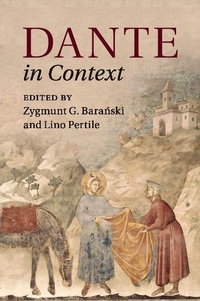
Dante in Context
Published on 27. July 2017
Book
Paperback/Softback
598 pages
978-1-108-41283-4 (ISBN)
Description
In the past seven centuries Dante has become world renowned, with his works translated into multiple languages and read by people of all ages and cultural backgrounds. This volume brings together interdisciplinary essays by leading, international scholars to provide a comprehensive account of the historical, cultural and intellectual context in which Dante lived and worked: from the economic, social and political scene to the feel of daily life; from education and religion to the administration of justice; from medicine to philosophy and science; from classical antiquity to popular culture; and from the dramatic transformation of urban spaces to the explosion of visual arts and music. This book, while locating Dante in relation to each of these topics, offers readers a clear and reliable idea of what life was like for Dante as an outstanding poet and intellectual in the Italy of the late Middle Ages.
More details
Series
Language
English
Place of publication
Cambridge
United Kingdom
Target group
Professional and scholarly
Product notice
Paperback (trade)
Illustrations
Worked examples or Exercises; 2 Printed music items; 3 Maps; 18 Halftones, unspecified; 18 Halftones, black and white; 2 Line drawings, black and white
Dimensions
Height: 229 mm
Width: 152 mm
Thickness: 32 mm
Weight
854 gr
ISBN-13
978-1-108-41283-4 (9781108412834)
Copyright in bibliographic data and cover images is held by Nielsen Book Services Limited or by the publishers or by their respective licensors: all rights reserved.
Schweitzer Classification
Other editions
Additional editions
Zygmunt G. Baranski | Lino Pertile
Dante in Context
Book
09/2015
Cambridge University Press
€170.84
Shipment within 15-20 days
Persons
Zygmunt G. Baranski is Serena Professor of Italian Emeritus at the University of Cambridge and Notre Dame Chair of Dante and Italian Studies at the University of Notre Dame, Indiana. Lino Pertile is Carl A. Pescosolido Professor of Romance Languages and Literatures at Harvard University, Massachusetts, and Director of the Harvard University Center for Italian Renaissance Studies at Villa I Tatti, Florence.
Content
Introduction Zygmunt G. Baranski and Lino Pertile; Part I. Politics and Society: 1. Empire, Italy, and Florence William Caferro; 2. Economy William R. Day, Jr; 3. Law Sara Menzinger; 4. Justice Giuliano Milani; 5. Men and women Holly Hurlburt; 6. The official Church George Dameron; 7. The unofficial Church David Burr; 8. Daily life Edward D. English; Part II. Intellectual Traditions: 9. Philosophy and theology Andrea A. Robiglio; 10. Moral philosophy Luca Bianchi; 11. Natural philosophy Edward Grant; 12. Medicine Michael R. McVaugh; 13. Islamic and Jewish influences Luis M. Giron Negron; 14. Cosmology, geography, and cartography Theodore J. Cachey, Jr; Part III. Linguistic and Literary Cultures: 15. Linguistic Italy Mirko Tavoni; 16. Education Robert Black; 17. Rhetoric, literary theory, and practical criticism Ronald L. Martinez; 18. Classical antiquity Robert Black; 19. Religious culture Peter S. Hawkins; 20. Visions and journeys Eileen Gardiner; 21. Historical and political writing John C. Barnes; 22. Vernacular literatures Paolo Cherchi; 23. Popular culture Jan M. Ziolkowski; Part IV. Visual and Performative Culture: 24. Illumination, painting and sculpture Louise Bourdua; 25. Architecture and urban space Areli Marina; 26. Music Michael Scott Cuthbert; Part V. Dante: Life, Works, and Reception: 27. Life Lino Pertile; 28. Works Lino Pertile; 29. Textual transmission Zygmunt Baranski; 30. Early reception (1290s-1481) Zygmunt G. Baranski; Further reading.