

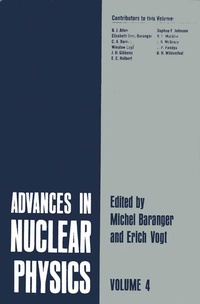
Advances in Nuclear Physics
Volume 4
Published on 31. January 2013
Book
Paperback/Softback
XVI, 448 pages
978-1-4615-8230-4 (ISBN)
Description
1 The Investigation of Hole States in Nuclei by Means of Knockout and Other Reactions.- 1. Introduction.- 2. Formalism for Knockout and Pickup Reactions.- 3. Single-Nucleon Knockout and Related Reactions.- 4. Cluster Knockout and Related Reactions.- 5. Other Reactions.- 6. Summary and Conclusions.- Acknowledgments.- References.- 2 High-Energy Scattering from Nuclei.- 1. Introduction.- 2. Models of High-Energy Scattering. Scattering of Objects with "Preexisting" Subunits.- 3. Existing Evidence Supporting Our Understanding of the High-Energy Scattering.- 4. Scattering of Objects without "Preexisting" Subunits. Scattering from Fluctuations.- 5. Prospects of what Nuclear Physics and Particle Physics Can Learn from High-Energy Nuclear Scattering.- 6. Concluding Remarks.- Acknowledgments.- Appendix A.- Appendix B.- References.- 3 Nucleosynthesis by Charged-Particle Reactions.- 1. Introduction.- 2. Charged-Particle Reaction Rates.- 3. Hydrogen Burning.- 4. Helium Burning.- 5. Synthesis of the Nuclei with 20 ? A ? 60.- 6. Synthesis of the Nuclei with A ? 60 and the l-Process.- 7. Nucleosynthesis in Massive Exploding Objects.- Acknowledgments.- References.- 4 Nucleosynthesis and Neutron-Capture Cross Sections.- 1. Introduction.- 2. Development of Neutron Buildup Theory.- 3. Stellar Neutron Sources.- 4. Neutron Capture Cross Sections.- 5. Abundance-Cross-Section Correlations.- 6. Conclusion.- Acknowledgments.- References.- 5 Nuclear Structure Studies in the Z = 50 Region.- 1. Introduction.- 2. Experimental Data.- 3. Theoretical Calculations.- 4. Conclusion.- Acknowledgments.- References.- General References.- Even-Mass Tin Isotopes.- Odd-Mass Tin Isotopes.- Odd-Mass Antimony Isotopes.- Odd-Mass Indium Isotopes.- Pittsburgh Calculations.- Trieste Calculations.- ChalkRiver Calculations.- 6 An s-d-Shell-Model Study for A = 18-22.- 1. Introduction.- 2. Model Hamiltonians.- 3. Excitation Energies and Spectroscopic Factors.- 4. Ground-State Binding Energies.- 5. Electric Quadrupole Moments and E2 Transitions.- 6. Magnetic Moments and M1 Transitions.- 7. Summary and Final Remarks.- Acknowledgments.- Appendix A. Shell-Model Basis and Methods.- A.1. Coupling Scheme.- A.2. Phases.- A.3. Computer Codes.- References.
More details
Series
Edition
Softcover reprint of the original 1st ed. 1971
Language
English
Place of publication
New York
United States
Target group
Professional and scholarly
Research
Illustrations
XVI, 448 p.
Dimensions
Height: 229 mm
Width: 152 mm
Thickness: 26 mm
Weight
672 gr
ISBN-13
978-1-4615-8230-4 (9781461582304)
DOI
10.1007/978-1-4615-8228-1
Schweitzer Classification
Other editions
Additional editions
Michael Baranger
Advances in Nuclear Physics: v. 4
Book
07/1971
Springer
€111.73
Article exhausted; check different version
Content
1 The Investigation of Hole States in Nuclei by Means of Knockout and Other Reactions.- 1. Introduction.- 2. Formalism for Knockout and Pickup Reactions.- 3. Single-Nucleon Knockout and Related Reactions.- 4. Cluster Knockout and Related Reactions.- 5. Other Reactions.- 6. Summary and Conclusions.- Acknowledgments.- References.- 2 High-Energy Scattering from Nuclei.- 1. Introduction.- 2. Models of High-Energy Scattering. Scattering of Objects with "Preexisting" Subunits.- 3. Existing Evidence Supporting Our Understanding of the High-Energy Scattering.- 4. Scattering of Objects without "Preexisting" Subunits. Scattering from Fluctuations.- 5. Prospects of what Nuclear Physics and Particle Physics Can Learn from High-Energy Nuclear Scattering.- 6. Concluding Remarks.- Acknowledgments.- Appendix A.- Appendix B.- References.- 3 Nucleosynthesis by Charged-Particle Reactions.- 1. Introduction.- 2. Charged-Particle Reaction Rates.- 3. Hydrogen Burning.- 4. Helium Burning.- 5. Synthesis of the Nuclei with 20 ? A ? 60.- 6. Synthesis of the Nuclei with A ? 60 and the l-Process.- 7. Nucleosynthesis in Massive Exploding Objects.- Acknowledgments.- References.- 4 Nucleosynthesis and Neutron-Capture Cross Sections.- 1. Introduction.- 2. Development of Neutron Buildup Theory.- 3. Stellar Neutron Sources.- 4. Neutron Capture Cross Sections.- 5. Abundance-Cross-Section Correlations.- 6. Conclusion.- Acknowledgments.- References.- 5 Nuclear Structure Studies in the Z = 50 Region.- 1. Introduction.- 2. Experimental Data.- 3. Theoretical Calculations.- 4. Conclusion.- Acknowledgments.- References.- General References.- Even-Mass Tin Isotopes.- Odd-Mass Tin Isotopes.- Odd-Mass Antimony Isotopes.- Odd-Mass Indium Isotopes.- Pittsburgh Calculations.- Trieste Calculations.- ChalkRiver Calculations.- 6 An s-d-Shell-Model Study for A = 18-22.- 1. Introduction.- 2. Model Hamiltonians.- 3. Excitation Energies and Spectroscopic Factors.- 4. Ground-State Binding Energies.- 5. Electric Quadrupole Moments and E2 Transitions.- 6. Magnetic Moments and M1 Transitions.- 7. Summary and Final Remarks.- Acknowledgments.- Appendix A. Shell-Model Basis and Methods.- A.1. Coupling Scheme.- A.2. Phases.- A.3. Computer Codes.- References.