

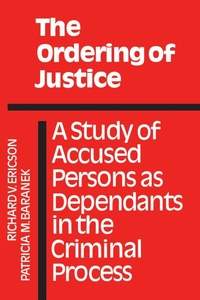
The Ordering of Justice
A Study of Accused Persons As Dependants in the Criminal Process
2nd Edition
Published on 1. January 1982
Book
Paperback/Softback
284 pages
978-0-8020-6463-9 (ISBN)
Description
From the point of his arrest through to the final disposition of his case, the authors follow the accused as he proceeds through the criminal control system. They draw a picture of one who is dependent upon the orders and decisions of the police, crown attorney, defence lawyer, and judge and not a defendant with significant autonomy.
Substudies conducted under a program of the Centre of Criminology provide empirical material on patrol police, detectives, crown attorneys and defence lawyers and are complemented by the authors' own interviews of accused persons. They produce a unique picture of the person who stands accused: unlike the official agents who are regular and experienced participants in the criminal process, the accused is a 'one-shot' player. As a dependant he is subject to the orders and decisions of the official criminal control agents; he fails to exercise what appear externally as his formal rights because the apparent costs exceed the advantages. He complies with police searches, fails to remain silent, fails to call a third party, gives a statement, often does not obtain a lawyer, routinely accepts his lawyer's advice, rarely demands a trial, often remains silent in court, and very rarely considers an appeal.
The ordering which the accused meets out of court is reproduced in the public forum of the court. Through the display of formal legal rationality there and in the belief that matters 'could have been a lot worse,' he experiences the 'majesty, justice, and mercy' of the criminal process and, in turn, accords legitimacy to the actions taken against him.
The authors discuss prospects for changing the criminal process and conclude that the range of reforms that have been advocated, and sometimes implemented, does not lead to an alteration of the accused's position within the ordering of justice because the system is not truly adversarial. Rather, it serves the interests of the state in ordering the population as well as professional interests of those who man the system.
Substudies conducted under a program of the Centre of Criminology provide empirical material on patrol police, detectives, crown attorneys and defence lawyers and are complemented by the authors' own interviews of accused persons. They produce a unique picture of the person who stands accused: unlike the official agents who are regular and experienced participants in the criminal process, the accused is a 'one-shot' player. As a dependant he is subject to the orders and decisions of the official criminal control agents; he fails to exercise what appear externally as his formal rights because the apparent costs exceed the advantages. He complies with police searches, fails to remain silent, fails to call a third party, gives a statement, often does not obtain a lawyer, routinely accepts his lawyer's advice, rarely demands a trial, often remains silent in court, and very rarely considers an appeal.
The ordering which the accused meets out of court is reproduced in the public forum of the court. Through the display of formal legal rationality there and in the belief that matters 'could have been a lot worse,' he experiences the 'majesty, justice, and mercy' of the criminal process and, in turn, accords legitimacy to the actions taken against him.
The authors discuss prospects for changing the criminal process and conclude that the range of reforms that have been advocated, and sometimes implemented, does not lead to an alteration of the accused's position within the ordering of justice because the system is not truly adversarial. Rather, it serves the interests of the state in ordering the population as well as professional interests of those who man the system.
More details
Series
Edition
2nd Revised edition
Language
English
Place of publication
Toronto
Canada
Product notice
Paperback (trade)
Dimensions
Height: 229 mm
Width: 152 mm
Thickness: 16 mm
Weight
422 gr
ISBN-13
978-0-8020-6463-9 (9780802064639)
Copyright in bibliographic data and cover images is held by Nielsen Book Services Limited or by the publishers or by their respective licensors: all rights reserved.
Schweitzer Classification
Persons
Patricia M. Baranek has an adjunct position in the Department of Health Policy, Management, and Evaluation at the University of Toronto.
The late Richard V. Ericson was Principal of Green College, University of British Columbia, a centre for interdisciplinary scholarship and graduate education.
The late Richard V. Ericson was Principal of Green College, University of British Columbia, a centre for interdisciplinary scholarship and graduate education.