

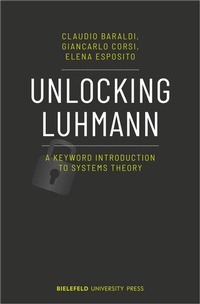
Unlocking Luhmann
A Keyword Introduction to Systems Theory
1st Edition
Published on 23. April 2021
Book
Paperback/Softback
276 pages
978-3-8376-5674-9 (ISBN)
Description
Luhmann's theory is fascinating and complex. It offers incomparably enlightening insights, references and research opportunities, but reveals its utility only after a quite high competence threshold. Using the reticular form of the glossary, this book makes the theory accessible while maintaining its complexity. Without being obstructed by knowledge gaps or by references to concepts presented elsewhere, readers inside and outside sociology get the required support to explore sociological systems theory and to engage with it. Luhmann himself, in his introduction, praises the form of the glossary to cope with the challenges of the theoretical description of our highly complex society.
Reviews / Votes
»Dies ist ein gelungenes Projekt, das unzweifelhaft die erste Kontaktaufnahme erleichtert und den Zugang zur Theorie um vielfältige Sichtweisen erweitert. Man kann sich nur über die englische Übersetzung freuen.«More details
Series
Language
English
Place of publication
Bielefeld
Germany
Publishing group
transcript
Target group
Professional and scholarly
Product notice
Klappenbroschur
Illustrations
Klebebindung
Dimensions
Height: 22.5 cm
Width: 14.8 cm
Thickness: 18 mm
Weight
432 gr
ISBN-13
978-3-8376-5674-9 (9783837656749)
Schweitzer Classification
Other editions
Additional editions
Claudio Baraldi | Giancarlo Corsi | Elena Esposito
Unlocking Luhmann
A Keyword Introduction to Systems Theory
E-Book
04/2021
1st Edition
Bielefeld University Press ein Imprint des transcript Verlags
€0.00
Available for download
Persons
Claudio Baraldi published several works in international books and journals on communication systems. His research concerns interaction systems related to facilitation of children's participation, interlinguistic and intercultural mediation, conflict management.
Giancarlo Corsi worked and published intensely on the theory of social systems, public opinion and communication media, education, career and social inclusion. His current research deals with the relationship between public sphere, mass media, and new communication technologies.
Elena Esposito published many works on the theory of social systems, media theory, memory theory, and sociology of financial markets. Her current research on algorithmic prediction is supported by a five-year Advanced Grant from the European Research Council.
Giancarlo Corsi worked and published intensely on the theory of social systems, public opinion and communication media, education, career and social inclusion. His current research deals with the relationship between public sphere, mass media, and new communication technologies.
Elena Esposito published many works on the theory of social systems, media theory, memory theory, and sociology of financial markets. Her current research on algorithmic prediction is supported by a five-year Advanced Grant from the European Research Council.
Content
Convivial Futures?; One Step Beyond; From Lived Convivialism to Convivialist Transformations; The First Convivialist Steps; Feminism and Convivialism; Convivialism Facing the Territorial Question; Is Convivialism the Answer? Depends on the Question; Convivializing the Economy; Imagining the Convivialist Enterprise; Towards a Post-Covid Economy for the Common Good; Is a Post-Growth Society Possible?; Money Creation as a Foundational Tool for Convivialism; Pluriversalism and Nature: Conviviality to Reanimate the World; Convivial Conservation with Nurturing Masculinities in Brazil's Atlantic Forest; A Convivialist Solution for the Multiple Crisis of Biodiversity, Climate, and Public Health; The Post-Development Agenda; Letter to the End-of-the-World Generation; (Un-)Convivial Futures: Right Here, Right Now; "2050"; Once upon a Time ... There Will Be a Convivial Desire; A Reflection on 200 Years of Our Youngest Bodily Organ: Convivialis Futuris; List of Contributors.