

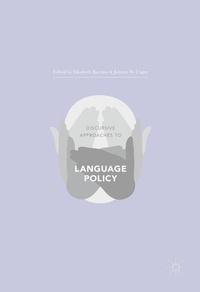
Discursive Approaches to Language Policy
Published on 20. December 2016
Book
Hardback
XIII, 299 pages
978-1-137-53133-9 (ISBN)
Description
This book brings together the fields of language policy and discourse studies from a multidisciplinary theoretical, methodological and empirical perspective. The chapters in this volume are written by international scholars active in the field of language policy and planning and discourse studies. The diverse research contexts range from education in Paraguay and Luxembourg via businesses in Wales to regional English language policies in Tajikistan. Readers are thereby invited to think critically about the mutual relationship between language policy and discourse in a range of social, political, economic and cultural spheres. Using approaches that draw on discourse-analytic, anthropological, ethnographic and critical sociolinguistic frameworks, the contributors in this collection explore and refine the 'discursive' and the 'critical' aspects of language policy as a multilayered, fluid, ideological, discursive and social process that can operate as a tool of social change as well as reinforcing established power structures and inequalities.
Reviews / Votes
"The volume provides strong foundational knowledge for graduate students and researchers working in the field of LPP, and I recommend it to those seeking to develop an interdisciplinary lens that brings together the fields of sociolinguistics, language policy, and (critical) discourse studies." (Pramod K. Sah, Language Policy, Vol. 18, 2019)More details
Edition
1st ed. 2016
Language
English
Place of publication
London
United Kingdom
Target group
Professional and scholarly
Illustrations
3 s/w Abbildungen, 5 farbige Abbildungen
XIII, 299 p. 8 illus., 5 illus. in color.
Dimensions
Height: 216 mm
Width: 153 mm
Thickness: 22 mm
Weight
523 gr
ISBN-13
978-1-137-53133-9 (9781137531339)
DOI
10.1057/978-1-137-53134-6
Schweitzer Classification
Other editions
Additional editions
Elisabeth Barakos | Johann W. Unger
Discursive Approaches to Language Policy
Book
01/2018
Palgrave Macmillan
€96.29
The article will not be published
Elisabeth Barakos | Johann W. Unger
Discursive Approaches to Language Policy
E-Book
11/2016
1st Edition
Palgrave Macmillan
€117.69
Available for download
Persons
Elisabeth Barakos is a Lecturer in Applied Linguistics at Aston University, Birmingham, UK. Her research interests focus on language policy discourse and practice, multilingualism and language in the workplace from a critical sociolinguistic perspective.
Johann W. Unger is a Lecturer and Academic Director of Summer Programmes at Lancaster University. He researches mainly in the areas of language policy and digitally mediated politics from a critical discourse studies perspective. His 2013 monograph The Discursive Construction of the Scots Language deals extensively with language policy.
Johann W. Unger is a Lecturer and Academic Director of Summer Programmes at Lancaster University. He researches mainly in the areas of language policy and digitally mediated politics from a critical discourse studies perspective. His 2013 monograph The Discursive Construction of the Scots Language deals extensively with language policy.
Content
Introduction: Why are discursive approaches to language policy necessary?.- PART I THEORETICAL FOUNDATIONS FOR DISCURSIVE APPROACHES TO LANGUAGE POLICY.- Chapter 1: Language policy and critical discourse studies: Towards a combined approach.- Chapter 2: State language policy in time and space: Meaning, transformation, recontextualisation.- Chapter 3: Language policy as metapragmatic discourse: A focus on the intersection of language policy and social identification.- PART II METHODOLOGICAL INNOVATIONS IN DISCURSIVE APPROACHES TO LANGUAGE POLICY.- Chapter 4: A critical integrated approach to language policy as discursive action: Strengths, challenges and opportunities.- Chapter 5: Heteroglossic practices and language ideologies: Combining heteroglossia with critical discourse analysis to investigate digital multilingual discourses on language policies.- PART III EMPIRICAL APPLICATIONS OF DISCURSIVE APPROACHES TO LANGUAGE POLICY.- Chapter 6: Eng flott Diskriminatioun?: Language andcitizenship policy in Luxembourg as experience.- Chapter 7: Luxembourgish language-in-education policy in limbo: The tension between ideologies of authenticity and anonymity.- Chapter 8: Language ideologies regarding English-medium instruction in European higher education: Insights from Flanders and Finland.- Chapter 9: On 'promoting and demanding' integration: A discursive case study of immigrant language policy in Basel.- Chapter 10: English language policy as ideology in multilingual Khorog, Tajikistan.- Chapter 11: Commentary.