

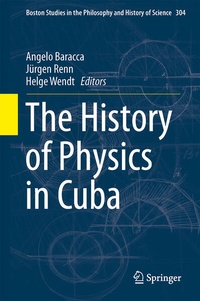
The History of Physics in Cuba
Description
Reviews / Votes
"The History of Physics in Cuba adds to our understanding of the development of contemporary physics in specific, if not unique, political circumstances. It offers valuable information and personal insights. . it relates to current debates concerning international relations, access to scientific knowledge, and the material and social conditions for advanced physical research. . Cuba will pose a fascinating case to those interested in the social and political relations of science in the first half of the twenty-first century." (Xavier Roqué, Isis, Vol. 107 (2), June, 2016)
More details
Other editions
Additional editions
Content
Introduction.- 1 A Short Introduction to this Volume; Angelo Baracca, Jürgen Renn, and Helge Wendt.- 2 The Cuban "Exception": The Development of an Advanced Scientific System in an Underdeveloped Country; Angelo Baracca.- 3 Cuba: Short Critical Bibliographic Guide; Duccio Basosi.- Part I Historical Surveys.- 4 The Teaching of Physics in Cuba from Colonial Times to 1959; José Altshuler and Angelo Baracca.- 5 Mathematics and Physics in Cuba Before 1959: A Personal Recollection; José Altshuler.- 6 A Comprehensive Study of the Development of Physics in Cuba from 1959; Angelo Baracca, Víctor Luis Fajer Avila, and Carlos Rodríguez Castellanos.- 7 Accomplishments in Cuban Physics (up to 1995); Carlos R. Handy and Carlos Trallero-Giner.- 8 Physics at the University of Oriente; Luis M. Méndez Pérez and Carlos A. Cabal Mirabal.- 9 The Training of Physics Teachers in Cuba: A Historical Approach; Diego de Jesús Alamino Ortega.- 10 Can Universities Develop Advanced Technology and Solve Social Problems?; Isarelis Pérez Ones and Jorge Núñes Jover.-Part II Reflections from the Inside.- 11 The Rise and Development of Physics in Cuba: An Interview with Hugo Pérez Rojas in May 2009; Angelo Baracca.- 12 An Interview with Professor Melquíades de Dios Leyva, December 2008; Olimpia Arias de Fuentes.- 13 Experimental Semiconductor Physics: The Will to Contribute to the Country's Economic Development; Elena Vigil Santos.- 14 Cuban Techno-physical Experiments in Space; José Altshuler, Ocatvio Calzadilla Amaya, Federico Falcon, Juan E. Fuentes, Jorge Lodos, and Elena Vigil Santos.- 15 Superconductivity in Cuba: Reaching the Frontline; Oscar Arés Muzio and Ernesto Altshuler.- 16 The Physics of Complex Systems in Cuba; Oscar Sotolongo-Costa.- 17 Magnetic Resonance Project 35-26-7: A Cuban Case of Engineering Physics and Biophysics; Carlos A. Cabal Mirabal.- 18 Nanotechnologies in Cuba: Popularization and Training; Carlos Rodríguez Castellanos.- 19 Physics Studies at the University of Havana;Osvaldo de Melo Pereira and María Sánchez Colina.- 20 Physics and Women: A Challenge Being Successfully Met in Cuba; Olimpia Arias de Fuentes.- Part III Reflections from the Outside.- 21 The Beginning of Semiconductor Research in Cuba; Theodore Veltfort.- 22 Andrea Levialdi in Memoriam; Dina Waisman.- 23 The Andrea Levialdi Fellowship; Roberto Fieschi.- 24 A Witness to French-Cuban Cooperation in Physics in the 1970s; Jacqueline Cernogora.- 25 My Collaboration with Cuban Physicists; Fabrizio Leccabue.- 26 Scientific Cooperation Between the German Academy of Sciences in Berlin (DAW) and Cuba in the 1960s and 1970s; Helge Wendt.- 27 A Beautiful Story; Federico García-Moliner.- 28 The Current State of Physics in Cuba: A Personal Perspective; Marcelo Alonso.- 29 Engaging Cuban Physicists Through the APS/CPS Partnership; Irving A. Lerch.- 30 A Perspective on Physics in Cuba; Carlos R. Handy.- 31 Cuban/US Research Interactions Since 1995; Maria C. Tamargo.- 32 Viva La Ciencia: Cuba's Creative Scientists Aim to Make Knowledge Their Country's Sugar Substitute; Rosalind Reid and Brian Hayes.- Part IV Scientific Communication and Its Conditions.- 33 Physics in Cuba from the Perspective of Bibliometrics; Werner Marx and Manuel Cardona.- 34 Contemporary Cuban Physics Through Scientific Publications: An Insider's View; Ernesto Altshuler.