

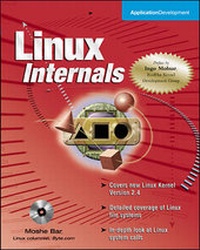
Linux Internals
Published on 16. August 2000
Book
Paperback/Softback
560 pages
978-0-07-212598-6 (ISBN)
Description
Linux is one of the hottest topics in the IT industry today-taking the OS market by storm, it is now installed on over 15 million desktops. Although Linux is distributed with the source code, few administrators or programmers have a full understanding of its inner-workings. As companies begin to rely on Linux for solutions, administrators and programmers will look for a source of valuable, in-depth information. Providing in-depth coverage of the source-code internals of Linux, this book gives a high-level explanation of how this operating system works and the knowledge needed to program and run it optimally. Performance and Tuning issues are discussed, measured and explained with crisis-avoiding strategies for busy servers explained in detail. Variations of different Linux versions are explained and the accompanying CD-ROM includes code from the book and sample kernel enhancements. This book is written by an expert active in the development of Kha0S, a secure version of Linux.
More details
Language
English
Place of publication
United States
Publishing group
McGraw-Hill Education - Europe
Target group
College/higher education
Professional and scholarly
Illustrations
25 illustrations, references, glossary
Dimensions
Height: 231 mm
Width: 185 mm
Thickness: 24 mm
Weight
680 gr
ISBN-13
978-0-07-212598-6 (9780072125986)
Copyright in bibliographic data and cover images is held by Nielsen Book Services Limited or by the publishers or by their respective licensors: all rights reserved.
Schweitzer Classification
Person
Moshe Bar (Milan, Italy) is the Linux columnist for Byte.com and one of the creators of Kha0s, a secure version of Linux. H is also a regular columnist for Linux Journal and contributes to Dr. Dobbs.
Content
Chapter 1: OpenSource - Implications for a Modern Operating System. Chapter 2: Compiling a Kernel. Chapter 3: Linux Kernel Base Functions. Chapter 4: The Linux Process Model. Chapter 5: The Linux VM Manager. Chapter 6: The Linux Scheduler. Chapter 7: Signals Handling. Chapter 8: kHTTPd. Chapter 9: Linux System Calls. Chapter 10: File Systems.